
Scale or deposit risk
Start with makeup-water hardness, alkalinity, pH, cycles of concentration and the deposit location. Then compare a phosphonate and dispersant route against the actual saturation and temperature conditions.
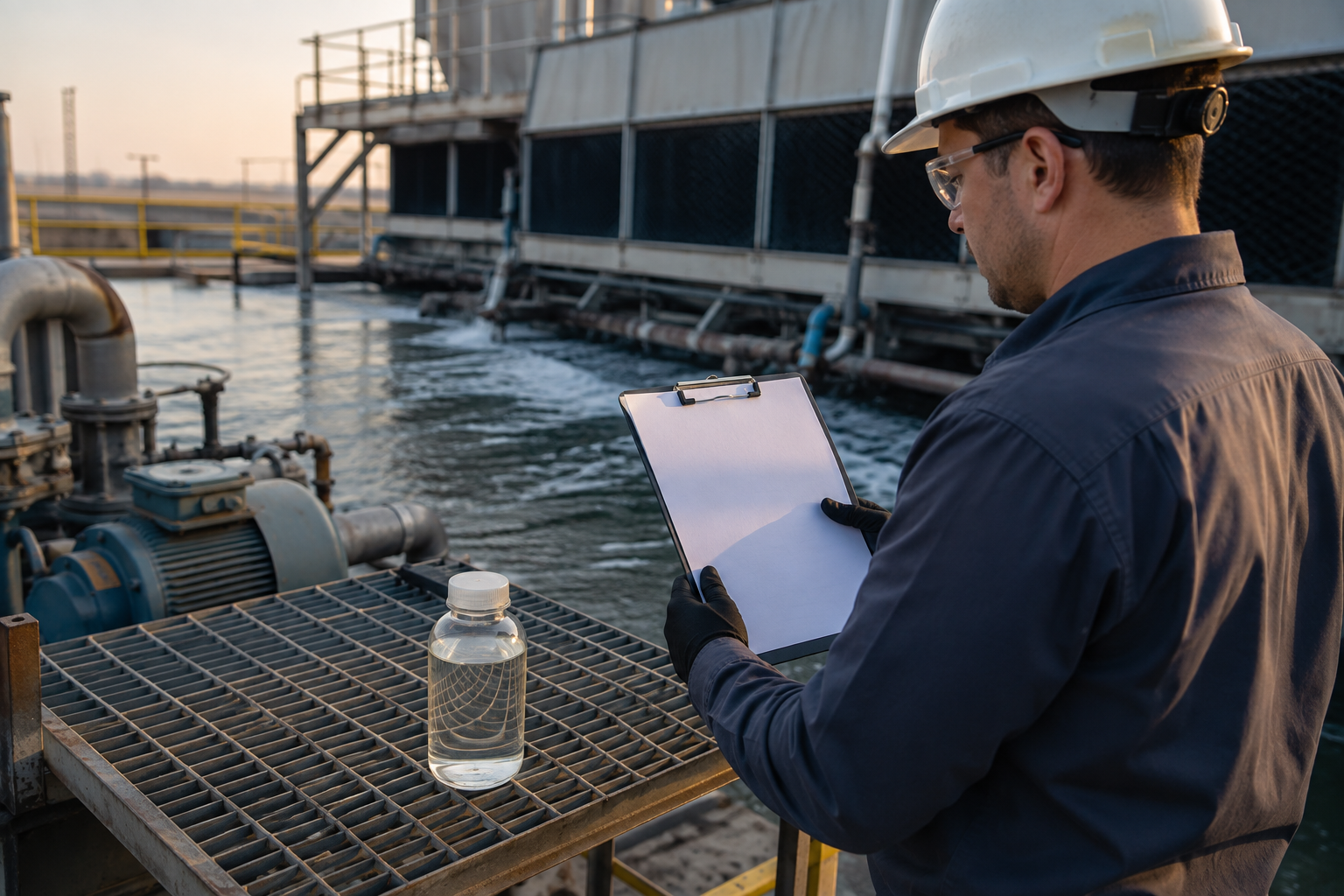
Build the program around the circulating-water system—not a single product. Scale and deposit control, corrosion protection, dispersancy and microbial control must fit the same makeup water, cycles, metallurgy, temperature and operating pattern.
Each route begins with a different mechanism and a different set of useful inputs.
Start with makeup-water hardness, alkalinity, pH, cycles of concentration and the deposit location. Then compare a phosphonate and dispersant route against the actual saturation and temperature conditions.
Identify the affected metal, water pH, chloride, oxidant exposure and whether copper alloys share the circuit. A yellow-metal inhibitor and a general corrosion-control component solve different parts of the problem.
Use the biofilm location, microbial trend, oxidant demand, system volume and downtime window to choose an oxidizing or non-oxidizing control route. Confirm compatibility with the rest of the water-treatment program.
Use these product families as a shortlist for comparison—not as interchangeable substitutes.
PBTC, HEDP and ATMP provide different starting points for scale-control formulations. Water chemistry and oxidant exposure decide which candidates deserve testing.
Compare phosphonatesA dispersant helps keep fine mineral and corrosion-product solids mobile. Select it together with the scale-control chemistry and expected solids load.
Explore dispersantsCompare oxidizing and non-oxidizing biocide families by system conditions, contact time and compatibility—not by a universal “best biocide” claim.
Explore biocidesSeparate scale, corrosion, suspended deposit and biological fouling before changing the program.
Use makeup and circulating-water analysis, cycles, metallurgy, temperature, volume and blowdown pattern.
Choose the chemistry route that addresses the dominant mechanism and remains compatible with the full program.
Set measurable operating endpoints and compare trends under representative conditions.
A cooling-water program may combine scale-control chemistry, a dispersant, corrosion protection and microbial control. The combination depends on the water analysis, metallurgy, cycles, temperature and operating pattern.
Start with the expected scale species and saturation conditions, then compare phosphonate and polymer candidates under the actual pH, hardness, alkalinity, temperature and oxidant program.
Oxidizing biocides support residual-based routine control, while non-oxidizing options can target organisms or biofilm under different contact and compatibility conditions. The system and current program determine the useful route.
Share makeup and circulating-water analyses, cycles, metallurgy, temperature, system volume, current chemicals and the specific scale, corrosion, deposit or microbial problem.