
Cooling Water Corrosion: Mechanisms & Protection
TL;DR Cooling water corrodes metal through several distinct mechanisms — general (uniform) attack, galvanic corrosion between dissimilar metals, oxygen pitting, crevice and under-deposit corrosion, microbiologically influenced corrosion (MIC), and erosion-corrosion. Each has a specific cause and cure: the right corrosion inhibitor (anodic, cathodic or mixed), azoles for copper, plus deposit, microbial and water-balance control keep the whole system protected.
Why cooling water corrodes metal
Recirculating cooling water is oxygen-saturated, warm and full of dissolved salts — an ideal electrolyte for corrosion. Metal loss proceeds electrochemically (anode + cathode), and it rarely stays uniform: it concentrates into pits and deposits that perforate tubes long before general thinning would. Understanding the mechanism tells you the cure.
The corrosion mechanisms
- General (uniform) — even metal loss; controlled by a film-forming inhibitor and correct water balance (LSI).
- Galvanic — a more-noble metal (copper) drives corrosion of a less-noble one (steel, aluminium) where they connect; control by azole copper inhibitors, isolation and inhibitor films.
- Oxygen pitting — localized pits under oxygen differential cells; the classic deep, perforating attack.
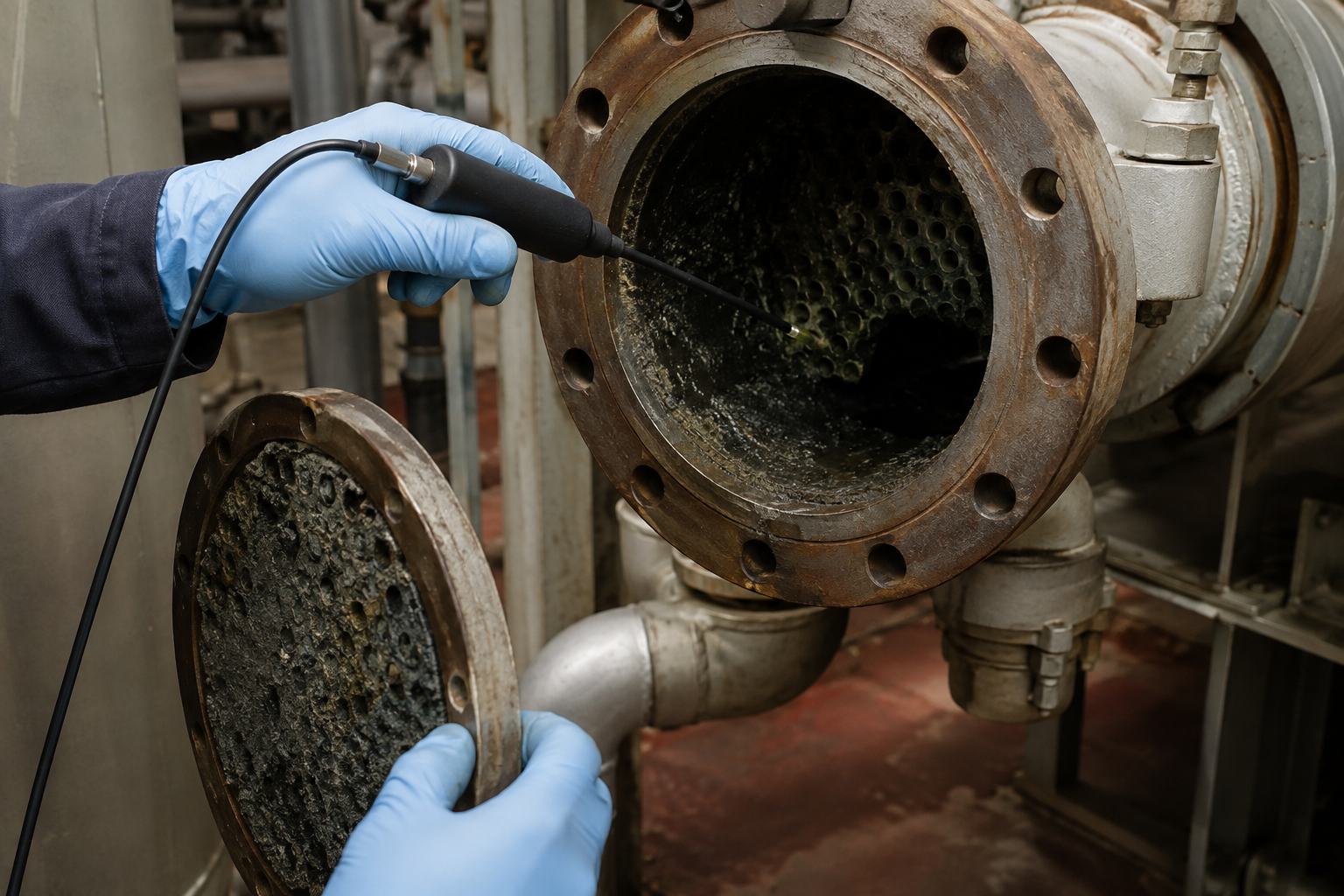
- Crevice & under-deposit — oxygen-starved zones under gaskets, deposits and biofilm become aggressive anodes; controlled by keeping surfaces clean (dispersants, antiscalant, biocide).
- MIC (microbiologically influenced corrosion) — sulfate-reducing and other bacteria under biofilm drive severe local corrosion; controlled by the biocide/biofilm program.
- Erosion-corrosion — high velocity or entrained solids strip the protective film; controlled by design and flow limits.
Corrosion inhibitor types
Inhibitors are classed by which reaction they slow: anodic (e.g., orthophosphate, molybdate — passivate the anode), cathodic (e.g., zinc, polyphosphate — slow the cathode) and mixed. Programs combine them, plus azoles (BTA, TTA, MBT) for copper and yellow metals, and phosphonates for scale so deposits don't shelter corrosion. Boilers add an oxygen scavenger.
Deposits and microbes make it worse
The most damaging cooling-water corrosion is under deposits and biofilm, where oxygen cells and bacteria concentrate. So corrosion control is inseparable from scale/dispersant control and a biocide program — a clean surface is a protectable surface.
Monitoring
Track corrosion with coupons (mils per year, mpy) or online probes for mild steel and copper, plus iron/copper in the water. General targets are roughly <3 mpy for mild steel and <0.2 mpy for copper; rising rates flag a program problem before failures occur.
Cooling water corrosion mechanisms & control
| Mechanism | Cause | Control |
|---|---|---|
| General / uniform | O₂, low LSI | Film-forming inhibitor, water balance |
| Galvanic | Dissimilar metals | Azole (Cu), isolation, inhibitor |
| Oxygen pitting | O₂ differential cells | Inhibitor + clean surface |
| Crevice / under-deposit | Deposits, gaskets, biofilm | Dispersant, antiscalant, biocide |
| MIC | SRB / biofilm | Biocide + biofilm control |
| Erosion-corrosion | Velocity / solids | Design, flow limits |
Watch

Frequently asked questions
What causes corrosion in cooling water systems?
Cooling water is oxygen-saturated, warm and salty — an ideal electrolyte — so metal corrodes electrochemically. It rarely stays uniform: it localizes into oxygen pitting, galvanic attack between dissimilar metals, crevice and under-deposit corrosion, microbiologically influenced corrosion (MIC) under biofilm, and erosion-corrosion at high velocity.
What are the types of corrosion inhibitors?
By the reaction they slow: anodic inhibitors (orthophosphate, molybdate) passivate the anode; cathodic inhibitors (zinc, polyphosphate) slow the cathode; and mixed inhibitors do both. Cooling programs combine these with azoles (benzotriazole, tolyltriazole) for copper and yellow metals, and with phosphonates and dispersants so deposits don't shelter corrosion.
What is under-deposit and microbiologically influenced corrosion?
Under-deposit corrosion occurs beneath scale, mud or biofilm, where oxygen-starved zones become aggressive local anodes. MIC is driven by bacteria — especially sulfate-reducing bacteria — living in biofilm. Both are severe and localized, and both are controlled by keeping surfaces clean with dispersants, antiscalant and a biocide program.
How do you protect copper in cooling water?
Copper and yellow metals are protected by azole inhibitors — benzotriazole (BTA), tolyltriazole (TTA) or mercaptobenzothiazole (MBT) — which form a thin passivating film on the copper surface and also stop copper from plating onto and galvanically corroding steel. They are dosed at 1–5 ppm alongside the steel-corrosion program.
Does VCYCLETECH supply corrosion inhibitors for cooling water?
Yes. VCYCLETECH supplies azole copper inhibitors (BTA, TTA, MBT), phosphonates, zinc/polymer corrosion programs and oxygen scavengers, factory-direct in China with current COA information on request, sample availability and OEM/ODM service. Email sales@vcycletech.com with your water analysis for a corrosion-control recommendation.
About the manufacturer
VCYCLETECH is a China-based manufacturer of water treatment chemicals — cooling-water scale & corrosion inhibitors, phosphonates, dispersants, biocides, coagulants and defoamers — ISO 9001 / 14001 / 45001 certified, with current COA information on request and OEM/ODM service. See our quality & certifications.
References
Related: Corrosion inhibitors · BTA · TTA · Cooling water treatment · Scale & corrosion control