
COOLING WATER · CHANGE CONTROL
Seasonal Cooling-Tower Makeup Changes: Recheck Cycles and Treatment
When cooling-tower makeup water changes with season, source blending or pretreatment performance, treat the old cycles and chemical settings as assumptions that need confirmation. Collect paired makeup and circulating-water samples under a known load, verify makeup and blowdown flows, and compare conductivity with conservative ions such as chloride or sulfate. Then identify the first new constraint: carbonate, sulfate or silica scale; chloride or ammonia stress; phosphate or iron deposition; suspended solids and organics; or microbial control. Stabilize makeup, bleed and solids removal before changing inhibitor or biocide chemistry. Revalidate the revised program with trends, treatment residuals, material-specific corrosion evidence, deposit inspection and microbiological indicators—not one conductivity value.
Define what changed before changing the treatment
A tower can receive a different water without an obvious operator action. Municipal wells may enter service, surface-water quality may shift after rain or drought, a reclaimed-water blend may vary, or a softener, clarifier or membrane pretreatment unit may drift. Lower seasonal load can also change evaporation and tower turnover while the makeup chemistry appears stable. Record the source, blend, pretreatment train, date, load, basin volume, temperature range and any recent maintenance or cleaning event.
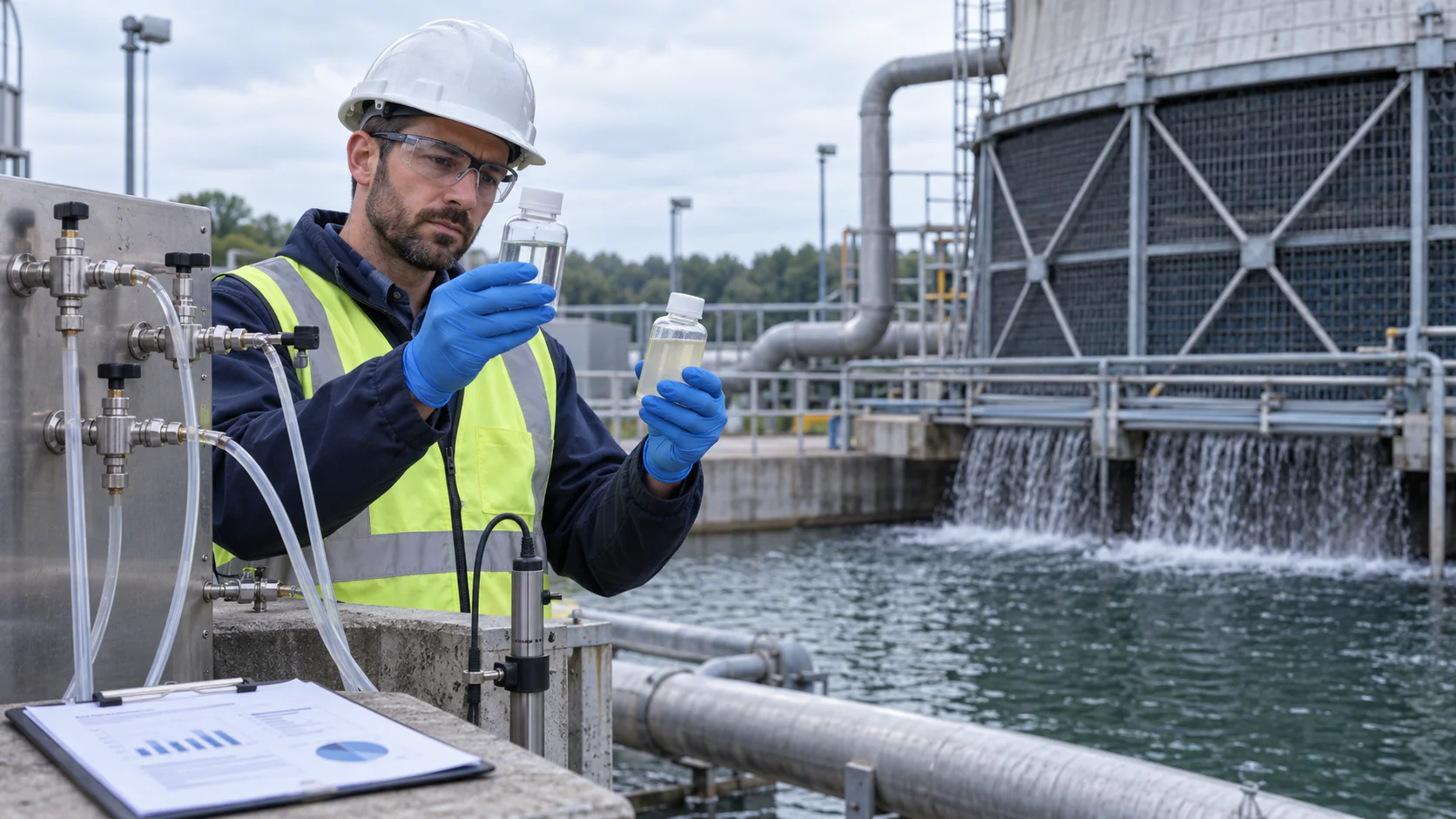
Build a paired baseline rather than comparing one new result with an old monthly average. Sample makeup after the point where sources and pretreatment streams have mixed. Sample circulating water at a representative, consistently flowing location—not a stagnant basin corner or chemical-feed zone. Use the same methods and units for both periods. If a result will drive a major change, confirm it with a second sample or laboratory method before acting.

The minimum useful panel usually includes pH, conductivity, alkalinity, calcium hardness, chloride, sulfate and silica. Add phosphate, ammonia, iron, turbidity, suspended solids and an organic indicator when the source, treatment or site history makes them decision-relevant. Record temperature because solubility and corrosion response change with temperature. Separate total and dissolved metals when a filtration step can distinguish transported particulate from dissolved release. A result without sample point, filtration state, preservation, method and operating context is weak evidence.
Reconcile actual cycles instead of trusting one conductivity ratio
Evaporation removes water but leaves most dissolved constituents behind. In a simplified steady state, makeup replaces evaporation, blowdown and drift, and concentration ratio can be estimated from makeup-to-blowdown flow or from a soluble constituent that is neither added nor removed in the loop. The U.S. Department of Energy recommends checking both flow and concentration ratios and investigating controller, valve, leak or unaccounted-loss problems when they do not agree.1
Conductivity is valuable for continuous bleed control, but it is the combined response of dissolved ions. Acid, oxidant, inhibitor and other treatment additions can raise it. Calcium, alkalinity, silica or phosphate can leave the soluble phase through deposition, making their apparent cycles lower. Process leakage can add ions that never came from the makeup. Solenis describes why conductivity and ion balances can diverge under these conditions.2 Treat divergence as diagnostic information, not a nuisance to average away.
| Check | Useful when | What disagreement may mean | Do not conclude |
|---|---|---|---|
| Makeup flow ÷ blowdown flow | Meters are reliable and overflow, drift and leaks are bounded | Unmetered loss, overflow, drift, intermittent bleed or meter error | That chemistry is stable |
| Circulating ÷ makeup conductivity | Treatment additions are small relative to source conductivity | Acid, bleach, inhibitor, contamination, low source conductivity or sensor error | That every ion is concentrating equally |
| Chloride or sulfate ratio | The selected ion is soluble and not materially added, removed or contaminated | Precipitation, chemical feed, process ingress, analytical error or a poor marker choice | That scale, corrosion and biology are controlled |
Do not raise the conductivity setpoint merely because cooler weather reduced evaporation or the new makeup appears cleaner. First establish which parameter limits the new operating window. Likewise, a lower conductivity target can be appropriate as a temporary protective response, but it is not a substitute for understanding why the old mass balance no longer closes.
Translate each makeup change into a specific failure mechanism
Hardness and alkalinity must be considered together with pH, temperature and cycles because they influence carbonate saturation. Sulfate introduces a different scale and corrosion context; silica may set a separate ceiling and can interact with magnesium or metal deposits. Chloride is usually a useful cycles marker, but rising chloride also matters to susceptible metallurgy. Phosphate may come from the source or treatment and can become part of calcium- or iron-rich deposits. Iron may enter with makeup, arrive as suspended corrosion product or indicate active system corrosion. The pattern matters more than any isolated number.
Ammonia requires its own branch, especially with copper alloys and oxidizing disinfectants. Use the dedicated ammonia and chloramine guide to distinguish free ammonia, total ammonia, free chlorine and total chlorine. Turbidity and organics can increase treatment demand, transport nutrients and shield microorganisms. A clean conductivity trend cannot demonstrate microbial control because organisms respond to temperature, water age, disinfectant residual, sediment and biofilm as well as dissolved salts.
The CDC places scale, corrosion, sediment, cleaning, makeup quality, turnover and disinfectant residual inside a site water-management program.3 Apply the facility plan and local law before changing microbial controls. For example, New York City increased Legionella testing frequency for covered operating towers in 2026; that requirement is jurisdiction-specific, not a global interval or a substitute for a site risk assessment.
| Observed change | Primary concern to test | Evidence to collect | First controlled response |
|---|---|---|---|
| Hardness or alkalinity rises | Carbonate saturation and heat-transfer deposition | Paired chemistry, pH, temperature, ion cycles, deposit location | Stabilize bleed; recalculate operating window; check pretreatment |
| Chloride or sulfate rises | Metallurgy stress or a lower cycles ceiling | Material list, ion ratios, corrosion trend, process-leak check | Bound cycles and find the source before changing inhibitor |
| Silica or phosphate rises | Silica, calcium-phosphate or iron-phosphate deposition | Soluble/total values, deposit analysis, inhibitor residual and pH | Correct concentration and solids handling; then revalidate dispersancy |
| Iron, turbidity or organics rise | Incoming solids, corrosion product, deposition or microbial demand | Filtered/unfiltered metals, turbidity trend, filter/deposit inspection | Separate source solids from system release; evaluate side-stream removal |
| Ammonia or microbial trend changes | Oxidant demand, nitrification, biofilm or copper-alloy risk | Ammonia species, oxidant species/residual, pH, ATP/culture trend as applicable | Follow the water-management plan; revalidate oxidant and corrosion controls together |
Choose the first intervention in the right sequence
Start with control and hydraulics. Verify the conductivity probe against a calibrated handheld result, confirm valve response, inspect makeup and bleed meters, and account for overflow, leaks, drift and intermittent blowdown. Correct a failed sensor or stuck valve before compensating with chemicals. If the source change is temporary, document whether a conservative operating window is needed until representative data accumulate.
Use pretreatment or bleed when dissolved constituents set the constraint. Use side-stream filtration when suspended matter and transported deposits are material contributors; filtration does not remove dissolved hardness, chloride or silica. Clean or inspect when deposits and biofilm already obscure surfaces, because a higher dispersant or biocide feed cannot prove that old material has been removed. The deposit-investigation guide provides the separate route once material exists.

Only then revalidate the chemical program. Model or bench-screen scale and dispersancy under the revised water, pH and temperature. Check the corrosion route against every important wetted material. Review oxidant exposure, non-oxidizing treatment, contact, feed sequencing and the water-management plan together. Change one major variable at a time where safe so the response remains interpretable. The ASHRAE water-treatment chapter reinforces that deposition reflects interacting chemistry and temperature rather than one universal hardness limit.4
Define acceptance evidence before adopting the new window
Write a baseline and acceptance plan before trial changes. Include makeup and circulating chemistry, flow-based and ion-based cycles, controller setpoint and observed bleed response, pH and temperature, treatment residuals, turbidity or suspended solids, and the relevant microbial indicator. Use material-specific corrosion coupons or another appropriate method, and preserve inspection or deposit evidence for critical heat-transfer surfaces. A coupon is a controlled exposure at one location; it does not reproduce every heat flux, velocity, crevice or deposit condition.
Review trends across representative load and source states, not immediately after one adjustment. Define stop conditions for rapid corrosion change, loss of microbial control, excessive deposition, unstable pH, unacceptable discharge or equipment limits. Keep the revised source-water envelope and sampling plan with the operating procedure so the next seasonal shift triggers a review rather than a surprise.
The Cooling Water Treatment application page is the Money Page for mapping the system, evidence and candidate treatment route. Use the HEDP-versus-PBTC guide only when that supported product-family decision is relevant; neither identity page proves fitness for the present water. Review the video and evidence library as process context, then share the paired water analysis and operating evidence →
Frequently asked questions
Should conductivity be the only basis for changing cooling-tower blowdown?
No. Conductivity is useful for control, but treatment additions, low-conductivity makeup, contamination and precipitation can make its ratio differ from actual cycles. Compare flow balance and suitable ion ratios before changing the operating window.
Which makeup-water tests matter after a seasonal source change?
Start with pH, conductivity, alkalinity, calcium hardness, chloride, sulfate, silica and temperature. Add phosphate, ammonia, iron, turbidity, suspended solids and organics when the source, treatment program or system history makes them relevant.
When should side-stream filtration be adjusted?
Adjust or add solids removal when representative turbidity, suspended solids, deposit loading or airborne/process solids show a meaningful particulate burden. Filtration does not solve a dissolved hardness, chloride, sulfate or silica limit.
Does a lower seasonal heat load allow higher cycles?
Not automatically. Load changes evaporation and turnover, but the safe window still depends on makeup chemistry, pH, temperature, metallurgy, deposits, treatment performance, discharge constraints and microbial control. Reconcile the new mass balance before raising cycles.
What should be sent for a seasonal cooling-water program review?
Send paired makeup and circulating analyses with dates, sample points and methods; makeup and blowdown flows; load and temperature; controller and feed history; metallurgy; inhibitor and disinfectant trends; corrosion, deposit and microbial evidence; and the site acceptance limits.
Sources
- U.S. DOE FEMP, Best Management Practice #10: Cooling Tower Management — water balance, cycles and monitoring principles.
- Solenis, Monitoring Ionic Balances in Cooling Towers — reasons conductivity and constituent cycles can diverge.
- CDC, Controlling Legionella in Cooling Towers — site water-management context for scale, corrosion, sediment and microbial controls.
- ASHRAE Handbook, Chapter 50: Water Treatment — deposition, corrosion, fouling and biological-control context.
Sources and current search results were reviewed on 6 October 2026. They support the decision framework and stated limits, not a universal setpoint, dose, compatibility claim or performance guarantee.