
Cooling water · reclaimed-water makeup
Ammonia and Chloramine in Reclaimed Cooling-Tower Makeup
When reclaimed water contains ammonia or arrives with a chloramine residual, do not treat it as ordinary freshwater makeup with one extra test result. First separate free ammonia, total ammonia, free chlorine and total chlorine in both the makeup and recirculating water. Then compare pH, alkalinity, water age, cycles, microbial trend and the metals exposed to the water. That distinction tells you whether the immediate problem is oxidant demand, a persistent combined residual, nitrification risk, loss of alkalinity, or copper-alloy corrosion. The treatment program may need a different monitoring point, oxidant strategy, inhibitor check or makeup-control response. A conductivity controller alone cannot see these changes, and one total-chlorine result cannot identify which branch the system is on.
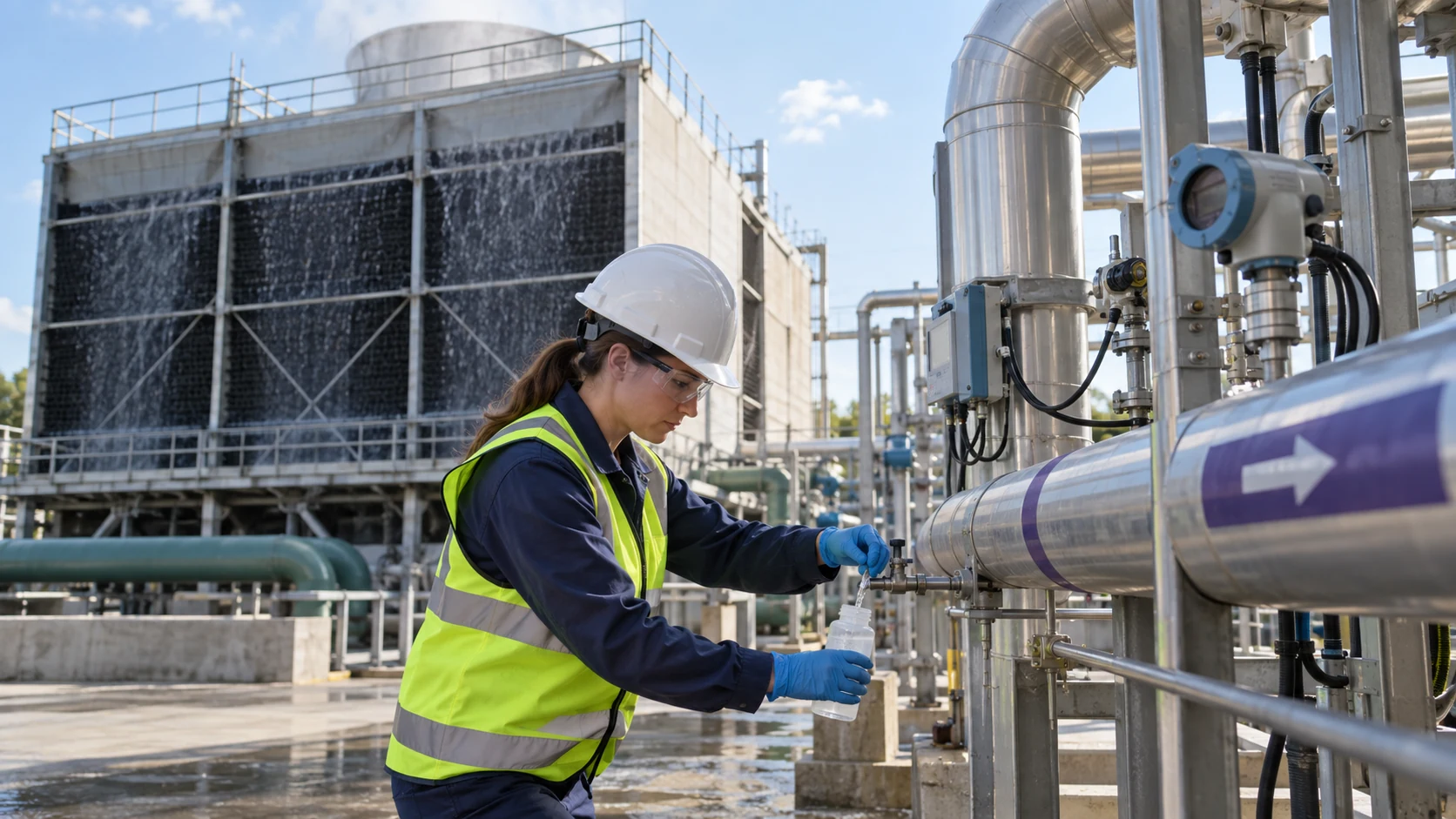
Make the first split: free ammonia, chloramine or neither?
The word “ammonia” is too broad for a treatment decision. Total ammonia includes the ammonia/ammonium pool, while the fraction present as un-ionized ammonia changes with pH and temperature. A reclaimed-water supplier may also use chloramination, so part of the chlorine result can arrive as combined chlorine. In that case, some free ammonia may remain from formation, decay or changing treatment conditions. EPA guidance for chloraminated distribution water recommends monitoring ammonia, free chlorine and total chlorine together because a single residual does not describe the chlorine-to-ammonia state.1
Take paired samples at the reclaimed-water entry point and at a representative tower-basin point. Record time, makeup flow, blowdown state and recent oxidant feed. Test free chlorine and total chlorine on the same sample; the difference is an operational estimate of combined chlorine. Measure free ammonia when the method is available, and retain total ammonia as a loading indicator. Add pH and alkalinity because nitrification consumes alkalinity and can depress pH in poorly buffered water. Nitrite and nitrate trends help distinguish biological ammonia conversion from a simple makeup fluctuation.
Do not calculate a predicted basin ammonia value by multiplying the makeup value by cycles of concentration. Cooling towers are dynamic: ammonia can volatilize, react with oxidants, enter biomass or be biologically converted. Conductivity still describes mineral concentration, but it does not describe nitrogen speciation or disinfectant history.
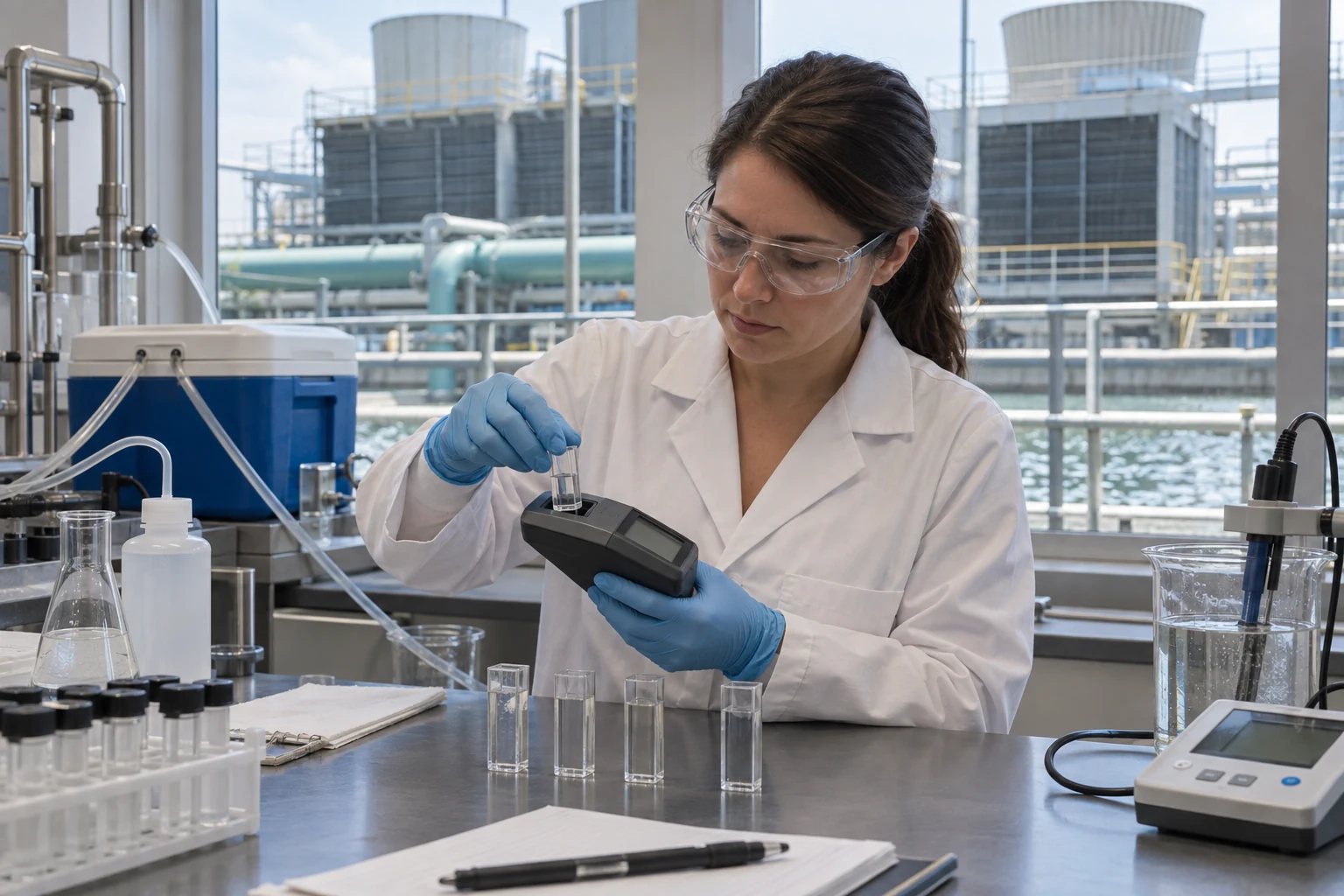
Recognize the operating state before selecting a response
Three patterns lead to different decisions. The table below is a diagnostic map, not a dosing table. Always compare the pattern with the site’s microbial control plan, discharge requirements and approved product instructions.
| Observed pattern | What it suggests | Next decision |
|---|---|---|
| Free ammonia rises; free chlorine disappears quickly | Oxidant demand is changing, and the same feed event may no longer produce the same free residual. | Trend makeup loading and the full residual curve; do not respond from one basin reading. |
| Total chlorine is present but free chlorine is low | A combined residual may be entering or forming. Its persistence cannot be interpreted as equivalent free chlorine. | Confirm chloramine at the source and select the monitoring method and control target for the actual residual. |
| Ammonia falls while nitrite/nitrate rise and alkalinity/pH drift down | Nitrification may be active, especially where warm water, water age and low turnover favor it. | Review source stability, basin turnover, dead legs, biofilm control and the water-management response together. |
| Residual appears stable but microbial or biofilm indicators worsen | The measured oxidant may not be reaching the critical surfaces, or the method may be reading a residual that is less effective under the current demand. | Check feed point, contact path, side-stream data and representative surface/biofilm indicators. |
The current water-reuse policy direction reinforces a fit-for-purpose approach rather than one universal reuse-water specification.2 For a cooling tower, that means translating source-water treatment and seasonal variation into the actual heat-rejection system, metallurgy and water-management plan.
Translate the result into a biocide and inhibitor decision
Start with the disinfectant already arriving in the makeup. A chloraminated supply can provide a persistent combined residual, but the tower still needs a microbial-control plan based on its own temperature, aeration, surface area, water age and biofilm risk. If free ammonia is consuming an oxidizing biocide, increasing feed without understanding the breakpoint path can create an unstable residual and an unnecessarily high local oxidant exposure. If the source alternates between chloramination and free chlorination, the monitoring and inhibitor program must tolerate those transitions.
Next, check whether the current biocide family and scale/corrosion inhibitor family have been screened together in the real water. The relevant question is not simply “Does this product work with chlorine?” It is: which oxidant species reaches which inhibitor components, at what pH and temperature, for how long, before the water contacts copper, steel and heat-transfer surfaces? The companion guide on oxidizing-biocide and inhibitor compatibility gives the step-by-step screening route.
Then review the makeup-control strategy. If ammonia or chloramine moves with the reclaimed-water supplier’s seasonal operation, a fixed tower recipe will lag behind the source. A useful control plan defines the input that triggers a review—such as a sustained shift in free ammonia, combined residual or alkalinity—and the measurements used to confirm that the tower has returned to its normal operating band.
Protect copper alloys and mixed metallurgy deliberately
Reclaimed water can change both the oxidant environment and the availability of corrosion inhibitors. A peer-reviewed laboratory and field study of secondary municipal effluent used as cooling-tower makeup found that orthophosphate in the water affected phosphorus-based inhibitor behavior, while tolyltriazole reduced copper corrosion in the studied system; it also observed different mild-steel corrosion under free chlorine and monochloramine at the tested conditions.3 Those findings explain why material-specific monitoring matters, but they are not universal product-selection or dose values.
List the wetted metals before changing the oxidant route. Give copper and copper-alloy heat exchangers, brass valves and mixed-metal couples their own monitoring plan. Useful field signals can include material-specific coupons or probes, dissolved copper/iron trends, inhibitor residual where a validated method exists, and inspection of high-heat-flux or low-flow locations. A total-chlorine result at the basin is not a corrosion measurement.
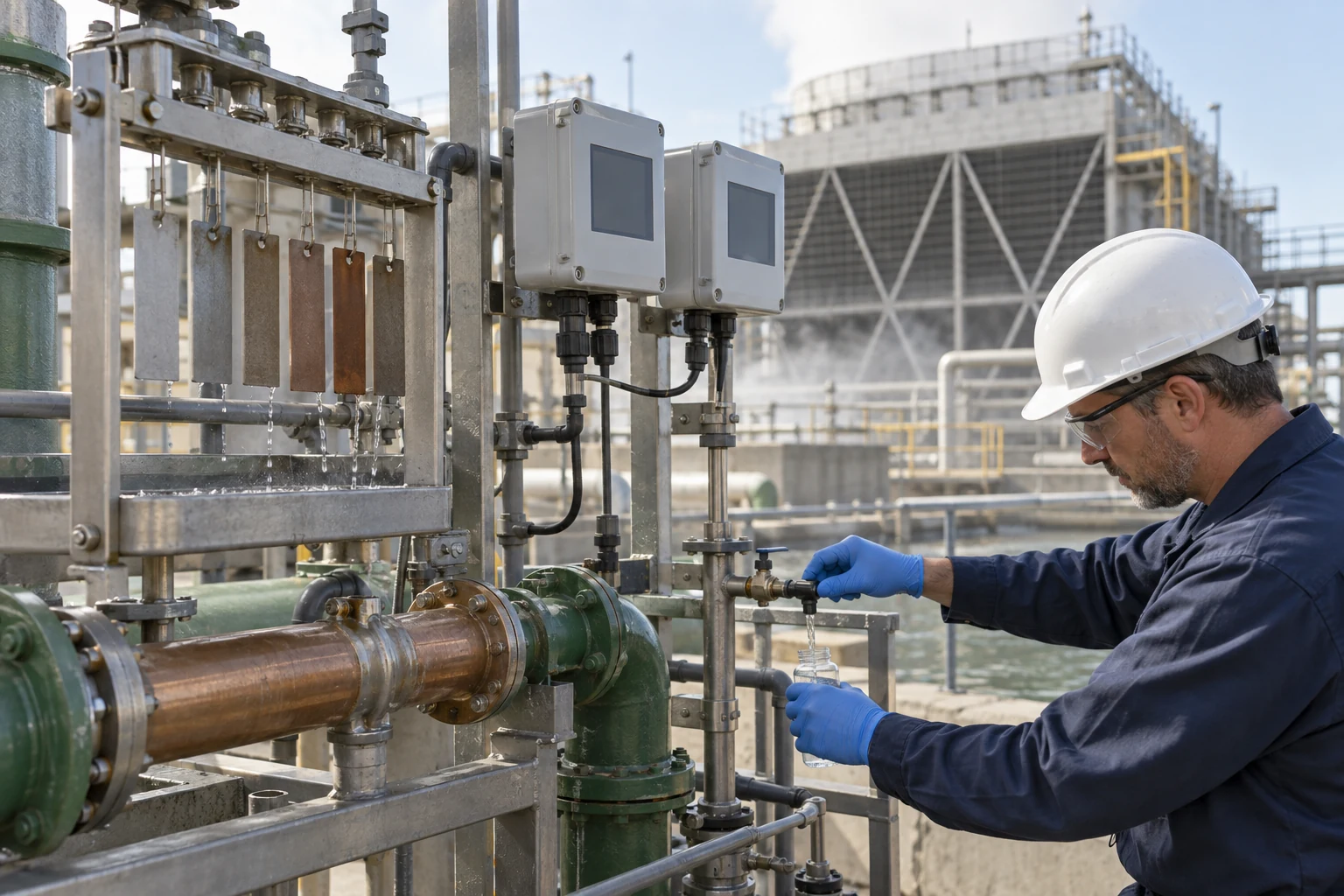
Build a monitoring route that catches source-water change
Use a short, repeatable sample route rather than a long list taken at unrelated times. Sample the reclaimed-water inlet before tower chemicals, the tower basin at a consistent location, and—when the system layout requires it—a point after adequate oxidant contact. Pair the chemistry with makeup flow, blowdown, conductivity, temperature and operating load. The U.S. Department of Energy notes that reclaimed effluent can be a cooling-tower source but that its quality must be evaluated for the actual system and cooling demand.4
- At the inlet: free and total ammonia, free and total chlorine, pH, alkalinity, conductivity, temperature and the source supplier’s treatment mode.
- In the basin: the same residual set, plus nitrite/nitrate when nitrification is a concern and the site’s microbial indicators.
- At critical assets: corrosion data for the actual metallurgy, surface condition and any validated inhibitor residual.
- Across time: capture source changes, warm-weather operation, long water age, shutdown/restart and major load changes.
ORP can show an oxidation trend, but it is not a substitute for identifying free versus combined chlorine. ATP, dipslides, cultures or other microbial methods each answer different questions; use the methods specified by the site’s water-management program and applicable rules.
Use a staged decision workflow
If the source-water pattern is the main driver, stabilize the makeup specification or pretreatment route before asking the tower program to absorb every fluctuation. If the source is stable but the basin pattern changes, inspect residence time, feed position, control logic, biofilm and operating load. If the microbial response improves while copper or steel indicators worsen, the next step is compatibility and sequence optimization—not simply a stronger oxidant event.
The broader reclaimed-water cooling-tower makeup guide covers phosphate, organics, salts and solids beyond this ammonia/chloramine decision. The cooling-water treatment application page connects those inputs to relevant chemistry families, and the water-treatment chemistry video overview provides a visual route through the portfolio.
For a focused discussion, share the paired makeup/basin results, source disinfection mode, tower volume and turnover, materials, current microbial-control approach and the trend you need to improve. Discuss your reclaimed-water cooling conditions →
Frequently asked questions
Why can total chlorine be present when free chlorine is low?
The difference can indicate combined chlorine, including chloramine, rather than freely available chlorine. Confirm the source treatment and use paired free/total chlorine methods before deciding what residual the tower actually has.
Does ammonia in reclaimed makeup always mean nitrification?
No. Ammonia is a substrate, not proof of nitrification. A falling ammonia trend together with rising nitrite or nitrate, alkalinity loss, pH change and suitable microbial conditions makes that branch more plausible.
Can I estimate tower ammonia by multiplying the makeup result by cycles?
Not reliably. Ammonia can volatilize, react with oxidants, enter biomass or be biologically converted. Measure the basin directly and compare it with makeup flow and operating time.
Is ORP enough to control chloraminated cooling water?
No. ORP is a useful trend but cannot identify free ammonia, free chlorine or combined chlorine. Pair it with specific residual methods and microbial indicators appropriate to the water-management plan.
What information is most useful when reviewing the program?
Provide paired makeup and basin ammonia/chlorine results, pH, alkalinity, nitrite/nitrate trend, conductivity, temperature, source treatment mode, system volume/turnover, wetted metals, current biocide route and the observed microbial or corrosion change.
Sources
- U.S. EPA, Simultaneous Compliance Workbook — ammonia, free/total chlorine, nitrification, alkalinity and corrosion-control interactions in chloraminated water.
- U.S. EPA, G20 Water Reuse Initiative (15 September 2026) — current fit-for-purpose water-reuse context.
- Corrosion control with secondary treated municipal wastewater as cooling-tower makeup — system-specific copper, steel, orthophosphate, free-chlorine and monochloramine findings.
- U.S. DOE/FEMP, Cooling Towers and Water Efficiency — makeup-water quality, reuse and cycles-of-concentration context.
Checked 24 September 2026. Source conditions are carried into the text; none establishes a universal VCYCLETECH dose, compatibility result or performance guarantee.