
Cooling water · biocide/inhibitor compatibility
Oxidizing Biocide Compatibility with Cooling-Water Scale and Corrosion Inhibitors
To judge whether an oxidizing biocide is compatible with a cooling-water scale and corrosion inhibitor, compare the actual oxidant, inhibitor ingredients, pH, temperature, contact time, injection geometry and system metallurgy—not just two product names. Chlorine, bromine and chlorine dioxide do not create the same exposure, and phosphonates, polymers and azoles do not respond identically. Map where each product enters the recirculating loop, how concentrated it is before dilution, and what residual reaches the inhibitor and metal surfaces. Then run a controlled compatibility screen in representative tower water and confirm the chosen sequence with residual, deposit and corrosion trends. Separate injection points or feed windows when local contact creates reaction, haze, precipitation, residual loss or a material-specific corrosion response.
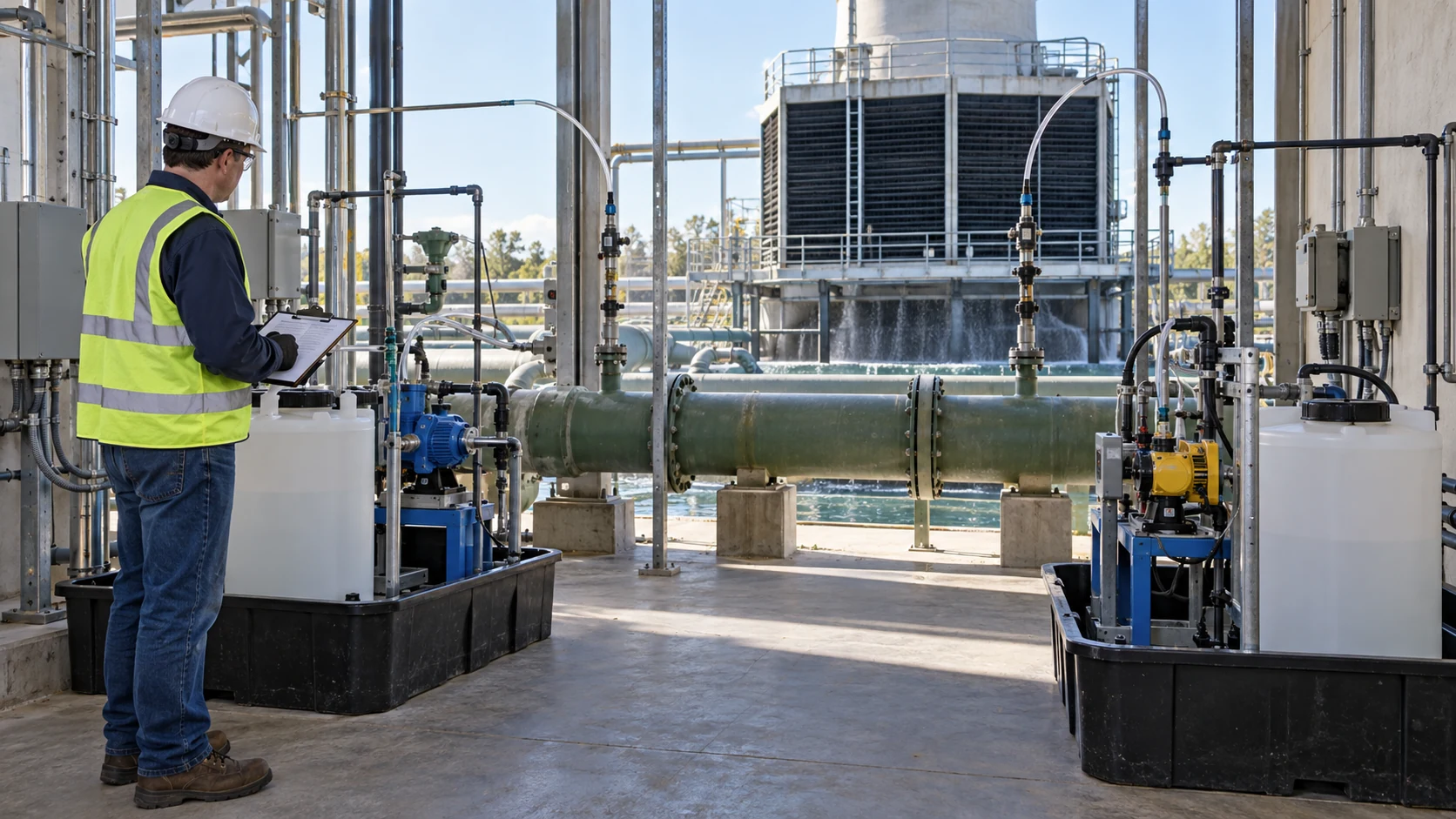
Map the real contact conditions before testing products
Write the oxidant route first: active oxidant, stabilizer or donor chemistry, feed concentration, batch or continuous pattern, target control method, contact time, pH and temperature. Then list the inhibitor package by function—scale inhibitor, dispersant, ferrous-metal inhibitor and copper-alloy inhibitor. A finished blend may contain several of these, so the trade name alone does not reveal which component is most exposed.
Draw the hydraulic path from each injection point to the tower basin, heat exchangers and return header. Estimate when the feeds first meet and whether that occurs before either stream is fully diluted. A chemically acceptable bulk-water combination can still fail in a small, high-concentration mixing zone. Conversely, products that react in a concentrated beaker may coexist after separate feed points provide rapid dilution and sufficient travel time.
Finally, list the wetted materials and the failure you are trying to avoid. Carbon steel, galvanized surfaces, copper alloys, elastomers, wood and coatings do not share one oxidant limit. Microbial control also cannot be weakened simply to protect an inhibitor; the program must still meet the site’s water-management and regulatory obligations.
Recognize four compatibility failure modes
| Failure mode | What may happen | What to observe | First design response |
|---|---|---|---|
| Oxidative loss | An oxidant changes an inhibitor or azole, reducing the amount available for its intended function. | Oxidant demand, inhibitor-residual change, orthophosphate or other validated transformation marker. | Reduce direct contact; compare timing or a more tolerant chemistry. |
| Local precipitation or haze | Concentrated feeds, pH or hardness create insoluble material before full dilution. | Haze, particles, filterable solids and deposit tendency at realistic mixing ratios. | Move injection points, improve dilution or change addition order. |
| Material response | Excess local oxidant or loss of protective chemistry changes corrosion behavior. | Material-specific coupons/probes, dissolved metals and inspection at representative exposure. | Control exposure and confirm the inhibitor film under the revised sequence. |
| Control-method conflict | A residual test or ORP signal no longer represents the active microbial-control condition. | Residual profile, demand curve and microbial response at the same sampling times. | Use the analytical method suited to the actual oxidant and water matrix. |
Veolia’s cooling-water handbook notes that oxidizing and nonoxidizing antimicrobials are often used together and that excessive chlorine can increase corrosion and damage tower materials.1 That supports a controlled program, not a universal residual or feed schedule.
Use the ingredient families to set the test matrix
Phosphonates are not one compatibility class
Published cooling-water work shows that oxidizing biocides can degrade some phosphonate additives, while PBTC showed greater resistance than aminomethylene phosphonate under the reported laboratory conditions; temperature and oxidant severity changed the extent of degradation.2 This is a reason to compare active components and conditions—not permission to label every PBTC program “compatible” or every other phosphonate “incompatible.” Finished formulations, blend ratios, impurities, water chemistry and exposure can change the result.
Azoles need their own copper-alloy check
Azoles protect copper and copper alloys, but oxidant exposure can reduce the amount available to maintain the protective film. Kurita’s pilot work on chlorinated synthetic cooling water describes oxidation of some inhibitor components and the secondary risk created when yellow-metal protection is lost.3 If the system contains copper or brass, include a copper-specific coupon or probe and dissolved-copper trend rather than relying on a carbon-steel result.
Polymers and finished blends need formulation-level confirmation
Polymeric dispersants differ in backbone, molecular weight and functional groups. A supplier family description cannot predict the behavior of a finished inhibitor blend with the site’s oxidant. Use the exact grade intended for the system, and keep any conclusion tied to the tested water, pH, temperature and contact pattern.
The HEDP versus PBTC cooling-water guide explains how scale-control selection changes with water chemistry. This article owns the separate question of biocide/inhibitor contact and sequencing.
Separate feed points and time windows when local contact is the problem
If a bench screen fails only when concentrated products touch, redesign the injection zone before discarding the whole program. Put each product into a point with strong, predictable flow; use an injection quill or distributor appropriate to the system; prevent backflow between feed lines; and allow one stream to disperse before it meets the other. The necessary distance is hydraulic, not simply a fixed number of pipe diameters—it depends on flow, turbulence, pipe geometry and recirculation.
Time separation can be useful for intermittent oxidant feed. Establish the oxidant contact period needed by the approved microbial-control program, then feed or restore the inhibitor according to its verified operating instructions and the measured residual decay. Do not turn a site-specific timing trial into a universal clock setting. Continuous oxidant programs need a formulation and injection design that tolerates continuous exposure rather than a schedule that only hides the contact.
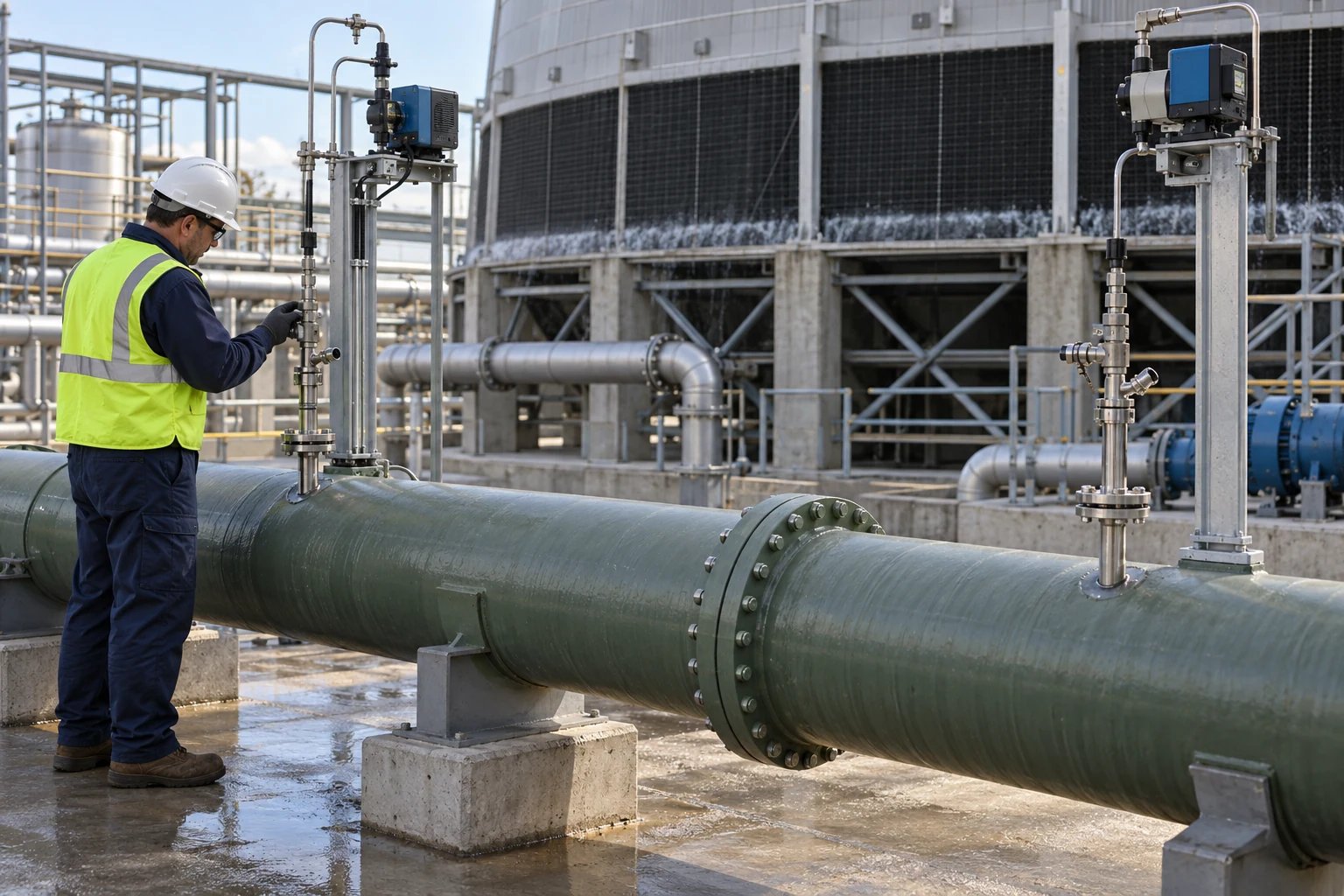
Run a compatibility screen that reproduces the system
Use representative tower water, not deionized water, because hardness, alkalinity, phosphate, suspended matter and organic demand can change both oxidation and precipitation. Keep temperature and pH close to the operating range. Prepare a control containing the inhibitor program alone, an oxidant control, and combined samples that reproduce the expected order of addition and contact time. If both simultaneous and separated feed are plausible, test both.
- At first contact: note temperature, pH, visible haze, particles, foam and any rapid oxidant demand.
- Across the intended contact period: trend the oxidant with the correct method and, where a validated method exists, the relevant inhibitor or transformation marker.
- After representative residence time: examine filterable solids, deposition tendency and the sample’s ability to support the next corrosion/deposit test.
- In a recirculating confirmation: expose the actual metallurgy and evaluate corrosion/deposit indicators alongside microbial control.
A clear beaker is not proof of functional compatibility. It only shows that no visible physical incompatibility appeared under that observation. An unchanged oxidant residual is also not proof that the inhibitor still performs. The screen should lead to a short recirculating or field confirmation with predefined indicators.

Make the program decision from the failure mode
If the problem is local precipitation, improve dilution, injection position or addition order and repeat the test. If the problem is oxidative loss after full dilution, compare an inhibitor formulation better suited to the oxidant exposure or a microbial-control route that meets the same operating requirement with less destructive contact. If corrosion changes without obvious residual loss, investigate the material-specific protective film and local oxidant exposure. If microbial control fails while compatibility looks acceptable, the limiting issue is likely demand, contact, biofilm penetration or the biocide route rather than inhibitor chemistry.
Use the biocide and algicide category to identify relevant microbial-control families, the phosphonate scale/corrosion inhibitor category to review inhibitor building blocks, and the cooling-water application page to place both within the wider program. The BKC video page is a separate nonoxidizing-biocide product route, not evidence of compatibility with a specific inhibitor.
For a useful compatibility discussion, share the exact oxidant and inhibitor grades, active components if known, water analysis, pH and temperature range, feed rates as currently set, injection-point sketch, residual trend, system volume/turnover, wetted metals and the failure signal. Discuss an oxidant/inhibitor compatibility screen →
Frequently asked questions
Can oxidizing biocide and corrosion inhibitor be fed at the same point?
Only when formulation-level compatibility and local dilution have been demonstrated. Separate injection points are safer when concentrated contact causes reaction, haze, precipitation, residual loss or a material response.
Does clear water after mixing prove compatibility?
No. It rules out obvious visible precipitation under that test, but it does not prove that the oxidant remains effective, the inhibitor remains active or the metals remain protected.
Are PBTC inhibitors always compatible with chlorine or bromine?
No. PBTC has shown comparatively strong oxidation resistance in published tests, but compatibility still depends on the finished formulation, oxidant, temperature, pH, exposure and water matrix.
Should oxidant and inhibitor feeds always be time-separated?
No. Time separation is one design option for intermittent programs. Continuous oxidant programs require a compatible formulation and hydraulic design. Follow the approved microbial-control plan and verify the full program.
What should a compatibility trial measure?
Measure the correct oxidant residual over time, pH and temperature; observe haze or solids; use a validated inhibitor or transformation marker where available; and confirm microbial, deposit and material-specific corrosion indicators in a recirculating or field test.
Sources
- Veolia Water Handbook, Air Conditioning and Refrigeration Systems — cooling-system inhibitor functions and careful use of oxidizing antimicrobials.
- Demadis and Ketsezi, degradation of phosphonate scale inhibitors with oxidizing biocides — condition-specific AMP and PBTC oxidation findings.
- Kurita America, oxidizing-biocide effects on cooling-water corrosion inhibitors — pilot-scale chlorinated-water and azole/phosphonate interaction context.
- U.S. EPA, Legionella efficacy-testing guidance for cooling-tower antimicrobials — antimicrobial claims, approved use and water-management-plan context.
Checked 24 September 2026. Results from cited studies remain tied to their formulations and test conditions; they do not establish a universal product pairing, feed interval or dose.