
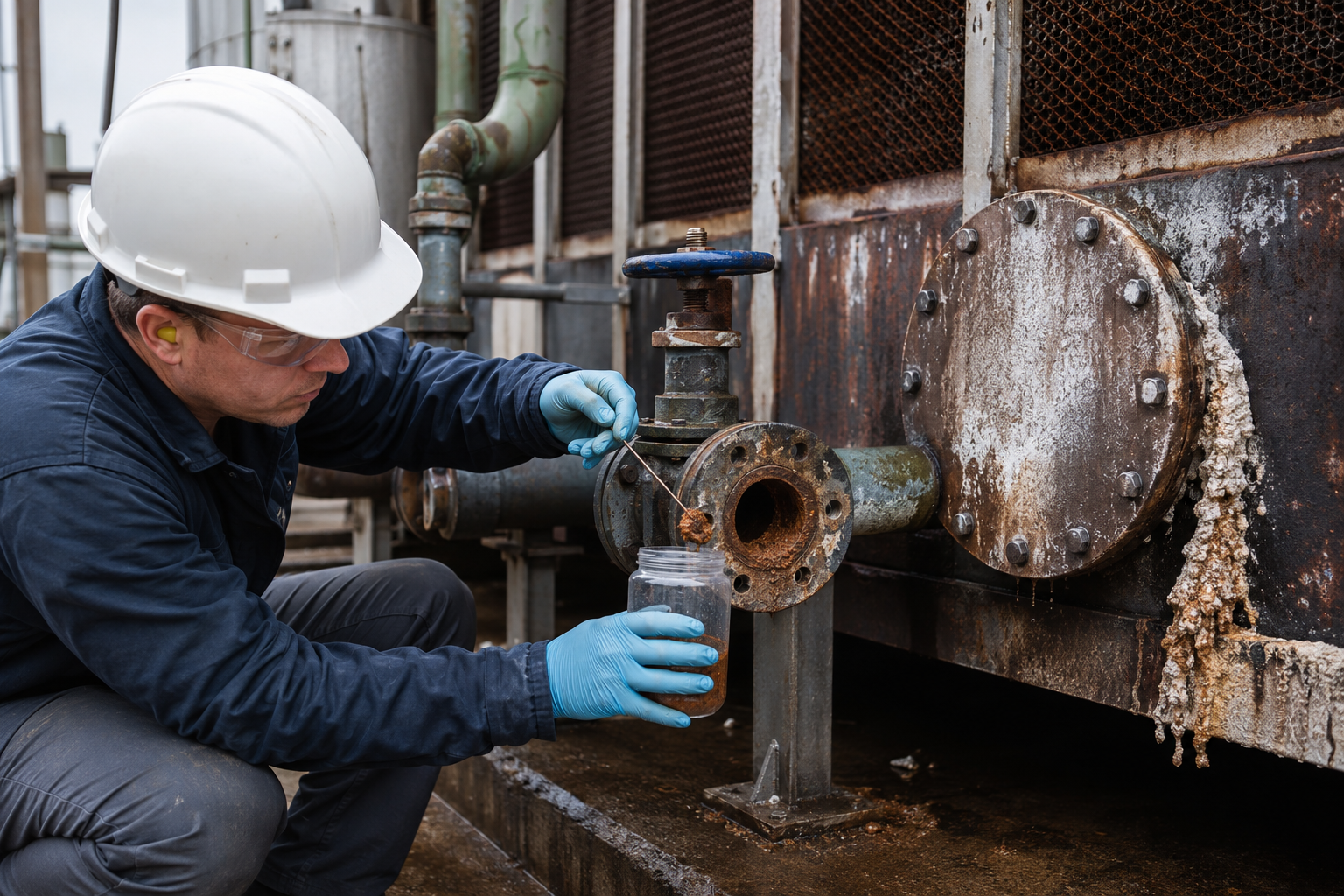
Cooling Tower Deposit Investigation: Identify Iron and Phosphate Deposits
TL;DR A cooling-tower deposit calls for two decisions: what the material is and why it collects at that location. Compare the deposit with makeup and circulating-water trends, metal surfaces, operating temperature, blowdown and recent treatment changes. Iron-rich corrosion products, calcium phosphate and biofilm can coexist, so appearance alone will not select an inhibitor or dispersant. Examine the affected surface safely, then match the likely mechanism to a control option and a measurable follow-up. A water analysis and a deposit sample help narrow the chemistry before the plant commits to a new program.
What should a cooling-tower deposit investigation prove?
A plugged strainer, brown tubercle, white scale or declining heat transfer points to a deposit, but not always to the same cause. Use the deposit location, sample and water trends to decide whether the next step is cleaning, solids control, corrosion work or a change in inhibitor chemistry.
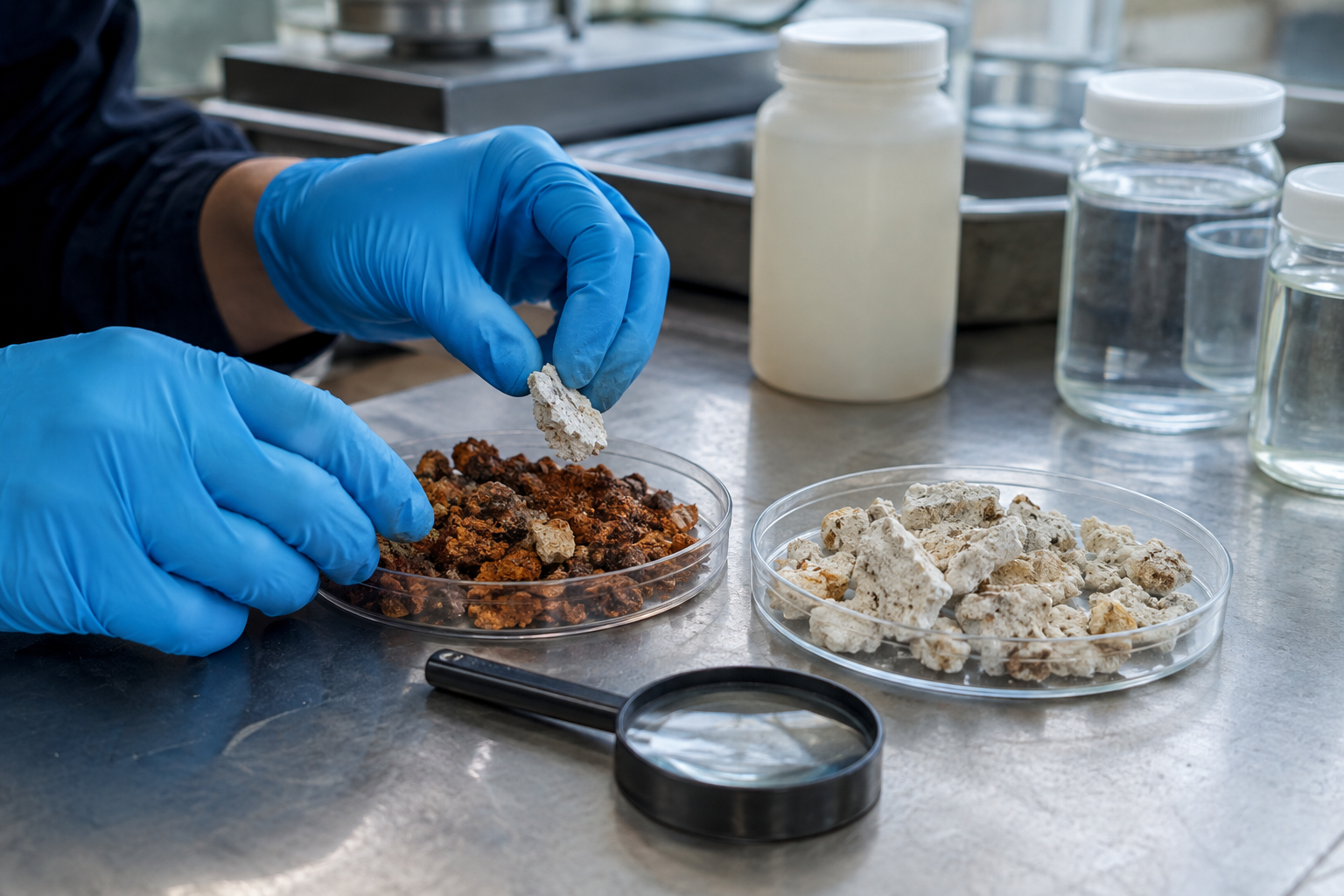
| Observation | What it may indicate | Cross-check next | What to check next |
|---|---|---|---|
| Brown or red material with iron present | Corrosion product, incoming solids, process contamination or a mixed deposit. | That the deposit began as internal corrosion or that one inhibitor failed. | Location map, metallurgy, coupon/inspection history, dissolved and total iron context, deposit microscopy or elemental/mineral analysis where appropriate. |
| Hard off-white mineral layer | Mineral scaling conditions may be present; calcium carbonate and calcium phosphate are possible families. | The exact mineral, driving saturation condition or a universal cleaning method. | Representative deposit identification, calcium/phosphate/alkalinity/pH/temperature/cycles history and exchanger operating context. |
| Dark, soft or slimy material | Biofilm, suspended solids, corrosion product or a mixed matrix may be involved. | Microbiologically influenced corrosion or a specific organism. | Sampling method, microbiological method, oxidant/biocide history, water age, dead-leg and surface inspection context. |
| Localized attack beneath a deposit | An oxygen-differential or crevice-like environment can be a corrosion concern. | That all deposits cause corrosion at the same rate or that the observed attack is current. | Material identification, cleaned-surface examination, representative coupons or inspection, flow and under-deposit conditions. |
Iron, calcium phosphate and biological material: keep the hypotheses separate
Open-recirculating cooling systems are exposed to airborne debris and biological contamination; DOE identifies corrosion, scaling, fouling and microbiological activity as linked but separate treatment concerns. Veolia’s technical water handbook similarly notes that iron from steel corrosion can contribute to fouling, that calcium-phosphate deposits can occur when conditions are not controlled, and that deposits can create oxygen-differential cells. Those references describe mechanisms, not a diagnosis of any particular tower. A field sample often contains more than one material, so the key question is sequence: did mineral matter nucleate first, did corrosion products settle, did solids enter from makeup, or did a biological matrix retain all three?
| Candidate deposit family | Context worth checking | Test the correction against | When this applies |
|---|---|---|---|
| Iron-rich corrosion product or suspended solids | Carbon-steel condition, ingress, low-flow regions, corrosion evidence, filtration and recent upset/cleaning history. | Source control, solids management, corrosion review and deposit removal plan. | Iron trend and colour cannot distinguish source without context and analysis. |
| Calcium-phosphate or other mineral scale | Calcium, phosphate, pH, alkalinity, temperature, cycles, feed points and local high-heat surfaces. | Water-balance and formulation-compatibility review; retain sample before cleaning. | Do not infer a mineral phase from a field appearance or apply a generic acid-cleaning recipe. |
| Biofilm or mixed biological fouling | Biocide/oxidant history, water age, dead legs, suspended solids, cleaning practice and monitoring method. | Site water-management and biocide strategy review with safety/regulatory checks. | A soft deposit is not organism identification or proof of MIC. |
Sample the deposit and check the water trend
- Do not clean away the evidence first. Photograph scale, deposits and surrounding geometry; log date, location, surface, flow condition and whether the material was wet or dry. Follow site safety procedures before collecting anything.
- Take paired evidence. A deposit sample without a contemporaneous recirculating-water sample leaves a weak comparison. Where meaningful, include makeup water and a sample upstream/downstream of the affected section with method, unit and sample point.
- Map the equipment boundary. Note metallurgy, galvanic couples, heat flux, low-flow zones, strainers, dead legs, filtration, treatment-feed points and recent shutdown, cleaning or water-source changes.
- Ask a laboratory the right question. Suitable methods vary by material and question. Elemental, mineralogical, microscopy, microbiological or corrosion examinations should be selected by a qualified laboratory or corrosion professional; the article does not prescribe one method for every deposit.
- Correct the confirmed mechanism, then verify. The corrective option may involve solids control, cleaning, water-balance changes, corrosion review or program compatibility. Define success evidence and reinspection timing before release.
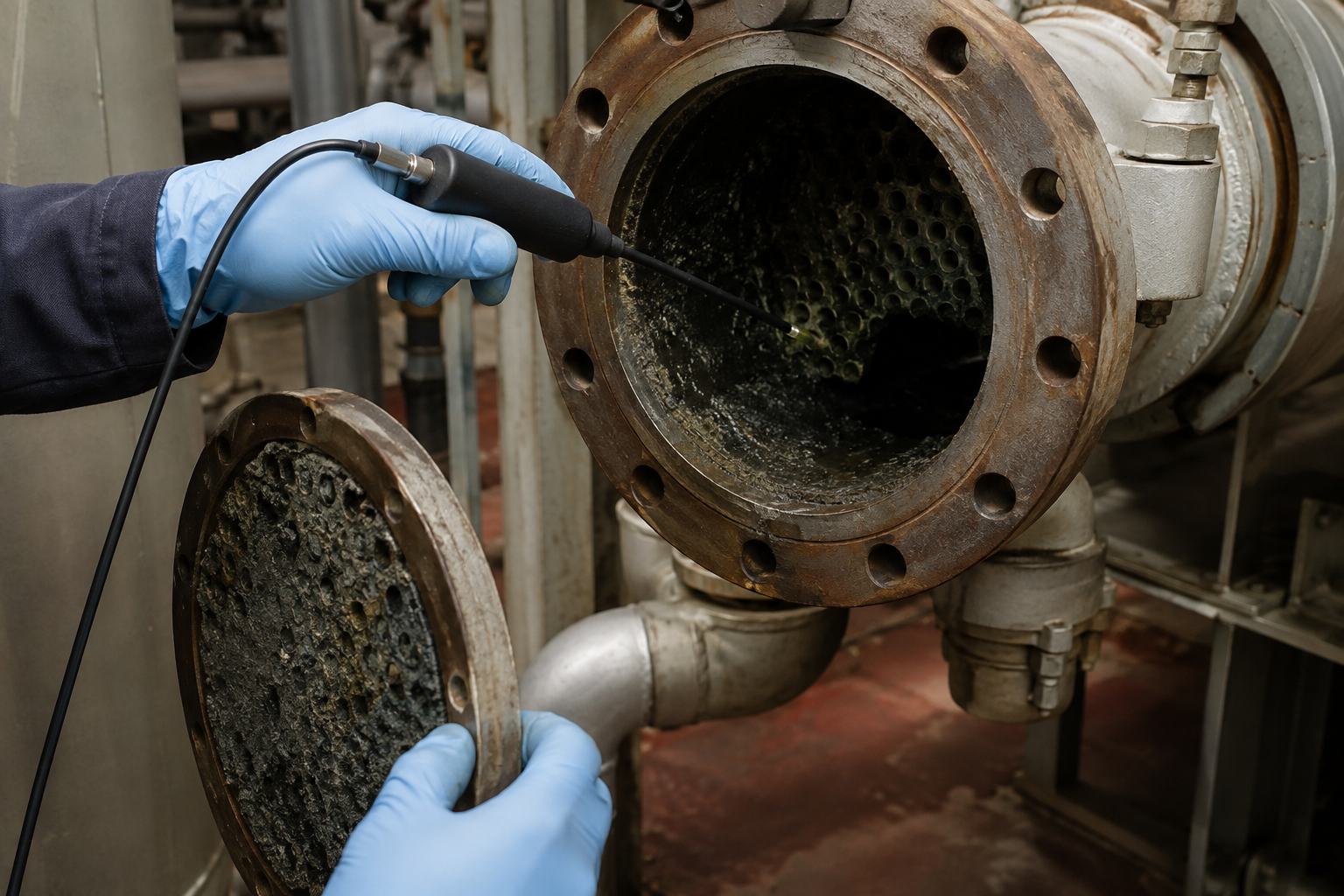
Check for corrosion beneath the deposit
Deposits can restrict transport at a metal surface and create differential conditions, but a photograph of a pit under a deposit does not establish the timing, mechanism or rate of attack. Preserve the deposit and document the surface condition before aggressive cleaning; then consider the material, geometry, water chemistry, oxygen/oxidant exposure, flow, previous coupon or inspection evidence and the sequence of operating changes. CTI’s 2026 journal identifies active work on corrosion-coupon preparation/testing and inspection/maintenance strategies for water-cooled heat exchangers—useful reminders that method and surface condition affect interpretation. A coupon, inspection report or lab result must retain its own method and exposure boundary.
What to share for a treatment recommendation
| Retain | Why it matters | Also check |
|---|---|---|
| Deposit chain of custody, photographs and location sketch | Keeps a laboratory finding tied to an actual surface and operating position. | A loose sample with no equipment context. |
| Dated makeup and recirculating-water results | Supports mineral, metal, concentration and treatment-context review. | A single old water report or a conductivity value alone. |
| Material and equipment map | Shows where compatibility and local corrosion questions differ. | A generic “cooling tower” description. |
| Current TDS, COA and SDS for products in use or proposed | Supports identity, handling and formulation-change questions. | A blog claim, generic product family name or unverified dose. |
| Trial/change-control record | Defines what changed, accepted evidence, hold points and reinspection. | An assumption that cleaning or a new product solved the root cause. |
Compare the cooling-water application and corrosion guide with the affected metal and water analysis. Use the HEDP product page for current grade information, then discuss the deposit sample and circulating-water trend before selecting a trial.
Frequently asked questions
What is the first step in a cooling-tower deposit investigation?
Make the area safe, preserve a representative sample, photograph and map the exact location, then collect paired water and operating-context evidence before cleaning removes the clues.
Does iron in a cooling-tower deposit prove corrosion?
No. Iron can come from corrosion products, incoming solids or a mixed deposit. Compare deposit findings with metallurgy, location, water data, inspection and operating history before assigning a source.
Is a white deposit always calcium phosphate scale?
No. Colour and hardness do not identify a mineral phase. Calcium phosphate is one possible family in cooling water, but representative analysis and water/operating context are needed before drawing that conclusion.
How do deposits contribute to under-deposit corrosion?
A deposit can create localized transport and oxygen-differential conditions at a metal surface. The consequence depends on material, geometry, water chemistry, deposit character, flow and time; a field photo alone does not establish mechanism or rate.
Should a cooling tower be cleaned before a deposit sample is taken?
Where safe and practical, document and retain representative evidence before cleaning. Follow site procedures and use qualified sampling/analysis support; cleaning without records can remove the information needed to identify the root cause.
About this guide
Prepared by the VCYCLETECH Technical Team. Compare product options with your own water, equipment and operating goals; use current grade documents and a representative trial to confirm the final choice.
Sources
- U.S. Department of Energy: cooling-tower fouling, scale, corrosion and microbiological context
- Veolia Water Handbook: cooling-system deposit and scale-control mechanisms
- Veolia Water Handbook: calcium-phosphate deposits, iron dispersancy and under-deposit corrosion context
- Cooling Technology Institute 2026 journal: coupon and heat-exchanger inspection work