
Scale or deposit risk
Start with makeup-water hardness, alkalinity, pH, cycles of concentration and the deposit location. Then compare a phosphonate and dispersant route against the actual saturation and temperature conditions.
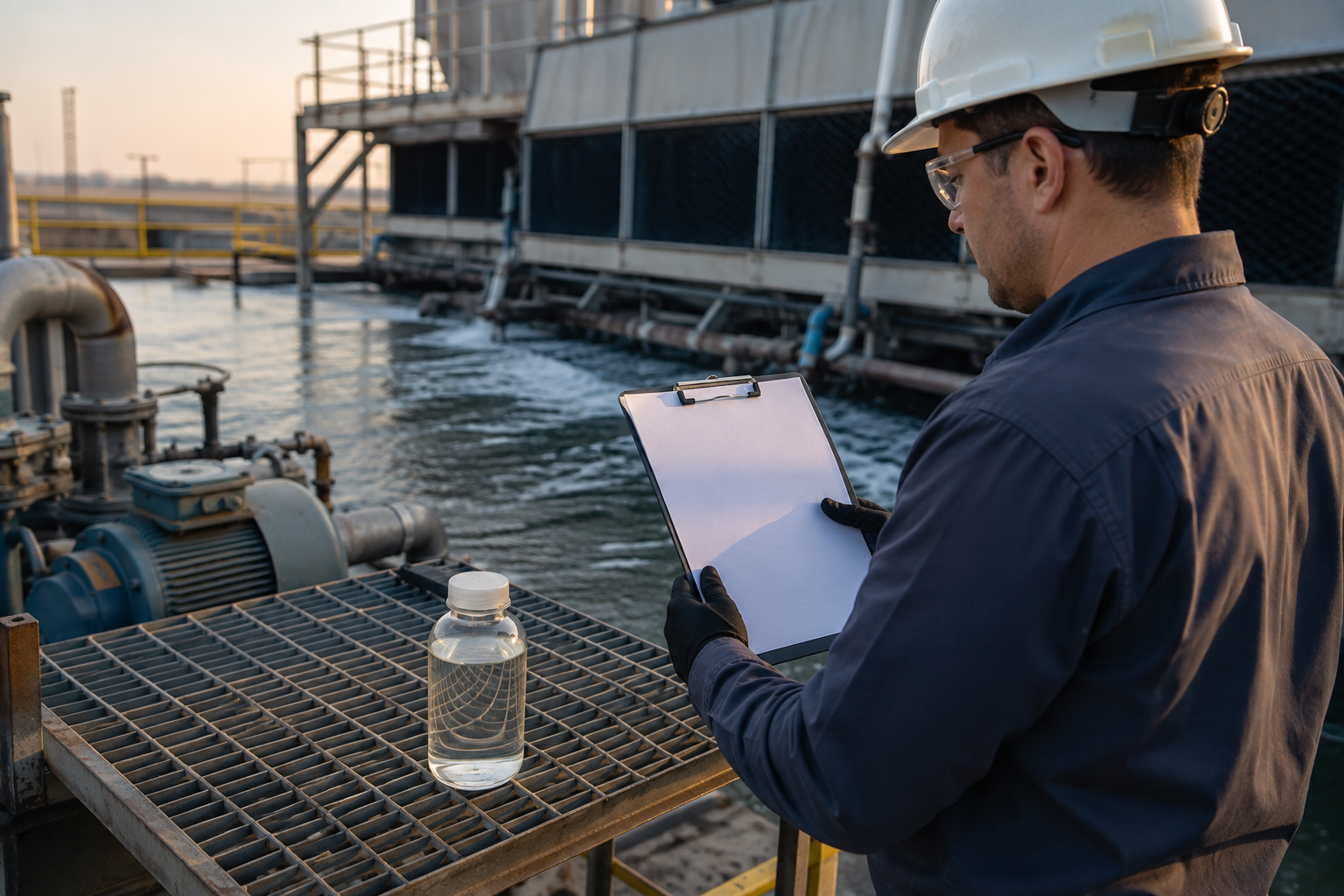
Build the program around the circulating-water system—not a single product. Scale and deposit control, corrosion protection, dispersancy and microbial control must fit the same makeup water, cycles, metallurgy, temperature and operating pattern.
Each route begins with a different mechanism and a different set of useful inputs.
Start with makeup-water hardness, alkalinity, pH, cycles of concentration and the deposit location. Then compare a phosphonate and dispersant route against the actual saturation and temperature conditions.
Identify the affected metal, water pH, chloride, oxidant exposure and whether copper alloys share the circuit. A yellow-metal inhibitor and a general corrosion-control component solve different parts of the problem.
Use the biofilm location, microbial trend, oxidant demand, system volume and downtime window to choose an oxidizing or non-oxidizing control route. Confirm compatibility with the rest of the water-treatment program.
Use these product families as a shortlist for comparison—not as interchangeable substitutes.
PBTC, HEDP and ATMP provide different starting points for scale-control formulations. Water chemistry and oxidant exposure decide which candidates deserve testing.
Compare phosphonatesA dispersant helps keep fine mineral and corrosion-product solids mobile. Select it together with the scale-control chemistry and expected solids load.
Explore dispersantsCompare oxidizing and non-oxidizing biocide families by system conditions, contact time and compatibility—not by a universal “best biocide” claim.
Explore biocidesChoose the next action from the system that changed. An open evaporative tower with new suspended solids needs source, particle and filter evidence. A closed loop that unexpectedly takes makeup needs leak repair, pressure and fluid restoration before inhibitor revalidation. Treating both as a generic request for more chemical obscures different equipment and evidence requirements.
| System and trigger | First engineering decision | Evidence and guide |
|---|---|---|
| Open tower: new grit, iron-bearing particles or changing filter load | Find continuing ingress; verify whether side-stream capture matches the particle burden. | Matched inlet/outlet size and solids data, filter flow/pressure/backwash, deposit location. Plan a side-stream filtration acceptance trial. |
| Closed circulating loop: leak, automatic makeup or refill | Repair and stabilize pressure/venting; compare original and replacement fluid before chemical changes. | Makeup history, fluid and metal analyses, program residual, coupons/deposits. Follow the closed-loop recovery sequence. |
For residual particulate deposition in an open tower, the real AA/AMPS and WT-445 acrylic polymer pages identify formulation candidates, not an established filter cure or site dose. For a stabilized closed loop, the closed-circulating-system inhibitor is a real catalog inquiry route. Its current grade documentation, glycol and metal compatibility, residual method and performance must be confirmed for the actual system. Explore the corrosion-inhibitor category only when corrosion protection is the remaining task.
Send a marked flow diagram, source and event chronology, paired water analyses with methods, wetted metals, present treatment identity, relevant filter or coupon/deposit evidence and the operating endpoint that needs improvement. For an open tower include side-stream flow, matched inlet/outlet samples, pressure and backwash; for a closed loop include leak/makeup and refill history, pressure/venting, glycol where used and program-specific residuals. Add destination, required quantity and timing through the technical inquiry. Do not substitute a universal dose or filter rating for the equipment and water evidence.
Separate scale, corrosion, suspended deposit and biological fouling before changing the program.
Use makeup and circulating-water analysis, cycles, metallurgy, temperature, volume and blowdown pattern.
Choose the chemistry route that addresses the dominant mechanism and remains compatible with the full program.
Set measurable operating endpoints and compare trends under representative conditions.
A cooling-water program may combine scale-control chemistry, a dispersant, corrosion protection and microbial control. The combination depends on the water analysis, metallurgy, cycles, temperature and operating pattern.
Start with the expected scale species and saturation conditions, then compare phosphonate and polymer candidates under the actual pH, hardness, alkalinity, temperature and oxidant program.
Oxidizing biocides support residual-based routine control, while non-oxidizing options can target organisms or biofilm under different contact and compatibility conditions. The system and current program determine the useful route.
Share makeup and circulating-water analyses, cycles, metallurgy, temperature, system volume, current chemicals and the specific scale, corrosion, deposit or microbial problem.
Do not select a treatment program from conductivity or a product name alone. A seasonal makeup-water change requires a new mass balance and ion-specific risk review. A copper signal requires clean confirmation, source localization and a material-specific corrosion route. Both decisions start with system evidence and end with a controlled verification plan.
| Buyer trigger | Use this guide | Evidence for the next step |
|---|---|---|
| Makeup source or chemistry changed | Recheck cycles, scale, corrosion and microbial control | Paired water analyses, flow balance, ion cycles, load and treatment trends |
| Copper or copper-alloy corrosion signal | Confirm, localize and revise the mixed-metal route | Filtered/unfiltered metals, wetted-material map, events, coupons and inspection |
Related product identity pages include HEDP, PBTC, TTA and BTA. Their presence does not establish a site dose or compatibility. Review the video and evidence library, then share current water, metallurgy and product-document requirements.