
COOLING WATER · CORROSION RESPONSE
Copper Corrosion Signals in Mixed-Metal Cooling Systems
A high copper result or damaged copper-alloy coupon should trigger confirmation and source localization before an inhibitor change. Repeat the sample from a clean, representative point; compare dissolved and total copper; map copper, brass, steel, aluminum and galvanic interfaces; and align the signal with pH, temperature, ammonia, chloride, oxidant exposure, deposits, microbial evidence and maintenance events. Then separate an open-tower problem from a closed-loop oxygen-ingress or contamination problem. An azole may be a candidate copper-alloy protection component, but it cannot replace steel and aluminum protection, deposit control, microbial control or equipment correction. Accept a revised route only with material-specific trends and inspection evidence.
Confirm that the copper signal is real and current
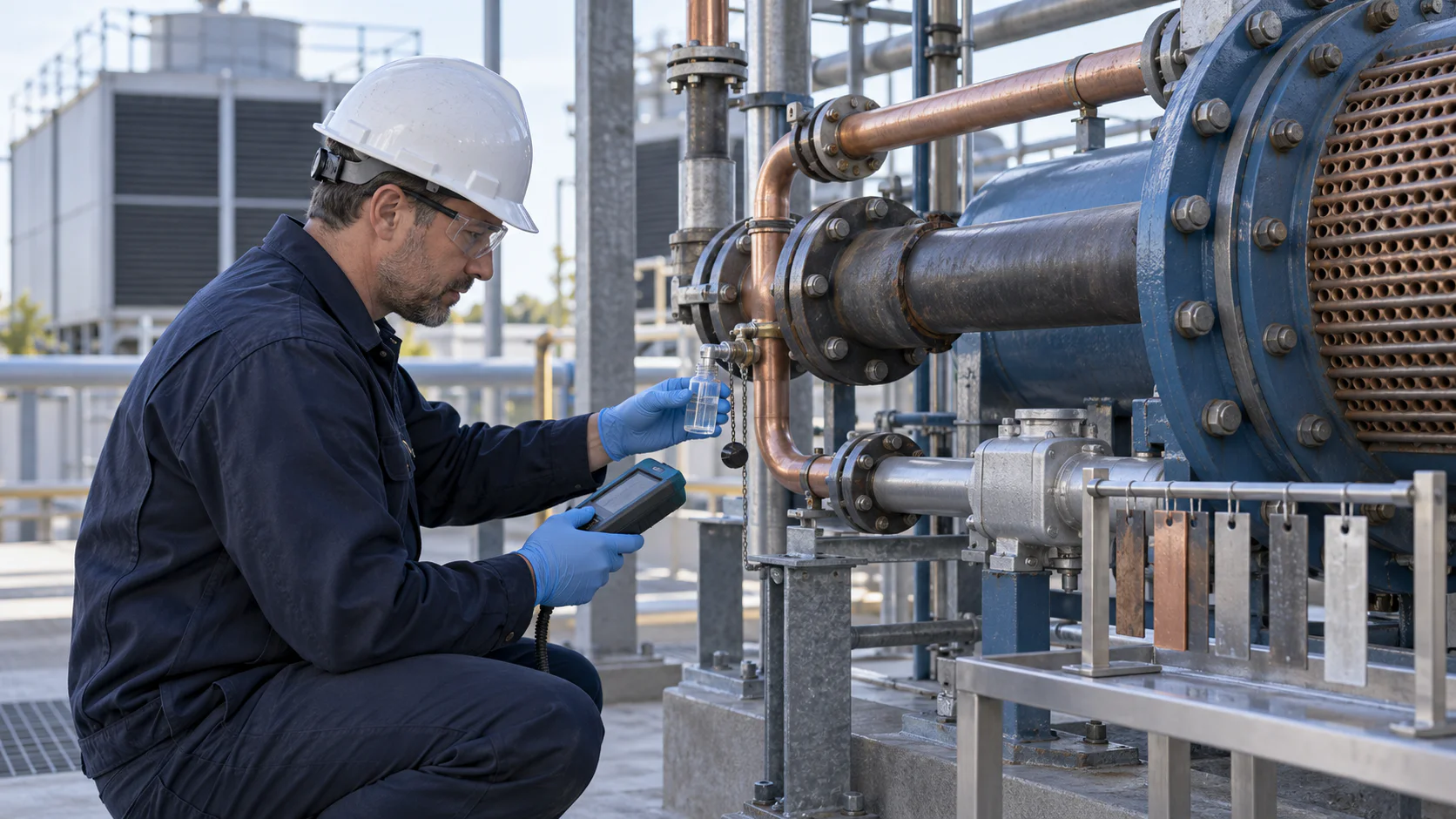
Define what produced the alert. A dissolved-copper result, total-copper result, blue-green deposit, tube inspection, coupon mass loss and online corrosion signal answer different questions. Total copper can include transported particulate or disturbed historical deposits. Dissolved copper can indicate active release, but sample preservation and filtration timing matter. A coupon integrates conditions at its rack location and exposure period; it does not identify every upstream source.
Repeat the result from a flushed, consistently flowing sample point using clean equipment. Avoid collecting immediately downstream of a chemical feed, dead leg or copper-bearing sample assembly unless that location is the subject of the investigation. Record filtration, preservation, analytical method, detection limit and elapsed time. Compare the laboratory result with a field trend only after units and sample states match.
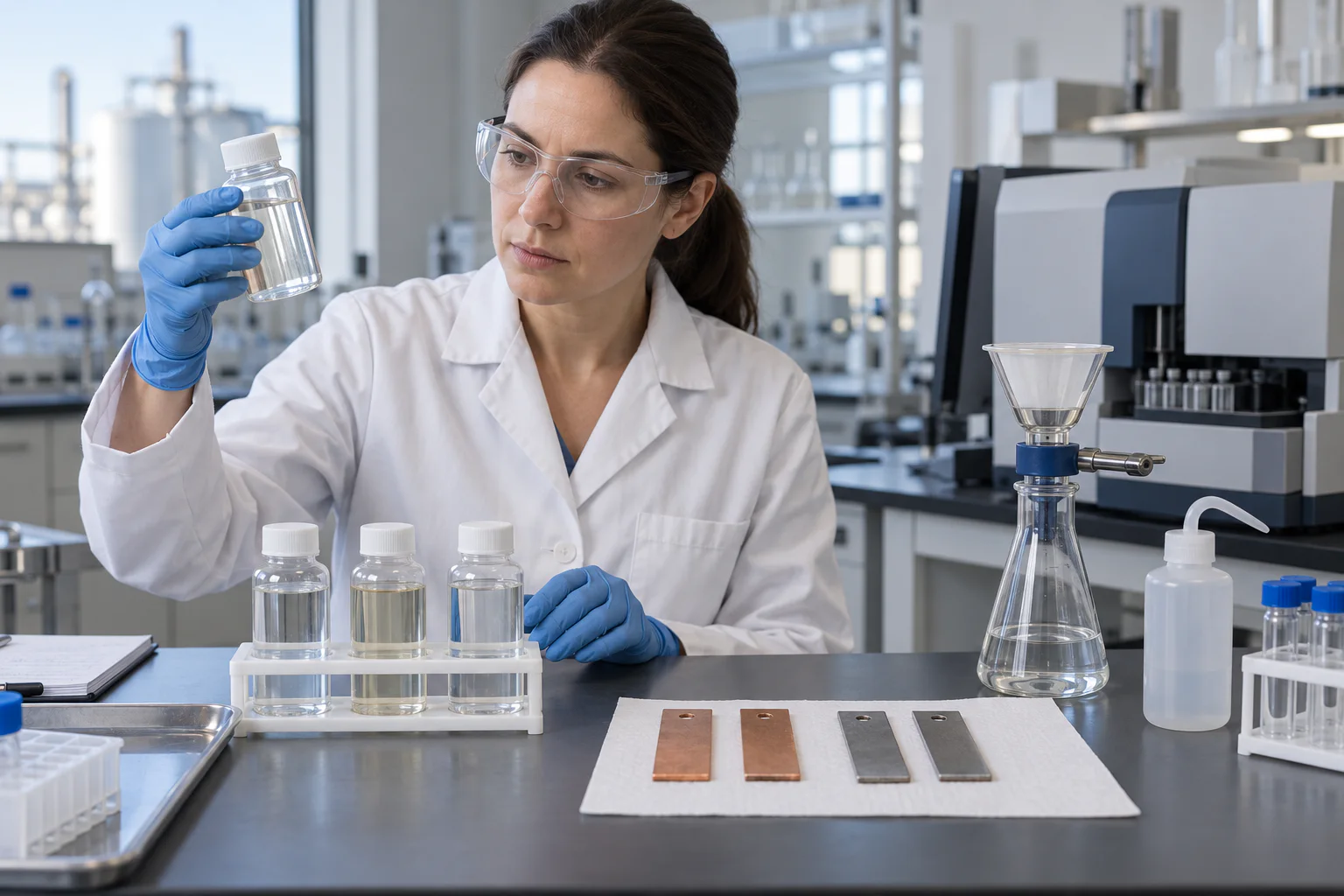
Build an event line covering makeup-source changes, pH excursions, oxidant shocks, non-oxidizing biocide use, inhibitor-feed interruption, heat-load or temperature change, shutdown and refill, cleaning, exchanger work, process leaks and coupon replacement. If the copper increase follows maintenance that disturbed a deposit, the first task may be separating released historical material from ongoing metal loss. If copper and iron rise together, do not assume one mechanism; copper can originate upstream while iron reflects a separate steel problem.
Locate the source and distinguish competing mechanisms
Create a wetted-material map, not just an equipment list. Identify copper, admiralty brass, other copper alloys, carbon steel, galvanized steel, stainless steel and aluminum; note direct electrical connections, surface-area imbalance, heat-transfer duty, local temperature, low-flow regions and deposit-prone locations. Trace water from makeup through treatment feed, tower or closed reservoir, heat exchangers and return headers. Copper released from one exchanger can travel and become part of a deposit elsewhere, so the highest downstream value is not necessarily the source location.
| Pattern | Questions to answer | Useful evidence | Common wrong conclusion |
|---|---|---|---|
| Dissolved copper rises across one exchanger | Is release active under current load and chemistry? | Paired inlet/outlet samples, temperature, pH, ammonia, oxidant and inspection | All copper alloys in the loop are failing equally |
| Total copper rises but dissolved copper does not | Was deposit or particulate material mobilized? | Filtered/unfiltered samples, turbidity, deposit composition, maintenance history | More soluble inhibitor will remove existing solids |
| Copper deposit appears on steel | Is upstream copper release contributing to a galvanic site? | Deposit analysis, upstream/downstream copper, steel surface inspection | The steel inhibitor alone caused the copper source |
| Coupon changes after oxidant event | Was exposure representative and was the copper-protection component present? | Time-aligned residual/feed data, coupon handling, pH and water chemistry | Every oxidant or every azole is incompatible |
| Localized attack under deposit or biofilm | Are mass transport, crevice chemistry or microbiology involved? | Deposit/biofilm examination, surface morphology, microbial and operating trends | A bulk-water copper number identifies the local mechanism |
Ammonia can stress copper alloys, especially when source water, process contamination or biological activity changes. Oxidants can alter both copper surfaces and some protective organic films. Chloride, sulfate, pH and temperature affect the surrounding corrosion environment. Deposits can create a local chemistry unlike the bulk water, and biological activity can participate in localized attack. Use the evidence combination; no single parameter proves the mechanism.
Separate open-tower and closed-loop decisions
An open recirculating tower continuously receives makeup and concentrates constituents through evaporation. It also receives airborne solids and normally has an active microbial-control program. The copper-protection route must therefore be evaluated with cycles, makeup variability, bleed, solids, oxidant exposure, treatment feed and discharge constraints. Use the Cooling Water Treatment application page to frame this broader system.
A closed loop has little intentional makeup, so a rising water demand, pressure loss or recurring refill can be a critical clue. Oxygen can enter with makeup or through expansion and sealing problems, while process contamination, glycol condition, nitrite or molybdate chemistry, pH and microbiology may require different interpretation. The identity page for corrosion inhibitor for closed circulating systems is a candidate commercial path, not evidence that one formulation suits the actual fluid, metals or temperature.
| Decision factor | Open recirculating tower | Closed loop |
|---|---|---|
| Water entry | Routine makeup; source variability is expected | Makeup should be limited; repeated addition can signal leakage or maintenance |
| Concentration | Evaporation and blowdown control cycles | No normal evaporative cycles; concentration may reflect fill fluid, leakage or contamination |
| Microbial control | Active tower water-management and disinfectant program | System-specific biocide need, contamination and stagnation review |
| Corrosion stress | Concentrated ions, oxidant exposure, deposits, variable load | Oxygen ingress, fluid chemistry, replenishment, deposits and material compatibility |
| Verification | Representative side stream plus equipment and tower evidence | Representative loop sampling plus leak, fluid and component evidence |
Change the route, not just the azole feed
Aromatic azoles such as benzotriazole and tolyltriazole are established candidate mechanisms for copper and copper-alloy protection. Veolia describes their interaction with cuprous oxide and also notes that dissolved copper can create treatment demand and that excessive chlorination can deactivate triazoles.1 The Hong Kong EMSD code likewise lists BTA and TTA as copper-corrosion inhibitors acting through bonding with cuprous oxide.2 Those facts support a candidate mechanism; they do not select a grade, dose or operating window for this plant.
Before changing the copper-protection component, verify the exact current product and active program, feed point, residual method, makeup and bleed state, oxidant peak and duration, pH, temperature, ammonia, chloride, deposit condition and dissolved-copper load. A controlled study found that TTA behavior differed in the presence of free chlorine, monochloramine and ammonia under the study conditions.3 Use that as evidence that exposures interact, not as a universal preference for one disinfectant or inhibitor.
Rebuild the full mixed-metal route. Carbon steel may need a different passivation or precipitation mechanism; aluminum can narrow acceptable pH and chemistry; galvanized surfaces and stainless alloys have their own limits. Deposit control keeps protective surfaces accessible, and microbial control cannot be abandoned to preserve a film. Check feed sequencing and whether a shock event creates a different exposure from the measured routine residual. Repair oxygen ingress, process contamination, low flow or galvanic construction problems when chemistry cannot remove the cause.
The Corrosion Inhibitors category is the Money Page for discussing a candidate route. The Tolyltriazole (TTA) and 1,2,3-Benzotriazole (BTA) pages confirm product identity and inquiry availability only. Request the current specification, TDS, SDS, COA format and compatibility evidence for the exact proposed grade. Do not carry a web dosage, temperature claim or competitor result into the operating procedure.
Verify the revised route with material-specific evidence
Use coupons that represent the important alloys and install them in a controlled, documented side stream with known flow direction and exposure. ASTM D2688-23 covers weight-loss coupons and pitting evaluation for water systems without heat transfer and emphasizes relative comparisons.4 The method does not make a coupon rack equivalent to a hot exchanger tube, crevice, dead leg or deposit-covered surface. Preserve coupon preparation, orientation, handling, exposure time and cleaning records so a comparison is defensible.
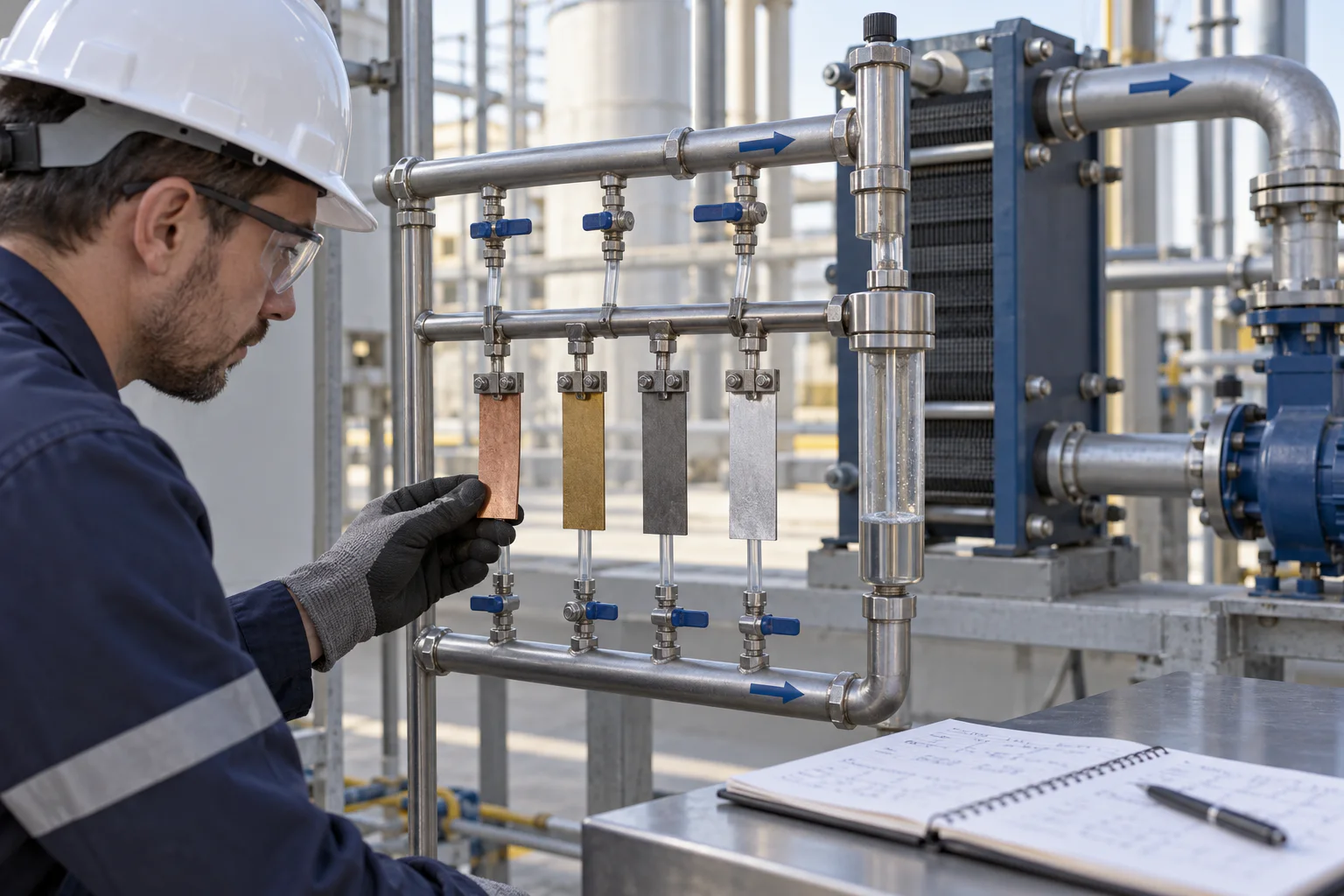
Combine coupon results with dissolved and total copper and iron trends, pH, temperature, ammonia and key ions, treatment residuals, oxidant event data, deposit analysis, equipment inspection and wall-thickness or other integrity evidence where appropriate. Look for agreement across independent evidence. A stable bulk-water copper result does not rule out localized under-deposit attack, and an acceptable steel coupon does not prove copper or aluminum protection.
Define acceptance and stop conditions before the controlled change. Specify which materials, sampling points, source-water states and load conditions must be represented. Include a response for rapid metal release, loss of microbial control, unstable pH, excessive deposition, incompatible discharge or equipment alarms. Review the video and evidence library only as process context, then send the metallurgy map, event history and current product documents →
Frequently asked questions
Does high copper in cooling water prove active copper-alloy corrosion?
No. Confirm sample location and handling, compare dissolved and total copper, repeat the measurement, and align it with upstream/downstream trends, maintenance, deposits, coupons and equipment inspection before identifying active corrosion.
Should an azole be increased whenever copper rises?
No. Check the actual product, residual method, dissolved-copper demand, feed reliability, oxidant exposure, ammonia, pH, temperature, deposits and source location first. An uncontrolled increase can hide the cause and does not protect every other metallurgy.
Can one steel coupon verify a mixed-metal program?
No. It can describe steel behavior at that rack and exposure. Important copper alloys, aluminum or other materials need representative evidence, supported by water trends and equipment inspection because coupon conditions do not reproduce every surface.
Why does open versus closed cooling matter for copper corrosion?
Open towers concentrate makeup constituents and normally use active blowdown and microbial control. Closed loops should have limited makeup and can be dominated by oxygen ingress, refill, fluid condition or contamination. Their control and verification routes are therefore different.
What information should accompany a corrosion-inhibitor inquiry?
Send the loop type, wetted-material map, makeup and circulating-water analysis, pH and temperature range, oxidant and biocide history, current inhibitor identity and residual method, dissolved and total metal trends, coupon and inspection evidence, deposit findings, discharge limits and current documents requested.
Sources
- Veolia Water Handbook, Cooling Water Corrosion Control — copper-azole mechanism, dissolved-copper demand and oxidant interaction.
- Hong Kong EMSD, Code of Practice for Fresh Water Cooling Towers, Part 3 (2023) — BTA/TTA mechanism and copper-inhibitor context.
- Hsieh and Dzombak, Effect of TTA on Copper Protection against Ammonia and Disinfectants — condition-specific interaction evidence.
- ASTM D2688-23, Corrosion Rate in a Water System without Heat Transfer — coupon weight loss, pitting and relative-comparison scope.
Sources and current search results were reviewed on 6 October 2026. They support the mechanism and verification boundaries, not a universal inhibitor dose, temperature range, compatibility statement or guaranteed corrosion rate.