
Cooling water · microbial control
Cooling-Water Biofilm Recurrence: Choose the Control Route
When a cooling-water biocide program appears to control bacteria in a bulk-water sample but slime, deposits, or the same fouling location return, do not switch families from one count alone. First compare the microbial signal with where it was collected: circulating water, a surface coupon, basin sediment, a low-flow branch, or the affected exchanger. Then check sampling timing, neutralization, water demand, mixing, contact path, and the exact product directions. Oxidizing and non-oxidizing families can support different control strategies, but neither guarantees control of an established surface biofilm without representative testing and, where needed, physical cleaning. The next step is a site-specific verification plan that separates a water-phase result from an attached-growth problem.
TL;DR
Persistent cooling-water biofilm is a location-and-contact problem as much as a chemistry choice. Compare planktonic indicators with samples or monitoring devices that represent attached growth, and record where and when each sample was taken relative to treatment. Map water chemistry, system materials, flow, dead legs, oxidant demand, inhibitor contact, and the actual residence path before comparing oxidizing and non-oxidizing options. A low water count does not prove that a surface is clean; a positive count does not identify the best biocide. Follow the applicable product label, clean deposits when needed, and verify the same operating locations with a defined method and trend.
On this page
Why biofilm can return after a water sample improves
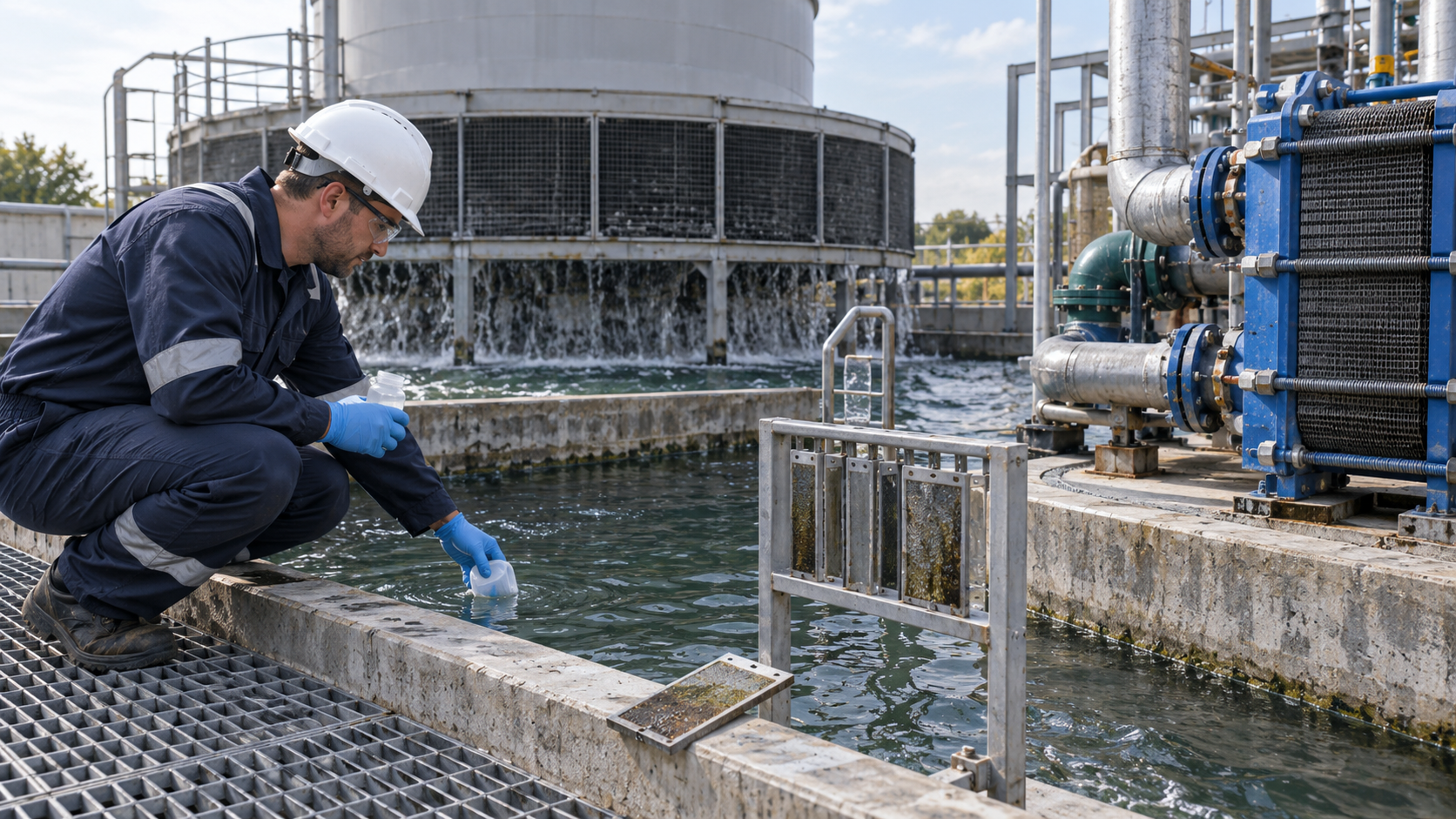
A sample taken from circulating water describes the organisms and conditions present in that sample at that point in the loop. It does not automatically describe the population attached to a heat-transfer surface, inside a strainer, under a deposit, or in a low-flow branch. A cooling tower can contain both suspended, planktonic cells and attached, sessile communities. Biofilm structure, deposits, and local hydraulics can change how a treatment reaches organisms; CDC likewise identifies sediment, biofilm, temperature, water age, and disinfectant residual as factors affecting Legionella growth in cooling towers.
That distinction matters when the symptom is local recurrence. If a basin sample improves but an exchanger pressure drop, slime on a coupon, or recurring deposit remains, the sample and the symptom may not be measuring the same compartment. Conversely, a high count in one bottle may reflect timing, sample handling, or a temporary upset rather than a persistent surface problem. The useful question is not simply “Which biocide is strongest?” It is “What does the current evidence represent, where is control failing, and what observation would distinguish the likely causes?”
Studies of pilot cooling towers have observed that surface colonization does not necessarily follow the growth pattern measured in batch tests. The study design, coupon material, operating conditions, organisms, and biocide exposure all bound those results; they do not create a universal dose or contact-time rule. They do reinforce why a planktonic assay and a biofilm or surface observation should not be treated as interchangeable proof.
Map the recurrence before changing chemistry
Make a simple location map before you change a product family. Mark the makeup entry, basin or sump, return, heat exchangers, strainers, side-stream filters, chemical injection points, low-flow branches, dead legs, and the location where the problem is visible. Add operating state: normal load, intermittent operation, restart, shutdown, cleaning, and any recent water-source or process change. A map often reveals that a sample is being collected upstream of the suspected location, after dilution, or at a time that misses the intermittent treatment cycle.
Choose sample type to match the question. A bulk-water sample may support a planktonic indicator or water-chemistry test. A surface coupon, swab, deposit, or biofilm monitor may be more relevant when the concern is attached material. Sediment can carry organisms and organic demand, but mixing it into a water sample changes what that sample represents. When product-efficacy claims are being evaluated, use a method designed for the claimed organism and exposure state; EPA’s cooling-tower guidance is specifically framed around planktonic Legionella pneumophila, not a blanket demonstration of control over every sessile biofilm.
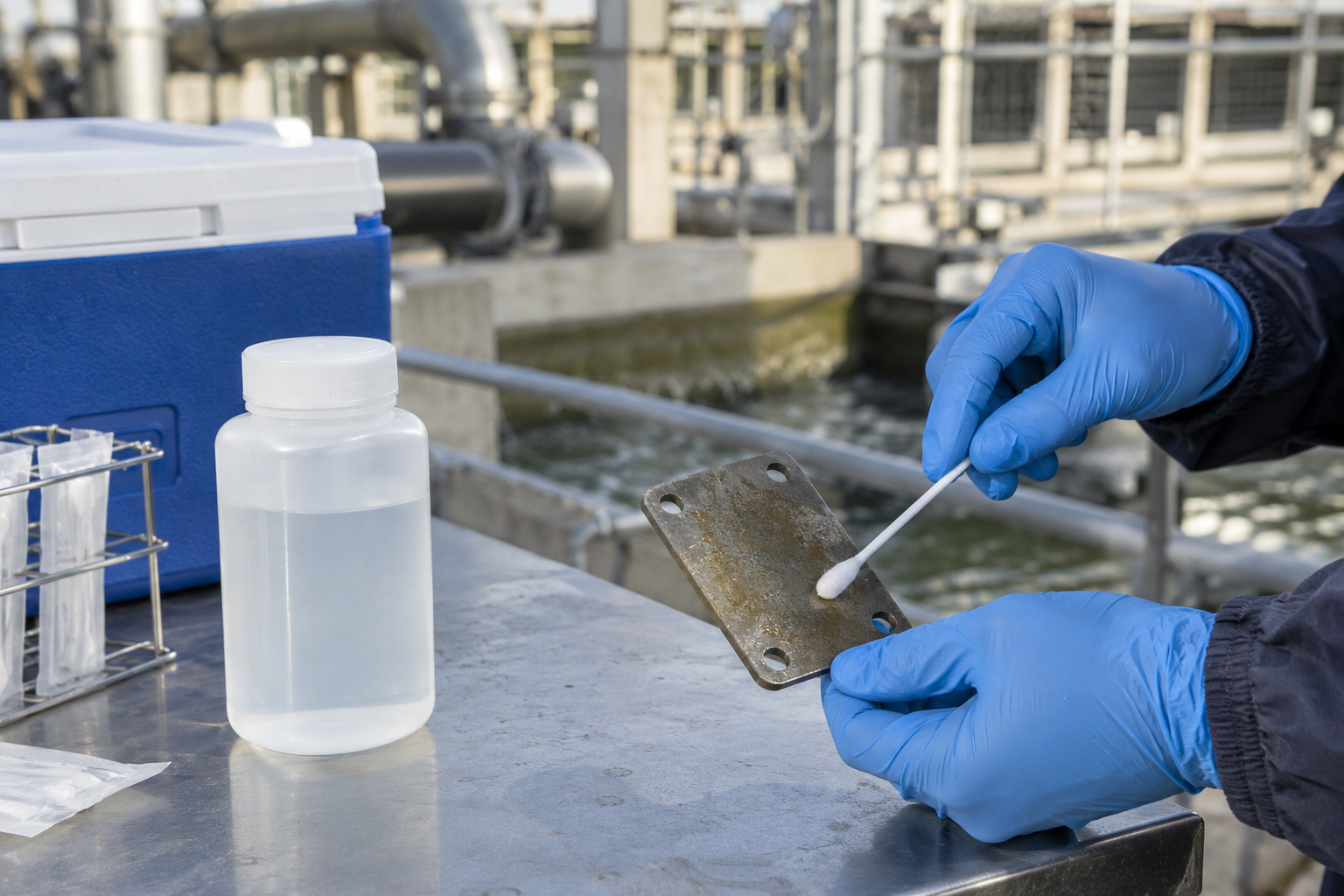
Record the sampling point, sample material, time, operating condition, treatment timing, neutralizer used where required by the method, storage, and laboratory method. If intermittent dosing is used, a sample collected immediately after a slug can look very different from a sample collected before the next feed. Ecolab’s published sampling advice also notes that sample timing matters and that a surface biofilm swab may be needed for a surface-associated question. Follow the laboratory and product-method instructions rather than improvising neutralization or handling.
Compare biocide families against the actual control problem
Oxidizing and non-oxidizing are useful screening categories, not a substitute for an organism-specific label or a treatment program. Oxidizing disinfectants are commonly monitored through an appropriate residual or related control method; CDC recommends a measurable residual through the day for oxidizing disinfectants in its cooling-tower module, while noting that pH control depends on disinfectant type and manufacturer directions. A non-oxidizing product may use a product-specific concentration and contact-time direction. Those differences do not establish that one class is universally better for biofilm, corrosion control, or a given material.
For a recurring surface signal, compare candidate routes under representative water and the location that matters. Consider whether an oxidant is being consumed by organics, ammonia, reduced species, or deposits before it reaches the target. Consider whether the site can distribute a non-oxidizing treatment through the required loop and respect its label contact conditions. Confirm effects on corrosion inhibitors, scale-control chemistry, elastomers, metals, downstream treatment, and discharge requirements. Check the exact approved use, destination, and product directions; regulatory authorization is product- and jurisdiction-specific.
| Observed pattern | What it may indicate | Next check before changing family |
|---|---|---|
| Bulk-water indicator remains high | Water-phase population, feed interruption, high demand, or poor distribution may be contributing. | Repeat a correctly timed sample; check feed records, residual or method-specific control, water demand, flow, and injection distribution. |
| Bulk-water result is low but a surface problem persists | The sample may not represent attached growth, deposits, or the local hydraulic zone. | Inspect and sample the affected surface or coupon using a suitable method; evaluate deposits and cleaning needs. |
| Only one location repeatedly returns | A branch, dead leg, stagnant pocket, material, deposit, or local mixing issue may be limiting contact. | Compare adjacent locations and operating states; inspect flow path, residence, and physical access. |
| Results change with dosing schedule | Sampling may be capturing different points in an intermittent exposure cycle. | Standardize pre- and post-treatment timing and preserve the method's neutralization and handling requirements. |
Check demand, distribution, contact, and materials
Before comparing product families, write down the water factors that can change exposure: pH, temperature, oxidant demand, ammonia or other reactive constituents, organic loading, solids, conductivity or source shifts, and the existing inhibitor program. These are not a universal predictor; they are inputs for deciding whether the water and the trial are representative. If the makeup source, process leak, load, or blowdown pattern changed, compare the current water against the operating baseline before blaming product chemistry.
Map where the treatment enters, how the loop circulates, and where the target surface sits in relation to the injection point. A nominal feed rate cannot prove that the active chemistry reached a stagnant branch or deposit. Record actual feed timing, circulation state, operating load, and any side-stream treatment. If a system is fouled, evaluate safe physical cleaning and deposit removal under the site's procedures; a biocide feed alone does not replace cleaning when the label or maintenance plan calls for it.
Contact strategy must come from the exact product directions and site constraints. Do not import another product's contact time, oxidant residual, pH range, or use pattern into a new matrix. In the EU, an updated 2026 Union authorization illustrates how specific authorized uses, instructions, and risk measures can be; it is not a global direction for every biocide. Check the market's current authority and exact formulation, and use the site's water-management program for public-health obligations.
Material compatibility also needs a system view. Review wetted metals, tower materials, seals, elastomers, coatings, and downstream membranes or biological treatment where relevant. If oxidizing and non-oxidizing agents, corrosion inhibitors, biodispersants, or cleaners are used in the same program, list the order and first-contact locations. A compatibility screen should represent the actual water and contact sequence; a clear beaker is not a universal compatibility certificate.
Build a verification plan that can answer the next question
Set a baseline before the adjustment. Keep a fixed sample map, method, sample timing, operating condition, and record sheet. Track the same bulk-water and surface indicators over time where the method permits. Pair microbiology with observations that matter to operation: visible deposits, heat-transfer approach or pressure drop, flow, strainer condition, cleaning history, corrosion observations, and treatment feed records. The signal is useful only when the method and operating state are comparable.
For a laboratory screen, use the site's water or a justified representative matrix, the target organism or community required by the question, the actual product directions, and the exposure condition being evaluated. Distinguish a planktonic efficacy test from a biofilm/sessile simulated-use test. UK HSE guidance describes separate evidence expectations for planktonic organisms and for sessile bacteria or biofilm claims; the test must match the claim and use condition. This does not mean every site must run a regulatory efficacy test before adjusting an operating program. It means that a test cannot support more than the organisms, surfaces, water, contact, and conditions it actually represents.
Compare one change at a time where safe and operationally practical. If the problem is local, change or verify access and circulation before concluding that the active family failed. If it is water-wide, check demand, feed, and timing. If both planktonic and surface indicators persist, review cleaning, incoming load, contact, and chemistry with the site's water-treatment professional. The acceptance endpoint should state what will be measured, where, when, with which method, and what operating change would trigger a different route.

For a technical discussion, the most useful inputs are the loop drawing or sample map, water analyses, product names and label directions, current feed schedule, treatment history, materials, symptom location, and the method used for each microbial result. The biocide and algicide category lists current product identity routes, and the benzalkonium chloride page identifies one catalog route without establishing its suitability or efficacy for a site. The cooling-water application page provides broader program context. The BKC shipment video documents a shipment context only; it does not show biofilm testing or prove efficacy. Share the conditions through the technical inquiry route.
For the public-health and product-use context, consult the CDC's cooling-tower water-management module, EPA's planktonic Legionella efficacy guidance, the UK HSE's biocidal-product efficacy guidance, and the pilot-scale cooling-tower biofilm study. Each source is bounded by its jurisdiction, test method, organism, and study conditions.
Cooling-water biofilm and biocide verification FAQs
Why can biofilm return when the cooling-water bacteria count is low?
A bulk-water test mainly describes organisms in that sample and at that sampling time. It may not represent organisms attached to a heat exchanger, coupon, deposit, or low-flow branch. Compare the water result with an appropriate surface observation or sample, then check timing, circulation, cleaning, and treatment contact.
Should I change from an oxidizing to a non-oxidizing biocide when biofilm returns?
Not from recurrence alone. First verify the sample method, water demand, feed records, contact path, label directions, materials, and whether the affected surface was cleaned or sampled. Then compare candidate families using a representative method that matches the target organism and exposure condition.
Can a planktonic Legionella test prove biofilm control?
No. A method designed for planktonic organisms evaluates organisms suspended in the test water under its stated conditions. It does not automatically demonstrate control of attached cells or an established biofilm. Use a surface or simulated-use method when the decision concerns sessile growth.
Where should I sample when fouling repeatedly appears in one exchanger?
Use the site's sampling plan and a qualified laboratory to compare the affected surface or a representative coupon with nearby bulk-water points. Record flow state, location, deposit condition, and treatment timing. Follow method-specific collection, neutralization, transport, and safety instructions.
What information is needed to compare a biocide route?
Share the system layout and materials, source and circulating-water analyses, pH and operating temperature, symptom location, sampling method and timing, current treatment sequence, feed records, and the exact product directions and destination market. These inputs support a site-specific discussion rather than a universal dose recommendation.
Bring the sample map and operating history
Tell us where recurrence occurs, what the water and surface samples represent, which products and directions are in use, and how the loop operates. That makes the next product-family or verification discussion more useful.
Discuss your cooling-water conditions