
Pitch & Stickies: Paper Machine Deposit Control
TL;DR Paper machine deposits come from two different sources and need two different answers. Pitch is natural wood resin released when virgin fibre is pulped; stickies are adhesive contaminants — pressure-sensitive adhesive, hot melts, thermoplastic inks and wax — that arrive with recycled fibre such as OCC. Identify which one you have before you dose anything, because the four control routes (passivate with talc or bentonite, disperse, fixate onto the fibre, or detackify enzymatically) each fail on the wrong deposit. Start by sampling the deposit, not by ordering a drum.
Pitch and stickies are not the same problem
Both show up as a brown, tacky, sheet-marking deposit, and both get called "pitch" in the mill. They have different origins, so they respond to different chemistry.
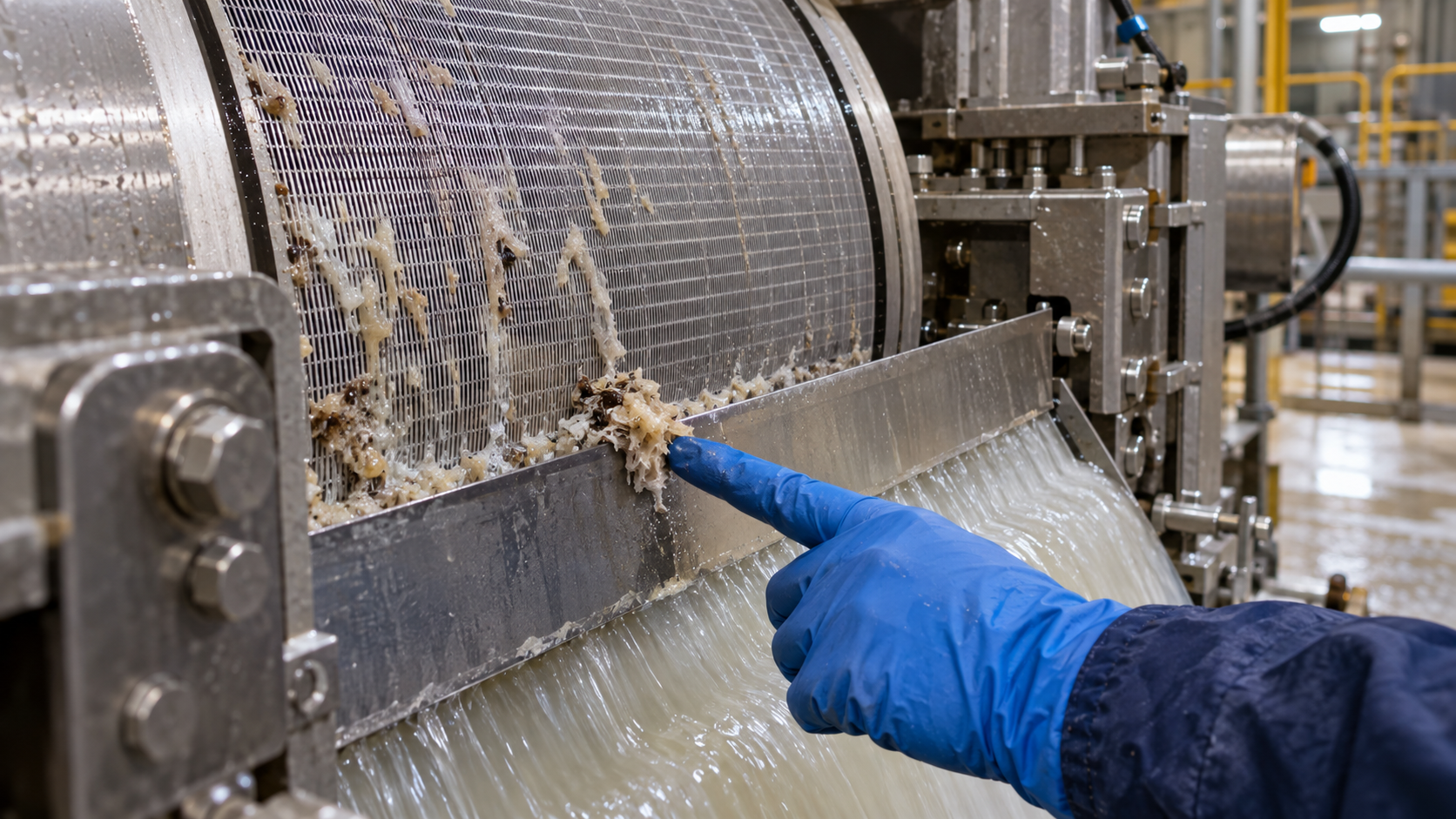
Pitch is the mill's own wood chemistry: natural resin (extractives) liberated from the wood during pulping, which enters the water circuit as a colloid and drops out where conditions change. Stickies are contamination that came in with the furnish — the adhesives from labels, tapes, envelope glue, book bindings and coatings that survive repulping of ONP (old newspaper), OCC (old corrugated containers) and MOW (mixed office waste).
| Pitch | Stickies | |
|---|---|---|
| Source | Wood resin from virgin pulp | Adhesives in recycled fibre (ONP, OCC, MOW) |
| Chemistry | Fatty and resin acids, esters, sterols | Pressure-sensitive adhesive, hot melts, thermoplastic ink, wax |
| Wax content | None | Common — mostly from wax-coated OCC |
| Typical form | Colloidal, drops out on change of pH/temperature/charge | Macro-stickies (screenable) and micro-stickies (not screenable) |
| Worst season / condition | Fresh wood, warm circuits, closed loops | Poor OCC grades, hot dryer section |
| First lever | Passivate or disperse the colloid | Remove at screening/cleaning, then passivate what is left |
Where the deposit sits tells you what it is
Before any lab work, the location is already evidence. Deposits are not random — each part of the machine selects for a particular material.
| Where you find it | What you see | Most likely cause |
|---|---|---|
| Forming wire / fabric | Gummy build-up, drainage falling off | Colloidal pitch or micro-stickies fixing onto the fabric |
| Press felts | Felt filling, water removal dropping, wet streaks | Stickies plus fines — often with wax from OCC |
| Dryer cans and hoods | Tacky film, sheet sticking, web tears | Thermoplastic material softening at dryer temperature |
| The sheet itself | Translucent spots, holes, dirt specks | Macro-stickies passing the screens |
| Whitewater chests, headbox walls | Slimy film, sour smell, sloughing lumps | Microbiological — a biocide problem, not a pitch problem |
| Hard white or grey crust on pipework | Scale, fizzes with acid | Calcium carbonate scale — no dispersant for stickies will touch it |
The last two rows are the ones that waste money. A slime deposit and a scale deposit both look like "a deposit problem" on a shift report, and both are routinely treated with a stickies product that cannot work on them.
Confirm the deposit before you dose it
Three cheap tests separate the four families, and they can be done with what a mill lab already has:
- Acid drop. Fizzes on dilute acid → carbonate scale. Stop; this is a scale and hardness question, not deposit control.
- Ash / burn. Burns away leaving little residue → organic (pitch, stickies, biological). Leaves substantial ash → mineral, or an organic deposit already loaded with filler and talc.
- Solvent. Softens or dissolves in a hydrocarbon or alcohol solvent → resinous/adhesive. Slimy, stringy, and smells sour instead → microbiological.
If the answer matters commercially, send the sample out for FTIR — it will separate wood extractives from synthetic adhesive polymer and identify wax, which decides whether the fix is upstream (furnish and screening) or in the wet end.
One useful reference point: colloidal pitch in a pulp suspension normally runs in the range of about 5–70 ppm by volume at 1% fibre consistency. If a deposit is worsening but the colloidal load is at the bottom of that range, the driver is usually a destabilising condition — a temperature or pH swing, a charge upset, a closed-up water loop — rather than more resin.
The four ways to control a deposit
| Route | Mechanism | Typical chemistry | Choose it when |
|---|---|---|---|
| Passivation / detackification | Mineral coats the tacky particle and kills its tack | Talc, bentonite, smectite | Tack is the problem and the material cannot be removed upstream |
| Dispersion | Keeps resin/adhesive finely divided so it leaves with the water | Anionic or nonionic aqueous dispersants | Colloidal pitch, and the loop is open enough to carry it out |
| Fixation | Cationic polymer attaches the colloid to fibre so it leaves in the sheet | PolyDADMAC, polyamine | Closed loop with nowhere to send the water; retention is under control |
| Enzymatic | Hydrolyses ester groups so the resin loses its tack | Lipase/esterase systems | Ester-rich wood pitch, and the system tolerates the temperature/pH window |
Dispersion and fixation pull in opposite directions. One sends the material out with the water, the other sends it out with the sheet. Running both hard at once is a common and expensive mistake — the fixative precipitates the dispersant, and you pay for two products to cancel each other. Pick the route that matches how open your water loop is.
What the talc numbers actually say
Talc has been the benchmark mineral for pitch control for decades, and the field evidence for why is unusually direct: deposits taken from mills running talc are found to contain up to 40% talc. That is the affinity working — the mineral is going where the tacky material is.
Two things follow from that, and they point in opposite directions:
- It works on tack. Talc adsorbs onto the deposit surface and detackifies it. Coating stickies with talc also raises their specific gravity, and that is what makes them removable mechanically — reported forward-cleaner removal rises from close to zero to over 50% once the particles are talc-loaded. Passivation and mechanical removal are the same programme, not alternatives.
- It is a bulk additive. Talc dosing is measured in kilograms per air-dry tonne — a documented mill case ran 4.50 kg/adt of talc against 450 g/adt of a concentrated liquid product for comparable duty, a 1:10 ratio. All of that mineral ends up in the sheet or the loop. On grades where ash is specified, or where the loop is already loaded, that is a real constraint.
And note the timing: talc added after a deposit has already formed only reaches the surface of it. It detackifies what is there; it does not clean the machine. Passivation is a preventive dose, not a rescue.
A diagnosis-to-fix sequence that works
The step mills skip is the fourth one. Chemistry is the cheapest lever to reach for and the most expensive one to run permanently against a source you could have removed.
Cut the source before you buy chemistry
- Furnish grade. Wax-coated OCC is the single biggest wax source. A grade change often costs less per tonne of paper than the deposit programme it makes necessary.
- Screening and cleaning. Slotted screens take out macro-stickies; forward cleaners take out anything dense — which is exactly why talc passivation and cleaning reinforce each other.
- Deinking and flotation. Flotation removes hydrophobic material, and stickies are hydrophobic.
- Broke handling. Coated broke returns adhesives and binders to the wet end in concentrated slugs.
- Water loop closure. Every step towards a closed loop concentrates dissolved and colloidal material. If you have closed the loop recently and deposits started, that is your cause.
Common mistakes
- Dosing before identifying. A dispersant against carbonate scale, or a stickies product against microbiological slime, is money spent on the wrong deposit.
- Running dispersant and fixative together. They neutralise each other; choose one based on how open the water loop is.
- Overdosing cationic fixative. Push it too far and the stock charge reverses, which wrecks retention and sizing at the same time. Fixation is a charge intervention — see wet-end additive order and compatibility.
- Treating talc as a cure. It passivates going forward; it does not remove an established deposit.
- Ignoring temperature steps. Colloidal pitch drops out where the stock cools or where shear changes. Fix the discontinuity and the deposit often stops without more chemistry.
- Confusing foam with deposit. Entrained air carries hydrophobic material to surfaces; a defoamer sometimes solves what looks like a pitch problem.
Key takeaways
- Pitch is yours, stickies came in with the furnish. The distinction decides whether the fix is in the wet end or upstream.
- Location is free diagnosis. Wire, felts, dryer cans and whitewater chests each select for different material.
- Three lab tests — acid, ash, solvent — separate scale, mineral, resin and slime before you spend anything.
- Dispersion and fixation are alternatives, chosen by how closed your water loop is. Never both at full dose.
- Talc works by detackifying and by adding density, which is why passivation and forward cleaning belong in the same programme.
Watch

Frequently asked questions
What is the difference between pitch and stickies in papermaking?
Pitch is natural wood resin — fatty and resin acids, esters and sterols — released from the wood during pulping of virgin fibre, and it enters the water circuit as a colloid. Stickies are adhesive contaminants that arrive with recycled fibre such as OCC, ONP and mixed office waste: pressure-sensitive adhesives, hot melts, thermoplastic inks and wax. They look similar as a deposit but have different sources, so pitch is usually controlled in the wet end while stickies are best reduced upstream at screening, cleaning and furnish selection first.
How do I identify what a paper machine deposit is made of?
Start with location — the forming wire and press felts collect colloidal pitch and micro-stickies, dryer cans collect thermoplastic material, and whitewater chests collect microbiological slime. Then run three cheap tests: dilute acid (fizzing means carbonate scale), ashing (little residue means organic), and a solvent test (softening means resin or adhesive; stringy and sour means biological). Send the sample for FTIR when the answer has to be certain, because it separates wood extractives from synthetic adhesive polymer and identifies wax.
Does talc actually work for stickies and pitch control?
Yes, and the field evidence is direct: deposits sampled from mills running talc are found to contain up to 40% talc, which shows how strongly it attaches to tacky material. Talc works two ways — it adsorbs onto the particle and detackifies it, and it raises the particle's specific gravity so that forward cleaners can remove it, with reported removal rising from close to zero to over 50%. The limits are that it is a bulk additive dosed in kilograms per air-dry tonne, and that talc added after a deposit has already formed only reaches its surface.
Should I use a dispersant or a fixative for deposit control?
It depends on how closed your water loop is, and you should not run both at full dose. A dispersant keeps the resin finely divided so it leaves with the water, which only helps if the loop is open enough to carry it away. A cationic fixative such as PolyDADMAC or polyamine attaches the colloid to the fibre so it leaves in the sheet, which suits a closed loop. Used together they precipitate each other, and overdosed fixative reverses the stock charge and damages retention and sizing.
Does VCYCLETECH supply paper machine deposit control chemicals?
Request current grade documents, available sample options and the lot-documentation terms for your intended application and destination. Discuss a product inquiry.
About the manufacturer
VCYCLETECH is a China-based manufacturer of water treatment and process chemicals — paper chemicals, surfactants, biocides, coagulants and flocculants, phosphonates and dispersants — ISO 9001 / 14001 / 45001 certified, with current COA information on request and OEM/ODM service. See our quality & certifications.
References
- A Novel Synthetic Adsorbent for Pitch Control — TAPPI Paper 360
- Troubleshooting Guide for Paper Chemistry — NC State (Hubbe)
- Paper recycling — Wikipedia
- Talc — Wikipedia
Related: Wet-end additive order · Retention aids · Deinking agents · Paper chemical procurement specs · Paper chemicals