
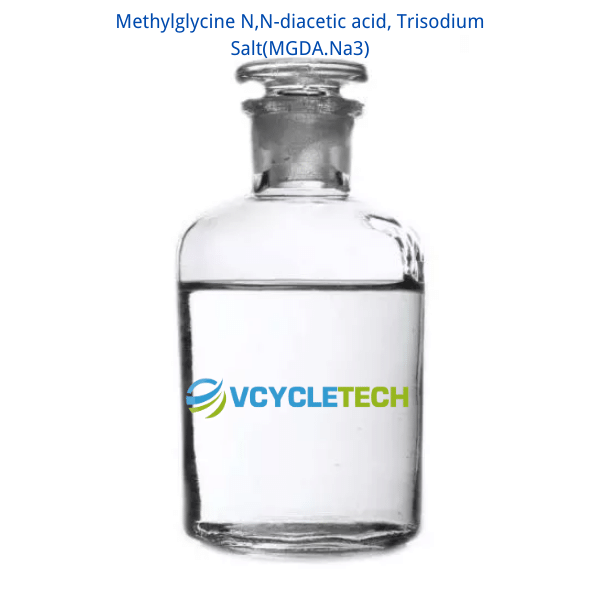
MGDA vs GLDA: Which Biodegradable Chelant?
TL;DR Choose MGDA when the formulation is strongly alkaline (pH above ~11) or strongly acidic, and when you want the higher calcium binding constant (~7.0 vs ~5.9) and faster biodegradation (>80% in 28 days vs >60%). Choose GLDA when you run neutral to mildly alkaline (pH 5–9) and want bio-based content, since GLDA is made from glutamic acid. Both replace EDTA, which binds calcium far harder (log K ≈ 10.6) but is poorly biodegradable and increasingly restricted.
Why either, instead of EDTA
EDTA is the strongest common chelant and the reason it is being replaced: it binds metals so well that it persists, remobilising heavy metals in receiving water and passing through treatment plants largely intact. MGDA and GLDA trade some binding strength for ready biodegradability. The background on that shift is in our guide to biodegradable chelating agents — this page is the head-to-head between the two.
Binding strength
The calcium binding constant is the honest measure of how much chelant you will need. MGDA sits near log K ≈ 7.0 and GLDA near 5.9, against EDTA at ≈ 10.6. Two consequences: MGDA does more per kilogram than GLDA, and both need a higher dose than EDTA for the same job. If a switch from EDTA looks like a straight swap on cost per kg, it is being costed wrong.
pH window — the deciding factor
This is usually what settles it. GLDA performs best from neutral to mildly alkaline, roughly pH 5–9. MGDA stays stable above pH 11, which is why it dominates alkaline cleaners and high-pH industrial systems. MGDA's most acidic carboxyl group has a pKa near 1.5–1.6, so it also holds up in acidic treatment fluids where GLDA is weaker. MGDA therefore covers a wider formulation range; GLDA is the specialist in the middle.
Biodegradation and origin
MGDA biodegrades >80% in 28 days; GLDA >60% — both count as readily biodegradable, MGDA more completely. The counterweight is feedstock: GLDA is made from glutamic acid and carries genuine bio-based content, which matters where the claim being made is renewable-origin rather than end-of-life. If the driver is an eco-label about renewable carbon, GLDA answers it; if the driver is degradation performance, MGDA does.
Scale removal
In comparative scale-removal work the order runs MGDA > GLDA > DTPA > HEDP, so where the job is dissolving existing deposit rather than threshold inhibition, MGDA leads. Note this is removal: for threshold scale inhibition at a few ppm, a phosphonate or a green polymer such as PASP or PESA is the cheaper tool — see PESA vs PASP. Chelants and antiscalants solve different problems.
How to choose
- pH > 11 alkaline cleaner or high-pH system → MGDA·Na3.
- Acidic treatment fluid → MGDA (low pKa holds up).
- Neutral to mildly alkaline, pH 5–9 → GLDA·Na4.
- Bio-based content required by the claim → GLDA.
- Maximum chelation per kg, fastest degradation → MGDA.
MGDA vs GLDA at a glance
| Property | MGDA | GLDA | EDTA (reference) |
|---|---|---|---|
| Ca binding constant (log K) | ≈ 7.0 | ≈ 5.9 | ≈ 10.6 |
| Biodegradation (28 d) | > 80% | > 60% | Poor |
| Best pH window | Stable > 11; also acidic | 5–9 | Wide |
| Feedstock | Synthetic | Glutamic acid (bio-based) | Synthetic |
| Scale removal rank | Highest of the two | Second | Strong but persistent |
| Typical use | Alkaline & acidic cleaners, I&I | Neutral eco-formulations | Being phased down |
Watch

Frequently asked questions
What is the difference between MGDA and GLDA?
MGDA has a higher calcium binding constant (log K ≈ 7.0 versus 5.9), biodegrades faster (>80% versus >60% in 28 days) and stays stable above pH 11 and in acidic fluids. GLDA works best from pH 5 to 9 and is made from glutamic acid, so it carries bio-based content. MGDA covers the wider pH range.
Is MGDA or GLDA a better EDTA replacement?
Both are readily biodegradable EDTA replacements, and neither binds calcium as hard as EDTA (log K ≈ 10.6), so both need a higher dose. MGDA suits high-pH and acidic formulations and gives more chelation per kilogram; GLDA suits neutral to mildly alkaline formulations and bio-based claims. Choose on formulation pH first.
Which is more biodegradable, MGDA or GLDA?
MGDA biodegrades more than 80% in 28 days and GLDA more than 60%, so both qualify as readily biodegradable and MGDA degrades more completely. GLDA counters with renewable feedstock: it is produced from glutamic acid, so it carries bio-based content that MGDA does not.
Can MGDA or GLDA replace a scale inhibitor?
Not economically. Chelants bind metal ions stoichiometrically and are best at dissolving existing scale, where the order is MGDA > GLDA > DTPA > HEDP. Threshold scale inhibition at a few ppm is a different job, better served by a phosphonate or a green polymer such as PASP or PESA at far lower dose.
Does VCYCLETECH supply MGDA and GLDA?
VCYCLETECH lists MGDA and GLDA chelating agents. Share your application, target grade, quantity, packaging and destination to request current TDS/SDS, a representative COA and sample options. Agree lot-documentation terms before ordering.
About the manufacturer
VCYCLETECH is a China-based manufacturer of water treatment chemicals — phosphonates and their salts, green antiscalants, biodegradable chelants, dispersants, biocides, coagulants and defoamers — ISO 9001 / 14001 / 45001 certified, with current COA information on request and OEM/ODM service. See our quality & certifications.
References
- Chelation — Wikipedia
- EDTA — Wikipedia
- Stability constants of complexes — Wikipedia
- Biodegradable Chelating Agents for CaSO4 Scale Removal — ACS Omega
Related: MGDA·Na3 · GLDA·Na4 · Biodegradable chelating agents · EDTMPA guide · PESA vs PASP