
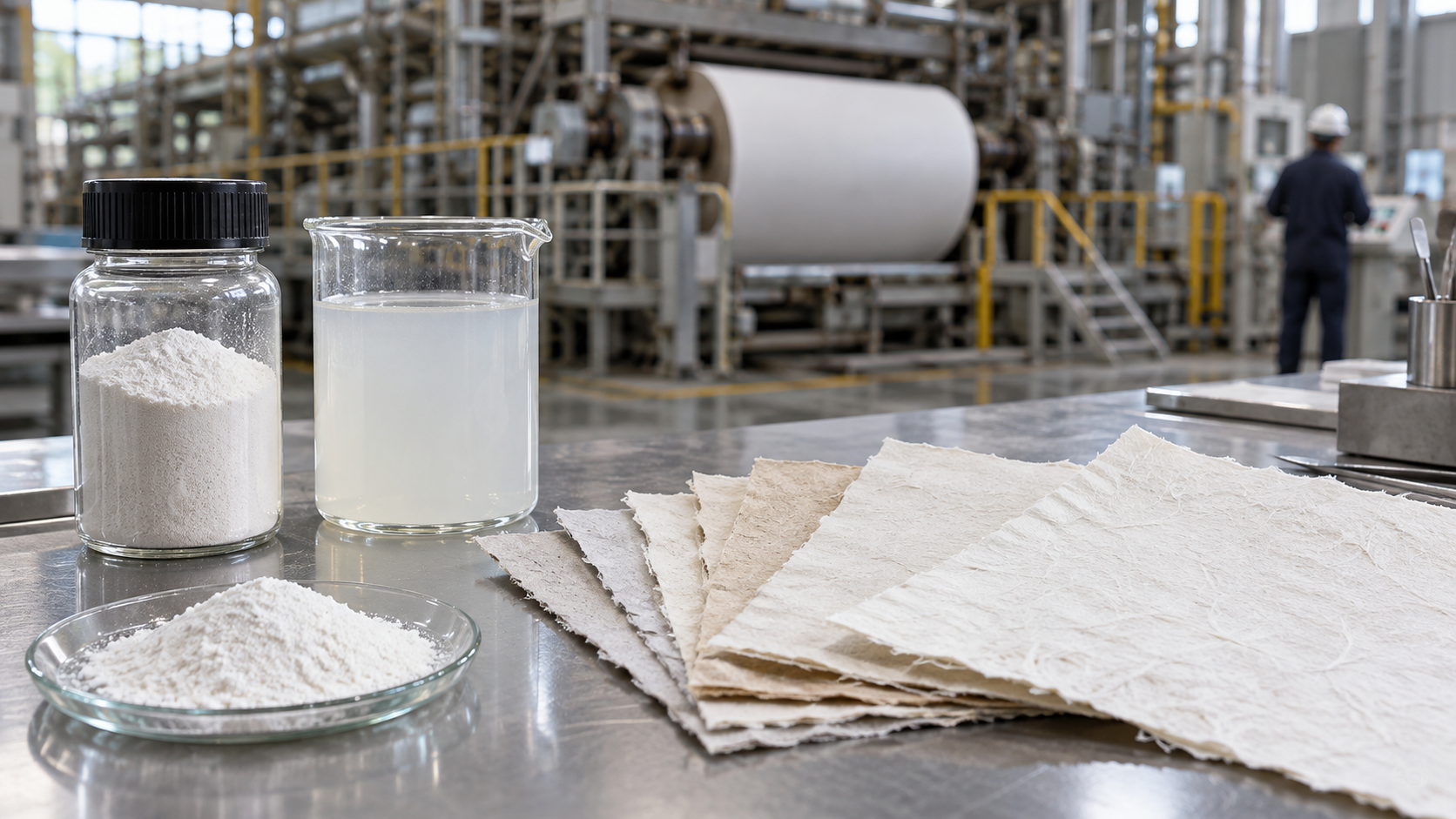
Dry Strength Agents: Selection, Dosage & Troubleshooting
TL;DR Dry strength agents raise the strength of dry paper by anchoring onto the fibres and multiplying fibre-to-fibre hydrogen bonding — they enlarge the contact area between fibres rather than forming a water-resistant crosslink. The two mainstream families are cationic starch and polyacrylamide (cationic or amphoteric). At the same dosage amphoteric PAM generally outperforms cationic starch, and the gain is largest on recycled fibre: at 0.5% on oven-dried pulp, reported breaking-length gains are about +25% on virgin hardwood but around +80% on OCC.
How dry strength agents work
Paper gets its dry strength from hydrogen bonds between fibres. A dry strength agent anchors onto the fibre surface, increases the number of bonding sites available as the sheet forms and dries, and enlarges the contact area between fibres. More bonds over more area means higher tensile, burst and stiffness.
What it does not do is survive water. The bonds are reversible, so a dry-strength sheet gives up its strength when soaked — that is the job of a PAE wet strength resin instead. If you are choosing between the two families, start with dry strength vs wet strength.
The options, compared
| Cationic starch | Cationic PAM | Amphoteric PAM | CMC | |
|---|---|---|---|---|
| Charge | Cationic | Cationic | Both (cationic + anionic) | Anionic |
| Relative strength gain | Moderate | Good | Highest of the four | Moderate |
| Needs cooking | Yes — gelatinisation | No | No | No |
| On recycled / OCC | Fair | Good | Best | Fair |
| Cost per unit strength | Lowest raw cost | Medium | Medium-high | Medium |
| Watch out for | Cook quality; moderate ceiling | Charge demand / overdose | Charge balance | Needs a cationic partner |
Ordinary cationic starch gives only a moderate lift and must be gelatinised before use; more highly substituted starches perform better. Synthetic cationic polyacrylamides — typically acrylamide copolymerised with a cationic monomer such as DADMAC — avoid the cook and give more strength per kilo. Amphoteric PAM carries both charges and, at equal dosage, has been reported to beat cationic starch as a dry strength additive, especially on secondary fibres.
Dosage — and why recycled fibre gains most
Dry strength agents are dosed as a percentage of oven-dried pulp, typically in the 0.3–0.8% range, with 0.5% a common working point. The published figure worth knowing: at 0.5% on o.d. pulp, amphoteric PAM improved breaking length by about 25% on virgin hardwood kraft — and by about 80% on OCC (old corrugated containers).
That gap is the commercial story. Recycled fibre has been dried and re-slushed repeatedly; its fibres are stiffer, more hornified and bond poorly on their own. A dry strength agent is therefore worth far more on a recycled furnish than on virgin stock — which is exactly where most packaging mills operate.
Where to add it
Dry strength agents are wet-end additives. Add after the main dilution and with enough mixing and contact time before the headbox for the polymer to adsorb. Watch the interaction with your retention aids and overall charge balance — a cationic dry strength agent consumes cationic demand, so it can shift retention behaviour. Anionic CMC normally needs a cationic partner to retain.
Troubleshooting
| Symptom | Likely cause | What to try |
|---|---|---|
| Little or no strength gain | Polymer not adsorbing — charge demand too high | Measure charge/conductivity; add fixative; try amphoteric grade |
| Gain then loss as dose rises | Overdose — charge reversal, re-dispersion | Back off dose; run a dose-response curve |
| Retention drops after adding | Charge balance disturbed | Re-tune retention programme; move addition point |
| Starch underperforming | Incomplete gelatinisation | Check cook temperature/time; consider higher substitution or PAM |
| Strength good, sheet stiff/brittle | Over-bonded | Trim dose; rebalance refining |
| Foam in the wet end | Polymer + surfactant carry-over | Dose a defoamer |
Choosing in one line
- Virgin furnish, cost-driven → cationic starch (make sure the cook is right).
- Recycled / OCC packaging grades → amphoteric or cationic PAM; this is where the big gains are.
- High charge demand / dirty system → amphoteric PAM, or fix the charge first.
- Sheet must survive wetting → that is not a dry strength job; use PAE.
- Surface picking or printability → treat at the size press, see surface sizing.
Watch

Frequently asked questions
What is a dry strength agent in papermaking?
A dry strength agent is a wet-end additive — usually cationic starch or a polyacrylamide — that increases the tensile, burst and stiffness of dry paper. It anchors onto the fibres, increases the number of hydrogen bonds formed as the sheet dries and enlarges the fibre-to-fibre contact area. The bonds are reversible, so it does not make paper water-resistant.
What is the dosage of dry strength agent?
Dry strength agents are dosed as a percentage of oven-dried pulp, typically 0.3–0.8%, with 0.5% a common working point. Published trials at 0.5% on o.d. pulp report breaking-length gains of roughly 25% on virgin hardwood kraft and about 80% on OCC. Always run a dose-response curve, because overdosing can reverse the charge and lose the gain.
Which is better, cationic starch or polyacrylamide?
At equal dosage, amphoteric polyacrylamide generally outperforms cationic starch as a dry strength additive, and the advantage is largest on secondary (recycled) fibres. Cationic starch has the lower raw material cost but needs gelatinising before use and has a lower performance ceiling. Many mills use both, with starch as the base and PAM for the top-up.
Why do recycled fibres need more dry strength aid?
Recycled fibre has been dried and re-slushed repeatedly, so it is hornified — stiffer, less conformable and much poorer at forming fibre-to-fibre bonds. A dry strength agent restores much of that lost bonding, which is why the reported gain on OCC (around 80% at 0.5% dosage) is far larger than on virgin hardwood (around 25%).
Does VCYCLETECH supply dry strength agents?
Request current grade documents, available sample options and the lot-documentation terms for your intended application and destination. Discuss a product inquiry.
About the manufacturer
VCYCLETECH is a China-based manufacturer of water treatment and process chemicals — paper chemicals, surfactants, biocides, coagulants and flocculants, phosphonates and dispersants — ISO 9001 / 14001 / 45001 certified, with current COA information on request and OEM/ODM service. See our quality & certifications.
References
- Papermaking — Wikipedia
- Polyacrylamide — Wikipedia
- Cationic starch — Wikipedia
- Amphoteric polyacrylamide with cationic starch for paper strength — BioResources
Related: Surface sizing agents · Dry vs wet strength · PAE wet strength agent · Polyacrylamide (PAM) · Retention aids · Paper chemicals