
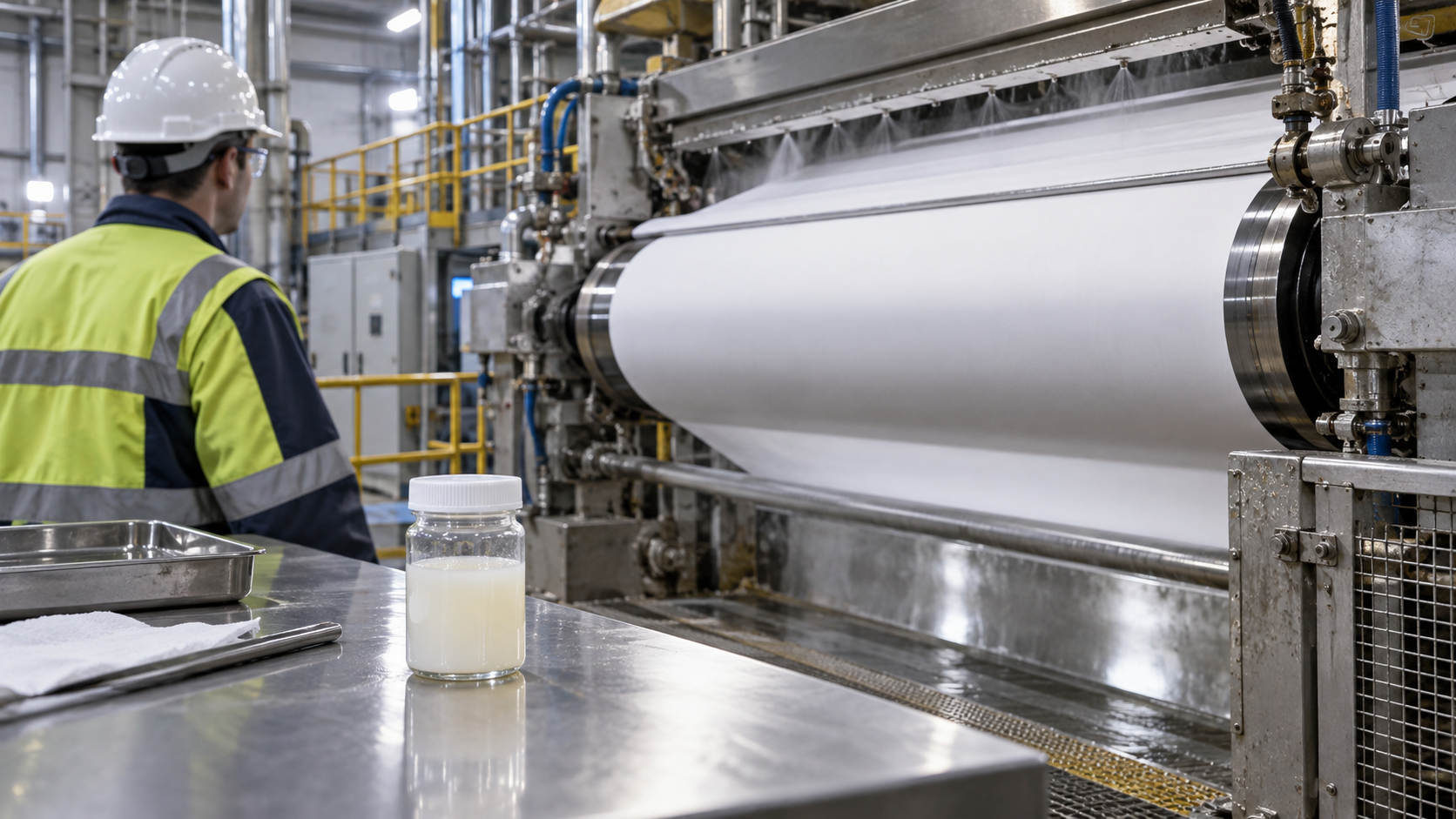
Surface Sizing Agents: The Size Press Guide
TL;DR Surface sizing is applied to the formed, dried sheet at the size press — not to the stock in the wet end. A film of starch plus a synthetic sizing agent (usually a styrene-acrylate emulsion) seals the surface, cutting water absorption and lifting surface strength and printability. It complements internal sizing with AKD, ASA or rosin rather than replacing it: internal sizing controls how the sheet resists liquid throughout its bulk, surface sizing controls what happens at the surface. Typical size-press liquor runs about 5% starch with 0.13–0.20% sizing agent on an active basis.
What surface sizing actually is
Surface sizing happens after the sheet has been formed and dried — the web passes through a size press (or film press) where a starch-based liquor is applied to both sides, then it is dried again. Internal sizing, by contrast, is dosed into the stock at the wet end, where AKD, ASA or rosin anchor onto the fibres before the sheet forms.
The distinction matters commercially: they solve different complaints. If ink feathers, if the surface picks in offset, or if the sheet fluffs and dusts, the answer is usually at the size press. If liquid penetrates the body of the sheet, the answer is internal.
Surface sizing vs internal sizing
These are complements, not alternatives — most graphic and packaging grades run both.
| Surface sizing | Internal sizing | |
|---|---|---|
| Where it is applied | Size press, on the dried web | Wet end, into the stock |
| Typical chemistry | Starch + styrene-acrylate (SAE), SMA, polyurethane | AKD, ASA, rosin |
| Acts on | The sheet surface | The whole sheet body |
| Main gains | Cobb, surface strength, printability, less dusting | Bulk water resistance, penetration control |
| Also raises | Tensile and stiffness (the starch film) | Little effect on surface strength |
| Fixes | Ink feathering, picking, fluffing | Liquid soaking through |
The chemistry you can choose from
- Starch — the carrier and the backbone of the film. Oxidised, enzyme-converted or cationic starch, cooked and diluted to the target solids. On its own it improves surface strength but gives limited water resistance.
- Styrene-acrylate emulsion (SAE) — the workhorse synthetic surface size. Added to the starch liquor, it delivers the hydrophobicity that starch alone cannot.
- SMA (styrene-maleic anhydride) — an anionic option, often chosen where a harder, more solvent-resistant surface is wanted.
- Rosin-modified systems — a starch-based styrene-acrylate emulsion modified with rosin has been reported to cut the Cobb value by a further 46.8% versus the unmodified emulsion.
Formulation and dosage
A representative laboratory size-press liquor is 5% starch by weight plus 0.13–0.20% sizing agent calculated as 100% active substance. Mill formulations vary with grade, size-press type and target Cobb, but the ratio is instructive: the synthetic size is a small fraction of the starch, and small changes in it move the water resistance a long way.
What you should see on the reel
Published trials give a useful sense of the size of the prize. Coating with starch mixed with a styrene-acrylate copolymer brought Cobb 60 down to roughly 31% of the reference, and tensile strength up about 15% compared with the reference formulation. Rosin modification of a starch-based styrene-acrylate emulsion reduced Cobb by a further 46.8%. Treat these as direction and order of magnitude — your furnish, starch and size press decide the actual numbers, so trial before you commit.
Troubleshooting the size press
| Symptom | Likely cause | What to try |
|---|---|---|
| Cobb too high | Too little active size, or poor film formation | Raise sizing agent; check starch cook and solids |
| Picking / surface strength low | Starch film too thin or under-converted | Raise starch solids or pick-up; check conversion |
| Sticking, deposits at the press | Over-dosing, or emulsion destabilised | Cut dose; check liquor pH and shear; check compatibility |
| Streaks / uneven size | Uneven application or rod/roll condition | Inspect applicator, liquor viscosity and temperature |
| Foam in the liquor | Air entrainment, surfactant carry-over | Dose a defoamer; check circulation |
Where it sits in the wet-end and surface programme
Surface sizing is one lever among several. Strength is usually split between a dry strength agent in the wet end and the starch film at the size press; water resistance is split between internal sizing and the surface size; and where the sheet has to survive being wetted outright, a PAE wet strength resin is the tool — see the wet strength guide and dry vs wet strength.
Watch

Frequently asked questions
What is a surface sizing agent?
A surface sizing agent is applied to the already-formed, dried paper web at the size press, normally as part of a starch liquor. It forms a film on the sheet surface that reduces water absorption and improves surface strength, printability and resistance to dusting. It is different from internal sizing, which is dosed into the stock at the wet end.
What is the difference between surface sizing and internal sizing?
Internal sizing (AKD, ASA or rosin) is dosed into the stock before the sheet forms and controls how liquid penetrates the body of the paper. Surface sizing is applied at the size press onto the dried web and controls the surface — Cobb, surface strength, printability and dusting. Most graphic and packaging grades use both, because they fix different complaints.
What chemicals are used for surface sizing?
The base is starch — oxidised, enzyme-converted or cationic — which carries the film and adds surface strength. A synthetic sizing agent is blended in for water resistance, most commonly a styrene-acrylate emulsion (SAE), sometimes SMA (styrene-maleic anhydride) or a polyurethane. Rosin-modified starch/styrene-acrylate systems are used where extra hydrophobicity is needed.
What is the typical surface sizing dosage?
A representative size-press liquor is about 5% starch by weight with 0.13–0.20% sizing agent on a 100% active basis. Actual mill figures depend on grade, size-press type, pick-up and the target Cobb, so the dose should be set by trial — the synthetic size is a small fraction of the starch, and small changes move water resistance significantly.
Does VCYCLETECH supply surface sizing agents?
Request current grade documents, available sample options and the lot-documentation terms for your intended application and destination. Discuss a product inquiry.
About the manufacturer
VCYCLETECH is a China-based manufacturer of water treatment and process chemicals — paper chemicals, surfactants, biocides, coagulants and flocculants, phosphonates and dispersants — ISO 9001 / 14001 / 45001 certified, with current COA information on request and OEM/ODM service. See our quality & certifications.
References
- Sizing — Wikipedia
- Paper machine (size press) — Wikipedia
- Starch — Wikipedia
- Cationic silicone-acrylic latex surface sizing agent — Progress in Organic Coatings
Related: Dry strength agents · Sizing agents (AKD/ASA/rosin) · Wet strength guide · PAE wet strength agent · Paper chemicals