
Direct-to-Chip Cooling Corrosion Control: Tolyltriazole & Yellow-Metal Protection
TL;DR For a direct-to-chip (DTC) liquid-cooling loop, specify an azole such as tolyltriazole (TTA) or benzotriazole (BTA) when copper cold plates, brass fittings or soldered yellow-metal parts need protection. The azole is one ingredient in a finished coolant, not a complete corrosion program: the final glycol/water formulation must also be validated for aluminium, steel, elastomers and the actual operating temperature. VCYCLETECH supplies TTA, BTA and related inhibitor raw materials—not finished PG25 coolant.
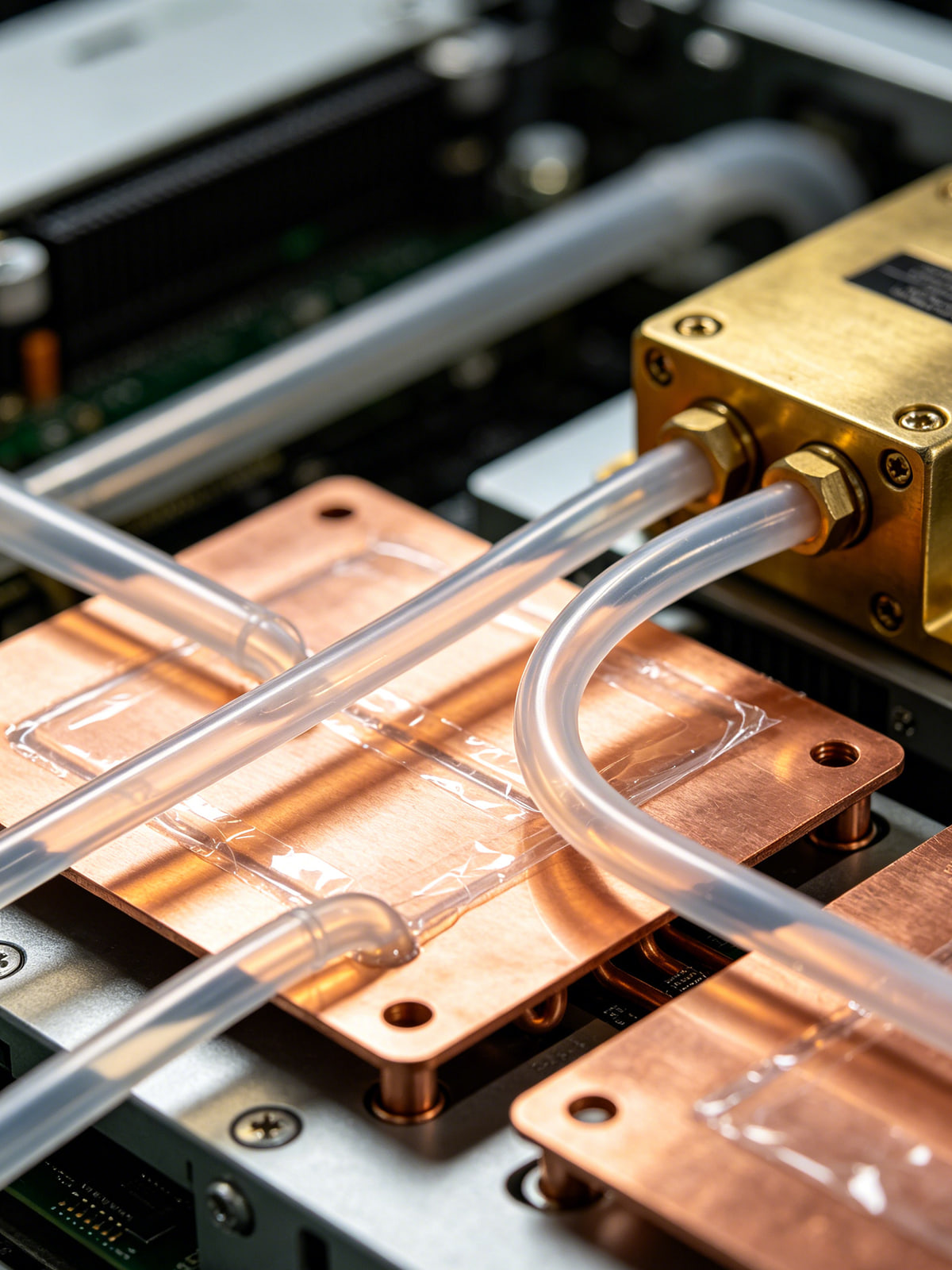
Cover image: AI-assisted conceptual illustration of a direct-to-chip cooling loop; it does not depict a VCYCLETECH installation, customer system or product test.
What protects copper in a DTC cooling loop?
TTA and BTA are azole corrosion inhibitors used to protect copper and other yellow metals. They should be selected as part of a formulation review, not selected by a generic “ppm” number. A DTC secondary loop can combine copper cold plates, brass manifolds, solder, aluminium parts, steel hardware and polymeric seals. Each material, the glycol concentration, the water quality and the service temperature affect the finished fluid’s compatibility.
The Open Compute Project lists PG25 heat-transfer fluid products that use an organic-acid-technology (OAT) package to protect copper, brass, steel, cast iron and aluminium. That is useful direction for formulators: copper protection is necessary, but a yellow-metal inhibitor alone cannot demonstrate whole-loop protection. A 2026 Corrosion Science study also evaluated BTA, TTA and other azoles in glycol heat-transfer fluids and reported that copper can accelerate glycol degradation; validate the inhibitor package against the actual fluid and materials.
TTA vs BTA: a formulation decision, not a universal winner
| Decision point | Tolyltriazole (TTA) | Benzotriazole (BTA) |
|---|---|---|
| Chemistry role | Azole candidate for copper and yellow-metal protection. | Azole candidate for copper and yellow-metal protection. |
| Where to assess it | Cold plates, copper tubing, brass and soldered assemblies. | Cold plates, copper tubing, brass and soldered assemblies. |
| Formulation check | Solubility, reserve chemistry and compatibility in the final glycol/water package. | Solubility, reserve chemistry and compatibility in the final glycol/water package. |
| What it does not replace | Aluminium, steel, seal and glycol-stability validation. | Aluminium, steel, seal and glycol-stability validation. |
Do not describe either azole as an aluminium inhibitor, a finished coolant, or a substitute for a materials-compatibility programme. Ask the formulation supplier to document the test method, coupon materials, temperature, fluid concentration and acceptance criteria before a loop is filled.
Build a mixed-metal corrosion-control specification
| Loop element | Specification question | Evidence to request |
|---|---|---|
| Copper / brass / solder | Is an azole included and stable in the intended heat-transfer fluid? | Finished-fluid corrosion and appearance results on representative yellow metals. |
| Aluminium / steel | Does the complete package protect each alloy at service temperature? | Compatibility data for the exact metallurgy—not an azole-only statement. |
| Glycol / water | Which glycol concentration and water-quality limits are controlled? | Formulation specification, incoming-water limits and maintenance instructions. |
| Seals / plastics | Are the wetted polymers compatible with the fluid and temperature? | Supplier compatibility confirmation or application-specific test plan. |
A practical selection workflow
Start with a bill of materials, not a product name. Then set the glycol concentration and water specification; select an azole candidate for yellow-metal protection; validate the finished package against the loop’s full metallurgy; and define maintenance tests with the equipment or coolant supplier. A plant should not add raw TTA or BTA directly to an operating DTC loop without a formulated-fluid and compatibility decision.
Procurement checklist for azole inhibitor raw material
- Confirm the active identity and grade required by the finished-fluid formulation.
- Request a current COA and confirm the lot, assay and applicable handling information.
- State the intended use accurately: formulation component for a closed DTC heat-transfer fluid, not an off-the-shelf coolant.
- Agree acceptance criteria with the formulator for appearance, solubility and finished-fluid compatibility.
- Keep the formulation, test reports and maintenance instructions with the asset record.
For raw-material sourcing, review our corrosion-inhibitor range, tolyltriazole (TTA) and benzotriazole (BTA). For a broader liquid-cooling water programme, see our guides to data-center tower treatment and cooling-water WUE and cycles.
Frequently asked questions
What corrosion inhibitor protects copper in direct-to-chip cooling?
TTA and BTA are azole inhibitors that may be selected to protect copper, brass and other yellow metals in a direct-to-chip cooling formulation. The correct choice and concentration must be validated in the finished glycol/water fluid with the loop’s actual materials and operating conditions.
Is tolyltriazole a finished PG25 coolant?
No. Tolyltriazole is an inhibitor raw material, not a finished propylene-glycol heat-transfer fluid. A PG25-type DTC fluid is a complete, compatibility-tested formulation that may include several inhibitor functions.
How do you protect copper and aluminium together in a coolant?
Use a finished-fluid package validated for both materials. An azole addresses yellow-metal protection; it does not by itself prove aluminium, steel, elastomer or glycol compatibility. Ask for evidence for the complete formulation and representative materials.
What is the difference between TTA and BTA?
Both are azole candidates for copper and yellow-metal protection. Their suitability depends on the formulation, solubility, other additives and performance in the intended glycol/water loop. Compare them in the final formulation rather than treating either as a universal replacement.
Can VCYCLETECH formulate and supply the inhibitor ingredient?
VCYCLETECH supplies TTA, BTA and corrosion-inhibitor raw materials with product documentation and COA support. Share the intended formulation, materials and target market with our team so we can confirm the appropriate product information; we do not represent these raw materials as finished PG25 coolant.
About this guide
VCYCLETECH publishes application and product-information guides for industrial water treatment. This page is not a site-specific coolant specification, water-management plan or regulatory determination. Confirm final selection, legal use and operating controls with the responsible equipment, formulation and compliance teams.
Request product information, a sample & COA →
References
- OCP: SOLUTHERM OAT PG 25 heat-transfer fluid
- Corrosion Science (2026): azole inhibitors in glycol heat-transfer fluids
Related: Corrosion inhibitors · Tolyltriazole (TTA) · Benzotriazole (BTA) · Closed-loop corrosion inhibitor · Data-center cooling-tower treatment · Data-center WUE and cycles