
Cooling Tower Water Treatment for AI Data Centers
TL;DR An AI data-center cooling tower needs three chemistries running together, not one product: a scale-and-corrosion inhibitor (a phosphonate–polymer blend, or all-organic where phosphorus discharge is capped) to protect steel and copper as evaporation concentrates the water; a dispersant to keep silt and iron in suspension for blowdown; and an oxidizing plus non-oxidizing biocide pair to hold Legionella and biofilm. Skip any one and you pay for it — just 0.5 mm of scale cuts heat transfer up to 25%, and uninhibited steel corrodes at 2–5 mpy. Match the program to your water, then prove it on corrosion coupons and a dip-slide, not on the drum label.
Why a data-center tower is a hard water problem
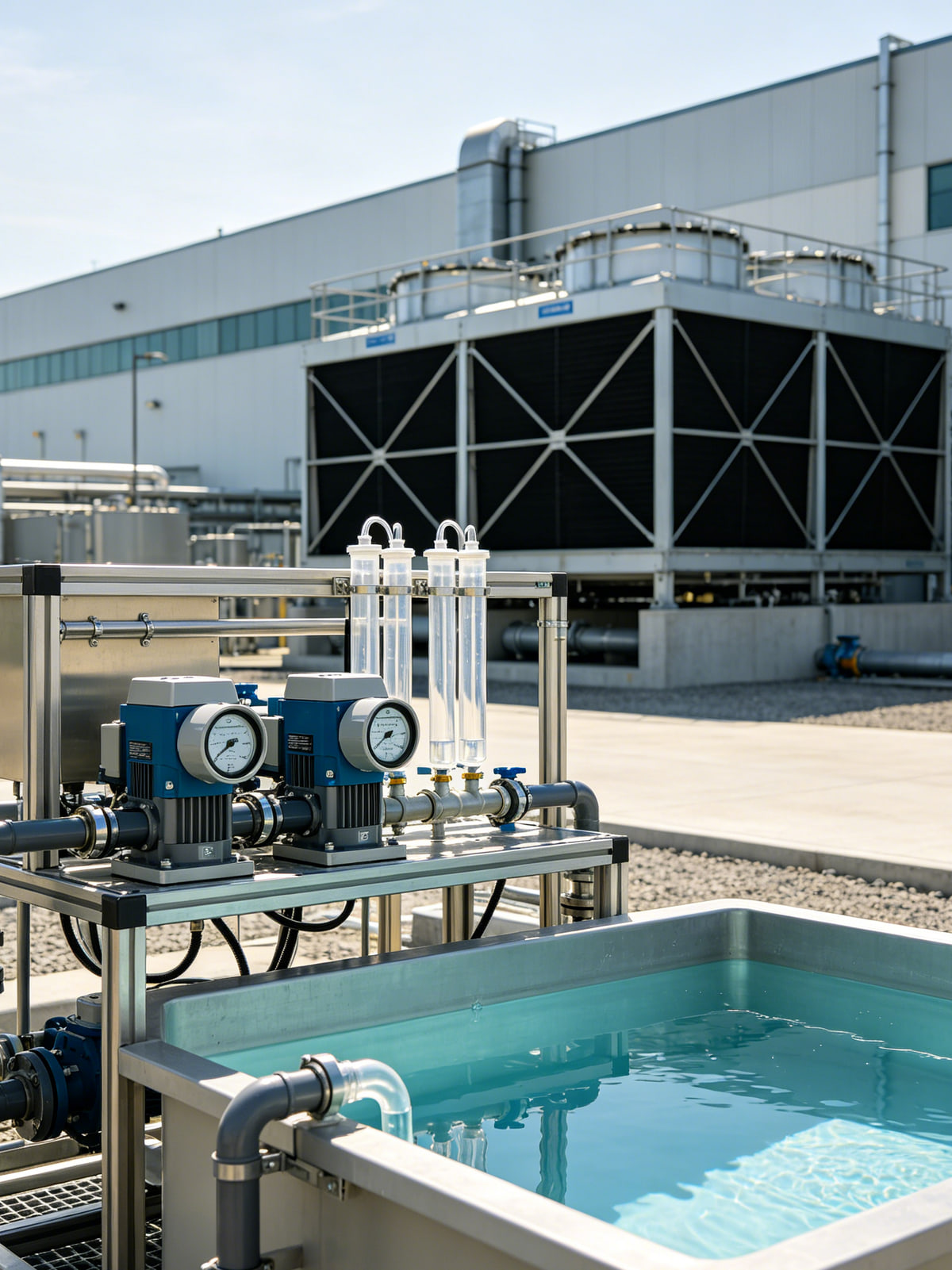
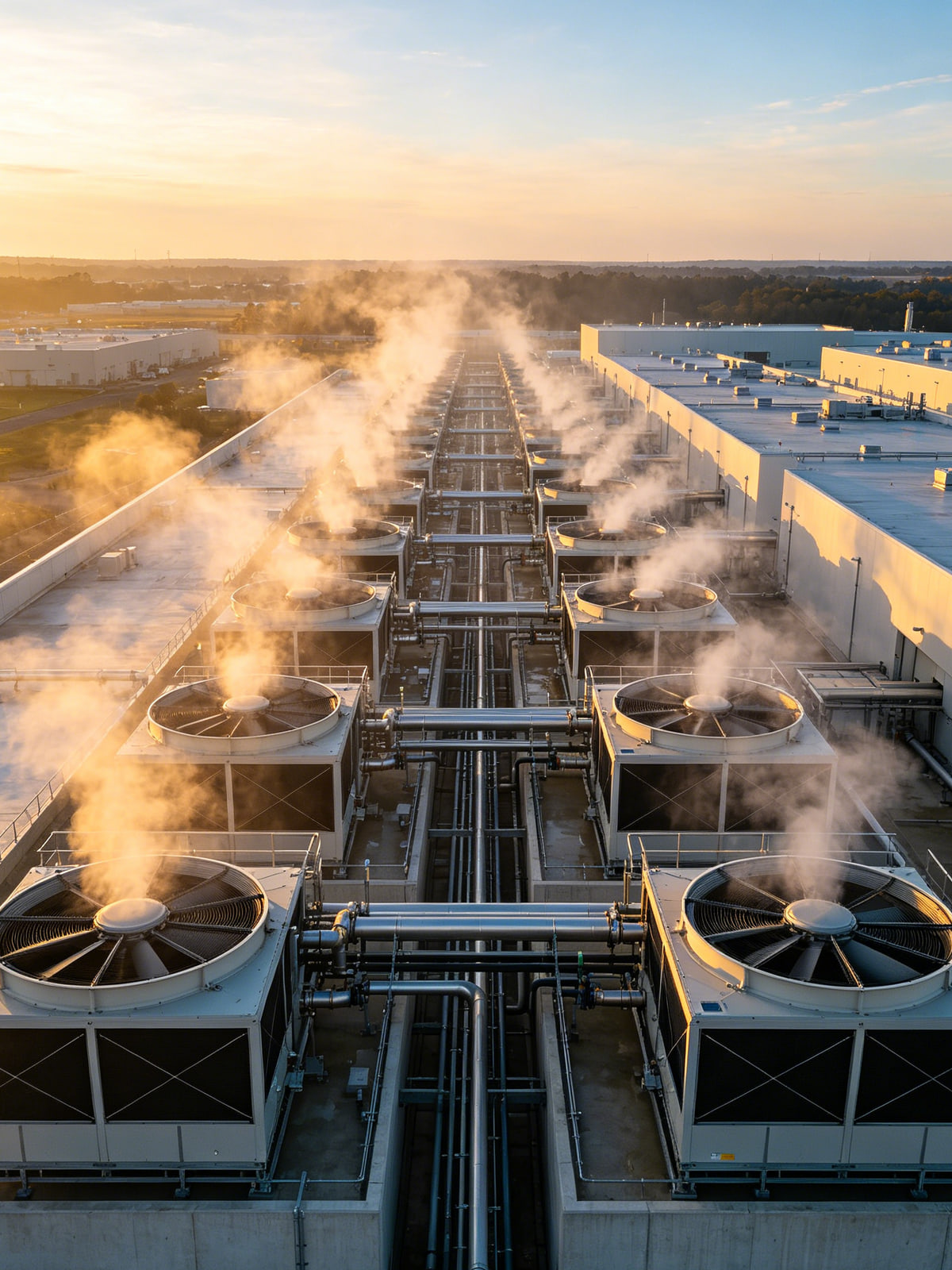
A hyperscale or AI data center rejects a large, steady heat load, and an evaporative cooling tower does it by boiling off pure water and leaving everything dissolved behind. Every pass concentrates the makeup water a little more, so the same tower is simultaneously trying to scale, corrode and grow biology — often on mixed metals (mild steel, copper, stainless) in one loop. The reliability stakes are high: a fouled condenser or a Legionella event is not a maintenance footnote when it sits under the compute.
The answer is not a single "cooling tower chemical" but a small program of three jobs done at once. Get the balance right and you can also run the tower at higher cycles of concentration, which is where the water savings live — the subject of our companion guide on cooling-water WUE and cycles.
Scale: what forms, and what it costs
As the water concentrates, calcium carbonate (and, depending on the makeup, calcium phosphate, silica or iron) drops out on the hottest surfaces — exactly where you least want it, on the heat exchanger. Scale is a thermal insulator: as little as 0.5 mm cuts heat-transfer efficiency by up to 25%, which the plant pays for in extra compressor or fan energy long before anyone notices a deposit.
Scaling tendency is predicted by indices such as the Langelier Saturation Index (LSI); the control is a threshold phosphonate (ATMP, HEDP, PBTC) that holds calcium in solution far below stoichiometric dose, backed by a polycarboxylic dispersant that keeps the fine particles from settling so they leave with blowdown. The two are usually blended into one scale-and-corrosion product.
Corrosion: protecting steel and copper together
Concentrated, oxygenated, warm water is aggressive. Left untreated, mild steel in an open recirculating system corrodes at roughly 2–5 mils per year (mpy) or worse, pitting through tube walls and shedding iron oxide that itself fouls the system. A proper inhibitor program brings that down into the "very good" band. The industry yardstick is the corrosion coupon, read against Association of Water Technologies (AWT) bands after a ~90-day exposure:
| Corrosion rate (open recirculating) | Mild / carbon steel | Copper alloys |
|---|---|---|
| Excellent | 0.0–0.2 mpy | 0.0–0.1 mpy |
| Very good | 0.2–0.5 mpy | 0.1–0.25 mpy |
| Good | 0.5–0.8 mpy | 0.25–0.35 mpy |
| Moderate | 0.8–1.0 mpy | 0.35–0.5 mpy |
Steel is protected by the inhibitor blend (phosphonate/polymer, plus zinc or an all-organic package). Copper and brass are a separate chemistry: an azole film-former — most often tolyltriazole (TTA) — bonds to the yellow metal and is essential wherever there are copper condenser tubes. The same azole chemistry protects the copper cold-plate loops in direct-to-chip cooling, which we cover separately.
Legionella and biofilm: the biocide pair
A warm, aerated, nutrient-bearing tower is an ideal home for bacteria, and an evaporative tower can aerosolise them in drift — which is why Legionella control is a named regulatory duty, not an optional extra. Biocides are the fastest-growing category of data-center water chemicals for exactly this reason.
Effective control uses two biocide classes together:
- An oxidizing biocide — chlorine, bromine or chlorine dioxide — as the continuous kill, held at a low free residual (typically ~0.2–0.5 ppm free chlorine in service), with a periodic higher dose. Under ASHRAE 188 practice an EPA-registered oxidizer is fed roughly 3–7 times a week to hold a residual for at least an hour; shock/disinfection uses ~5–10 ppm free chlorine.
- A non-oxidizing biocide — DBNPA, glutaraldehyde or isothiazolinone — rotated in to penetrate biofilm and prevent resistance, where oxidizers alone fall short.
The discipline that regulators now expect is a written Water Management Plan (ASHRAE 188) with defined control limits and records. From 2026, US rules also tighten limits on quaternary-ammonium biocides and make Legionella risk-management plans mandatory for large facilities — so the program has to be documented, dosed and verified — the oxidizing and non-oxidizing biocides for it are covered in our biocide range.
The three-part program at a glance
One tower, three jobs, dosed and controlled together:
| Component | Job | Typical dose* | Control test |
|---|---|---|---|
| Scale & corrosion inhibitor (phosphonate + polymer, or all-organic) | Hold calcium in solution; passivate steel | ~50–150 ppm product | Corrosion coupons; LSI; inhibitor residual |
| Dispersant (polycarboxylic) | Keep silt/iron suspended for blowdown | blended or ~5–20 ppm | Visual / turbidity; deposit checks |
| Yellow-metal inhibitor (tolyltriazole) | Protect copper/brass | ~1–3 ppm as azole | Copper coupon |
| Oxidizing biocide (Cl₂ / Br / ClO₂) | Continuous microbial kill | ~0.2–0.5 ppm free residual | Free residual; dip-slide |
| Non-oxidizing biocide (DBNPA / glutaraldehyde / isothiazolinone) | Penetrate biofilm; prevent resistance | slug, per label, in rotation | Dip-slide; Legionella test |
*Indicative ranges only — a program is set on your makeup-water analysis, metallurgy and cycles, not from a table.
How to design and verify the program
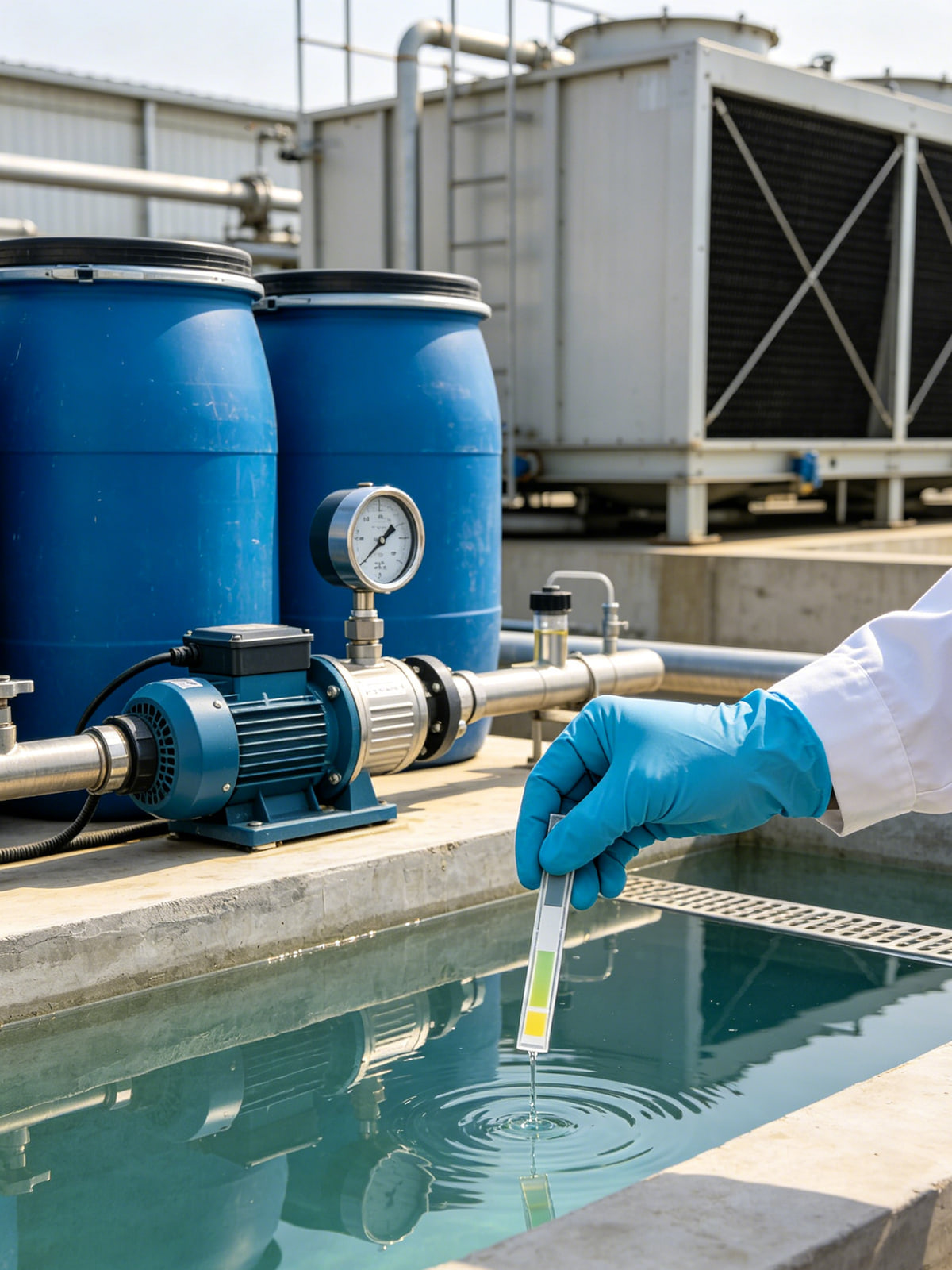
Verification is the part that separates a real program from a drum of chemical. Run corrosion coupons for ~90 days and read them against the AWT bands above; keep a dip-slide log and a periodic Legionella test; and track inhibitor residual and LSI so you can see control drifting before the tower does.
Phosphorus discharge and the non-P option
Traditional programs lean on phosphonate and zinc, but many municipalities now cap phosphorus in blowdown. Where that applies, an all-organic / non-phosphorus program — for example WT-907 non-P scale & corrosion inhibitor — holds scale and corrosion without adding phosphorus to the discharge. It is worth confirming your discharge permit before specifying the inhibitor chemistry, not after.
Key takeaways
- Treat three problems at once — scale, corrosion and microbial control — with one balanced program, not a single product.
- 0.5 mm of scale costs up to 25% of heat transfer, and uninhibited steel runs 2–5 mpy; a good program holds steel under ~0.5 mpy and copper under ~0.25 mpy.
- Protect copper separately with a tolyltriazole azole — steel inhibitors do not cover yellow metal.
- Legionella needs an oxidizing + non-oxidizing biocide pair and a written ASHRAE 188 water management plan, tightening under 2026 US rules.
- Verify on coupons and dip-slides, and check your phosphorus-discharge permit before choosing P vs non-P chemistry.
Watch

Frequently asked questions
What chemicals are used to treat a data center cooling tower?
A cooling-tower program is three chemistries dosed together, not one product. A scale-and-corrosion inhibitor — usually a phosphonate (ATMP, HEDP, PBTC) blended with a polycarboxylic dispersant, or an all-organic package where phosphorus discharge is limited — holds calcium in solution and passivates mild steel. A yellow-metal inhibitor such as tolyltriazole protects copper and brass, which the steel inhibitor does not cover. And an oxidizing biocide (chlorine, bromine or chlorine dioxide) plus a non-oxidizing biocide (DBNPA, glutaraldehyde or isothiazolinone) in rotation control Legionella and biofilm. Doses are set from a makeup-water analysis and confirmed on corrosion coupons and dip-slides.
How do you control Legionella in a cooling tower?
Use two biocide classes together and document it. An oxidizing biocide — chlorine, bromine or chlorine dioxide — provides the continuous kill, typically held around 0.2–0.5 ppm free residual in service and fed several times a week to maintain a residual for at least an hour; shock disinfection uses roughly 5–10 ppm free chlorine. A non-oxidizing biocide is rotated in to penetrate biofilm, where Legionella hides, and to prevent resistance. Underpinning it is a written Water Management Plan to ASHRAE Standard 188 with defined control limits, dip-slide monitoring and periodic Legionella testing. From 2026, US rules make Legionella risk-management plans mandatory for large facilities and tighten quaternary-ammonium biocide limits.
What is an acceptable corrosion rate in cooling water?
The industry reads corrosion coupons after about a 90-day exposure against Association of Water Technologies (AWT) bands. For an open recirculating system, mild/carbon steel is rated Excellent at 0.0–0.2 mils per year (mpy), Very Good at 0.2–0.5, Good at 0.5–0.8 and Moderate at 0.8–1.0 mpy. Copper alloys are held to a tighter scale: Excellent at 0.0–0.1 mpy, Very Good at 0.1–0.25. Untreated steel typically corrodes at 2–5 mpy or worse, so the goal of an inhibitor program is to pull steel into the very-good band (under ~0.5 mpy) and copper under ~0.25 mpy, verified on coupons rather than assumed.
How much does scale reduce cooling efficiency?
A lot, for very little scale. Calcium carbonate scale is a thermal insulator, and as little as 0.5 mm on a heat-transfer surface can cut heat-transfer efficiency by up to 25%. That penalty shows up as higher compressor or fan energy — and higher PUE — long before the deposit is visible, which is why threshold scale inhibitors (phosphonates) and dispersants are dosed continuously rather than only when scaling is obvious. Controlling scale is also what lets a tower run at higher cycles of concentration to save water without fouling the fill.
Can VCYCLETECH supply a complete cooling water treatment program?
Yes. VCYCLETECH manufactures the full cooling-water range — phosphonate and all-organic scale-and-corrosion inhibitors, polycarboxylic dispersants, yellow-metal inhibitors such as tolyltriazole, and oxidizing and non-oxidizing biocides — factory-direct with a Certificate of Analysis on every batch, ISO 9001/14001/45001 certified. We can build a program around your makeup-water analysis, cycles target and metallurgy, including non-phosphorus options where discharge is limited, and support the corrosion-coupon and dip-slide verification. Email sales@vcycletech.com for a program recommendation, samples and specifications.
About the manufacturer
VCYCLETECH is a China-based manufacturer of water treatment and process chemicals — coagulants and flocculants, paper chemicals, surfactants, biocides, phosphonates and dispersants — ISO 9001 / 14001 / 45001 certified, with current COA information on request and OEM/ODM service. See our quality & certifications.
References
- Legionella control in cooling towers — US CDC
- Standards for Corrosion Rates — Association of Water Technologies
- Langelier saturation index — Wikipedia
- Cooling tower — Wikipedia
Related: Scale & corrosion inhibitors · Data-center cooling water: WUE & cycles · Tolyltriazole · WT-907 non-P inhibitor · Cooling tower treatment guide · Biocides · Cooling water treatment