
BKC vs Glutaraldehyde vs Isothiazolinone Biocides
TL;DR BKC, glutaraldehyde and isothiazolinone are the three leading non-oxidizing biocides for cooling water and industrial systems — glutaraldehyde kills by cross-linking cell proteins (best at high pH, needs long contact), isothiazolinone works at very low dose over a wide pH range (but is deactivated by sulfide/reducers), and BKC is a cationic-surfactant biocide that also strips biofilm and slime (but foams and is weakened by hardness). The best programs alternate two of them to prevent resistance.
Why non-oxidizing biocides
Oxidizing biocides (chlorine, bromine, TCCA) are the first line of microbial control, but they are consumed by system load and lose punch at high pH. Non-oxidizing biocides are dosed as periodic slugs to reach biofilm, sulfate-reducing bacteria (SRB) and fungi that oxidizers miss. The three most used are glutaraldehyde, isothiazolinone (CMIT/MIT) and benzalkonium chloride (BKC). They differ in mechanism, pH window, contact time, foaming and cost.
Glutaraldehyde — protein cross-linker
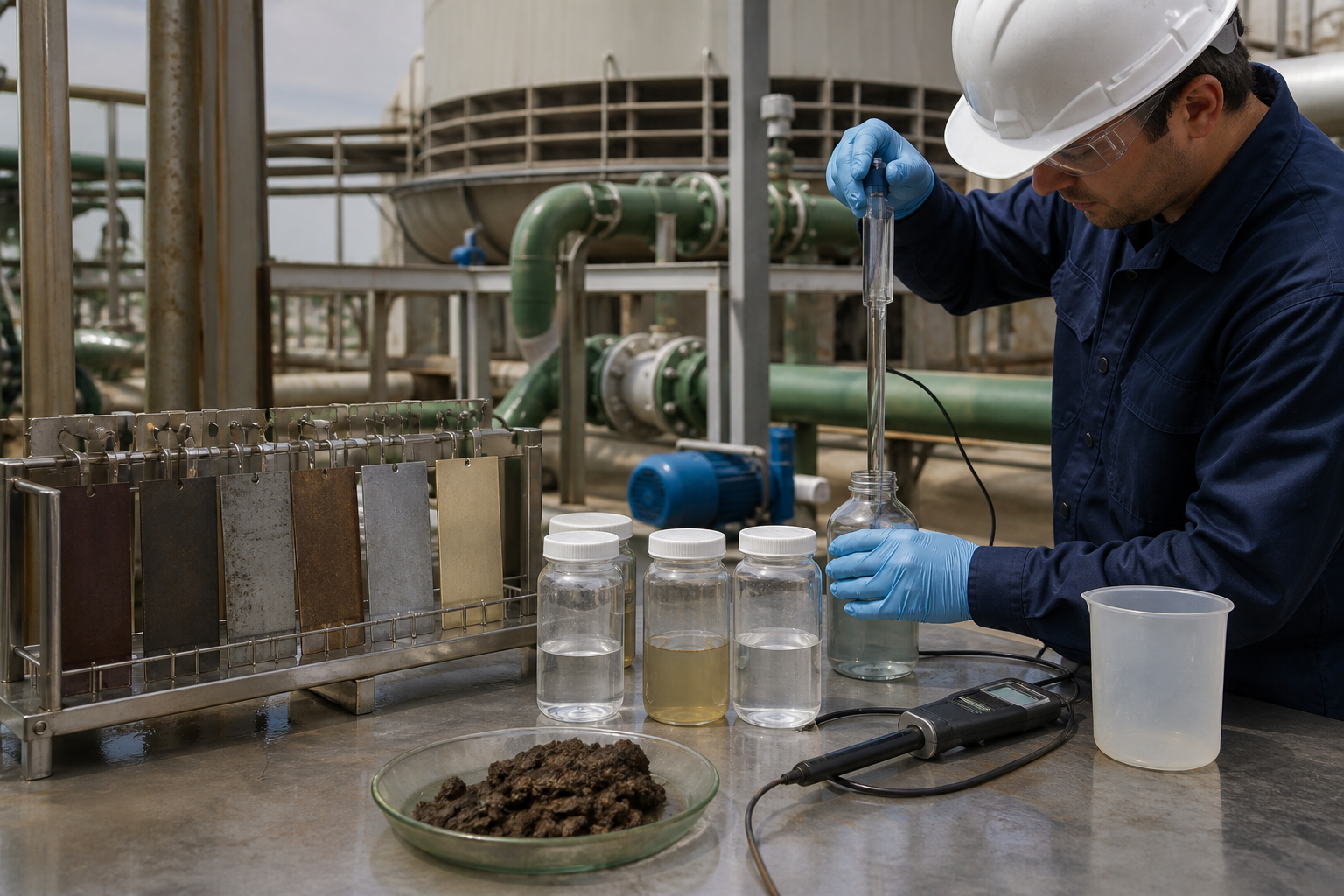
Glutaraldehyde kills by cross-linking amino groups in cell-wall and enzyme proteins, an irreversible action effective against bacteria, SRB, fungi and biofilm. It is more active at high pH (well suited to alkaline circulating water), does not foam, and is compatible with most treatment chemistry — but its kill is slower, needing longer contact (e.g., ~100 ppm active for several hours) and it can be deactivated by ammonia. A common, economical workhorse.
Isothiazolinone — low-dose, broad-spectrum
Isothiazolinone (a CMIT/MIT blend) is a broad-spectrum biocide effective at very low concentrations, stable across a wide pH range and especially good against algae and SRB. It is cost-effective per treatment because of the low dose, but it acts more slowly and can be deactivated by hydrogen sulfide and strong reducing agents (e.g., bisulfite oxygen scavengers), so dosing must be timed away from those.
BKC — biocide plus biofilm stripper
BKC is a quaternary-ammonium cationic surfactant: its positive charge binds the negatively charged cell membrane, disrupts it and lyses the cell. Because it is a surfactant, it also penetrates and strips biofilm/slime and has good algae control — a useful dual action. The trade-offs: it foams (a concern in open towers), and its performance drops in very hard water or high anionic load (it is consumed by anionic species). Often paired with glutaraldehyde for a stronger strip-and-kill.
How to choose (and why to alternate)
- Alkaline system, no foaming allowed, budget duty → glutaraldehyde.
- Lowest dose, wide pH, algae/SRB → isothiazolinone (keep away from sulfide/reducers).
- Biofilm/slime stripping + kill, algae → BKC (watch foam and hardness).
- Best practice: alternate two non-oxidizers (e.g., glutaraldehyde ↔ isothiazolinone) so microbes can't adapt; combine BKC with glutaraldehyde to cut total dose.
BKC vs glutaraldehyde vs isothiazolinone
| Property | BKC (quat) | Glutaraldehyde | Isothiazolinone |
|---|---|---|---|
| Mechanism | Membrane disruption (surfactant) | Protein cross-linking | Enzyme inhibition |
| Dose | Medium–high | Medium (long contact) | Very low |
| pH window | Wide | Best at high pH | Wide |
| Biofilm/slime stripping | Strong (surfactant) | Moderate | Low |
| Foaming | Yes | No | No |
| Deactivated by | Hardness / anionics | Ammonia | Sulfide / reducers |
| Best for | Slime strip + algae | Alkaline systems, SRB | Low-dose broad control |
Watch
Frequently asked questions
What is the difference between oxidizing and non-oxidizing biocides?
Oxidizing biocides (chlorine, bromine, TCCA, chlorine dioxide) kill by oxidation and are the everyday base treatment, but they are consumed by system load and weaken at high pH. Non-oxidizing biocides (glutaraldehyde, isothiazolinone, BKC) are dosed as periodic slugs to penetrate biofilm and kill organisms — like sulfate-reducing bacteria — that oxidizers miss.
Which non-oxidizing biocide works at the lowest dose?
Isothiazolinone (CMIT/MIT) is effective at the lowest concentration and over a wide pH range, making it cost-effective per treatment. Its drawbacks are a slower kill and deactivation by hydrogen sulfide and strong reducing agents, so it should be dosed away from bisulfite oxygen scavengers and sulfide-rich conditions.
When should I use glutaraldehyde instead of BKC?
Use glutaraldehyde in alkaline systems, where foaming must be avoided, and for cost-sensitive SRB/biofilm control — it is non-foaming and more active at high pH but needs longer contact. Use BKC when you also want to strip biofilm and slime and control algae, accepting that it foams and weakens in very hard or high-anionic water. The two are often combined.
Why alternate biocides in cooling water?
Rotating two non-oxidizing biocides with different mechanisms (for example glutaraldehyde and isothiazolinone) prevents microorganisms from adapting or developing tolerance, and covers a broader range of organisms and conditions than a single product used continuously.
Is VCYCLETECH a biocide manufacturer?
Yes. VCYCLETECH supplies benzalkonium chloride (BKC), glutaraldehyde, isothiazolinone (CMIT/MIT), DBNPA, THPS and formulated biocides factory-direct from China, ISO 9001/14001/45001 certified, with current COA information on request, sample availability and OEM/ODM service. Email sales@vcycletech.com.
About the manufacturer
VCYCLETECH is a China-based manufacturer of water treatment chemicals — disinfectants, biocides, coagulants, flocculants, antiscalants, scale & corrosion inhibitors and paper chemicals — ISO 9001 / 14001 / 45001 certified, with current COA information on request and OEM/ODM service. See our quality & certifications.
References
Related: BKC · Glutaraldehyde · Isothiazolinone (CMIT/MIT) · All biocides & algicides · Water-treatment biocides guide · isothiazolinone restrictions & allergen limits