
Anionic vs Cationic vs Nonionic PAM: Differences & Uses
TL;DR Polyacrylamide (PAM) is a high-molecular-weight flocculant that comes in three ionic types: anionic PAM (negatively charged, for positively charged or inorganic suspensions and clarification), cationic PAM (positively charged, for organic solids and sludge dewatering), and nonionic PAM (near-neutral, bridging for acidic or fine suspensions). The right choice depends on the charge of the particles you are removing, the water pH, and whether you are clarifying water or dewatering sludge.
What is polyacrylamide (PAM)?
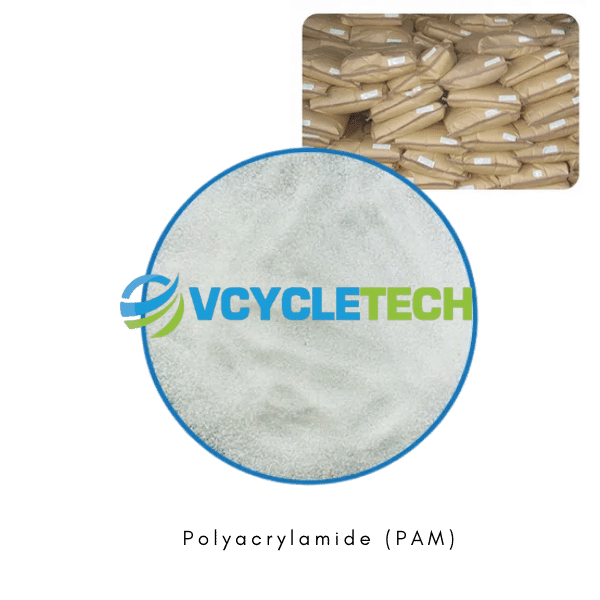
Polyacrylamide (PAM) is a long-chain, very high-molecular-weight water-soluble polymer used as a flocculant: after a coagulant such as PAC neutralizes particle charge, PAM's long chains bridge the micro-flocs into large, dense, fast-settling flocs. It is supplied as a white granular powder (and as emulsions) and is dosed as a dilute 0.1 % solution. PAM is classified by the charge it carries: anionic, cationic or nonionic.

Anionic PAM (APAM)
Anionic PAM carries negatively charged carboxyl groups and is usually the highest molecular weight of the three. It flocculates positively charged and inorganic suspensions — mineral slurries, sand, coal fines, metal hydroxides — through electrical neutralization plus bridging. Main uses: drinking-water and industrial-water clarification, mining and mineral processing, oilfield and settling of inorganic sludge. It is the standard flocculant aid downstream of PAC or alum.

Cationic PAM (CPAM)
Cationic PAM carries positively charged groups, so it grabs negatively charged organic particles — the material in municipal and food/beverage wastewater and biological sludge. Its signature job is sludge dewatering on belt presses, centrifuges and screw presses, plus clarification of organic-rich effluent (dyeing, brewing, paper, food). CPAM charge density is chosen to match the sludge; too little or too much both hurt cake dryness.
Nonionic PAM (NPAM)
Nonionic PAM carries little or no charge and works mainly by adsorption and bridging rather than charge neutralization. It suits acidic or weakly ionic suspensions where a charged polymer would be neutralized, and is used in some mineral, metallurgical and general suspended-solids duties. It is often the choice when the water is acidic.
How to choose: charge first, then MW and dose
Pick the opposite charge to the particle: inorganic/positively charged solids → anionic; organic/negatively charged solids and sludge → cationic; acidic or ambiguous water → nonionic (confirm by jar test). Then match molecular weight (higher MW = bigger floc, faster settling, but higher viscosity) and charge density to the load. Always dose PAM as a fully dissolved dilute solution, added after the coagulant and mixed gently — over-shearing tears the floc apart.
Anionic vs cationic vs nonionic PAM
| Property | Anionic (APAM) | Cationic (CPAM) | Nonionic (NPAM) |
|---|---|---|---|
| Charge | Negative | Positive | Near-neutral |
| Targets particles | Positive / inorganic | Negative / organic | Fine / acidic |
| Molecular weight | Highest | High | Medium–high |
| Main mechanism | Neutralization + bridging | Neutralization + bridging | Bridging / adsorption |
| Signature use | Clarification, mining, sand | Sludge dewatering, organics | Acidic suspensions |
| Best pH | Neutral–alkaline | Wide | Acidic–neutral |
Watch

Frequently asked questions
What is the difference between anionic, cationic and nonionic PAM?
They differ by ionic charge. Anionic PAM is negatively charged and flocculates positively charged or inorganic suspensions (clarification, mining). Cationic PAM is positively charged and captures negatively charged organic solids — its main use is sludge dewatering and organic wastewater. Nonionic PAM is near-neutral and works by bridging, suited to acidic or fine suspensions.
Which PAM is best for sludge dewatering?
Cationic PAM (CPAM) is the standard for dewatering municipal and biological sludge on belt presses, centrifuges and screw presses, because sludge solids are negatively charged. Select the charge density and molecular weight to match the sludge; jar or bench dewatering tests confirm the best grade and dose.
Which PAM should I use for clarifying turbid water?
For clarifying water and settling inorganic or mineral suspensions, anionic PAM (usually the highest molecular weight) is the typical flocculant aid, added after a coagulant such as PAC or alum. If the water is acidic, nonionic PAM may work better. Confirm with a jar test.
How is polyacrylamide dosed?
PAM is prepared as a dilute solution (about 0.1%), dissolved slowly and completely, then added after the coagulant and mixed gently. Typical dose is a fraction of a mg/L to a few mg/L. Over-dosing or over-shearing breaks the floc, so add it at the slow-mix/flocculation stage, not the rapid mix.
Is VCYCLETECH a polyacrylamide manufacturer?
Yes. VCYCLETECH supplies anionic, cationic and nonionic polyacrylamide across a range of molecular weights and charge densities, factory-direct from China, ISO 9001/14001/45001 certified, with current COA information on request, sample availability and OEM/ODM service. Email sales@vcycletech.com.
About the manufacturer
VCYCLETECH is a China-based manufacturer of water treatment chemicals — coagulants, flocculants, antiscalants, scale & corrosion inhibitors, biocides, dispersants and paper chemicals — ISO 9001 / 14001 / 45001 certified, with current COA information on request and OEM/ODM service. See our quality & certifications.
References
Related: Polyacrylamide (PAM) · PAC · PolyDADMAC · All coagulants & flocculants · Jar test procedure