

WASTEWATER · COLOR ROUTE
Post-Biological Effluent Color: Choose the Chemical Route from the Residual
Choose a post-biological color-removal route only after identifying what still carries the color. Compare the same fresh effluent before and after filtration, alongside turbidity, suspended solids, pH, color by the plant’s accepted method, and filtered versus unfiltered COD when relevant. If filtration removes much of the apparent color, improve solids capture or screen coagulation and flocculation. If color remains in the filtered sample, screen a compatible decoloring coagulant and verify whether the response is color removal, COD transfer, or both. In every case, reproduce the downstream settling, flotation or filtration step and score sludge production, carryover and final pH. A visually pale beaker is not proof of discharge compliance or stable plant performance.
Diagnose what carries the residual color
“Color after biology” is an observation, not yet a chemical-selection diagnosis. The residual may include dissolved dye or degradation products, very fine colloids, biological solids, natural organic matter, process additives, metal complexes or a combination. The best first split is operational: compare a well-mixed secondary-effluent sample with the same sample after the plant’s defined filtration step. Keep the method, cell path, dilution, pH condition and reporting basis consistent so the comparison means something.
If the filtered sample loses much of the apparent color and turbidity, solids capture may be the dominant task. If the color remains while turbidity drops, the test needs a route that interacts with dissolved or sub-filter color bodies. Filtered and unfiltered COD can show whether an apparent color response follows a change in measured organic load, but neither one identifies the compounds or their toxicity. The EPA textile-industry manual uses ADMI color to compare wastewater states and emphasizes source reduction as well as end-of-pipe control; any local permit or reuse specification still governs the plant’s accepted method and limit.1

Record the biological process state with the sample. Sludge carryover, an unsettled secondary clarifier, a recent dye or production campaign, pH drift and a change in hydraulic loading can all change the residual. Collect enough fresh sample to run the full comparison from one batch, while documenting any holding time. If the secondary process is unstable, treat that cause in parallel; a tertiary chemical screen should not hide a failing solids-separation step.
Compare routes by mechanism and separator
Research reviews consistently treat color removal as a portfolio of physical, chemical, electrochemical and biological mechanisms rather than one universal reagent. Coagulation-flocculation remains a practical route for many colored industrial wastewaters, but performance depends on dye or color-body chemistry, pH, other dissolved material and the solids-separation step.23 For a buyer, the useful choice is therefore between testable routes, not between supplier labels.
| Observed residual | First route to screen | What would support it | What can still make it fail |
|---|---|---|---|
| Color falls with filtration; turbidity/TSS also fall | Improve solids capture; screen metal-salt coagulation and a polymer aid if needed | Better floc formation, lower apparent color and stable clarification/flotation/filtration | Fragile floc, carryover, excess sludge or no change in filtered color |
| Filtered color persists; turbidity is already low | Screen a decoloring coagulant against the actual color body | Repeatable filtered-color response with acceptable COD, pH and downstream separation | Color rebound, dissolved residual, poor pH window or transferred load to sludge |
| Both dissolved color and fine solids remain | Staged decoloring/coagulation followed by flocculation and separation | Each addition has a defined job and the sequence improves the combined scorecard | Overlapping additions, order sensitivity, high sludge or a narrow operating window |
| Color persists after a sound chemical screen | Evaluate adsorption, oxidation or membrane polishing with specialist evidence | The mechanism matches the compounds and the reuse/discharge endpoint | By-products, fouling, concentrate, energy, media use or site-specific regulatory limits |
A product family name does not prove suitability. “Water decoloring agent” may describe a commercial category, but the exact grade, active chemistry, safe handling, pH window and compatibility need current documentation. PAC or another metal-salt coagulant may help where charge neutralization, sweep floc or precipitated solids capture is useful. PAM is normally screened as a flocculant aid after destabilization, not assumed to remove dissolved color by itself. Keep each role explicit so the test can reject an unnecessary addition.
Build a test sequence that reveals the mechanism
Start with an untreated control and a filtration-only baseline. ASTM D2035 provides a systematic framework for comparing coagulants, aids, concentration and order of addition under the same water and conditions.4 For post-biological effluent, use that discipline in successive screens rather than combining every candidate in the first run.
1. Lock the sample and endpoints
Use one well-mixed secondary-effluent batch for a comparison. Record pH, temperature, conductivity, turbidity/TSS, the plant’s color method and filtered/unfiltered COD when it helps the decision. Define the separator and sample depth or filtration procedure before chemical addition. Set an untreated control and, where appropriate, a pH-adjusted control so the effect of pH is not mistaken for the effect of a product.
2. Screen the primary color or coagulation route
For color that persists after filtration, compare a small number of supported decoloring-coagulant candidates across bounded pH and addition conditions. For solids-associated color, screen metal-salt coagulation first. Record the point where the response improves, plateaus or reverses. An overdosed condition may look pale initially yet produce difficult residuals, unstable floc or unnecessary sludge.
3. Add a polymer aid only where it has a job
Carry the leading destabilization conditions into a second run, then compare polymer charge family, exact candidate, make-down and addition point. Observe floc growth and resistance to the shear the plant actually applies. Keep the untreated and primary-chemistry controls in the same run so the incremental value of the polymer remains visible.
4. Reproduce downstream separation
Use settling only for a clarification decision. For DAF, add a flotation-relevant confirmation; for tertiary filtration, include a filterability or filtrate endpoint. Sample at the same time and depth. Repeat the leading condition on another representative day before treating it as a stable route.
Set endpoints beyond a pale beaker
Visual comparison is useful for screening but weak as a final acceptance method. Use the site’s defined color method and report whether the sample is filtered, unfiltered or both. Keep dilution, pH treatment and cell path consistent. Pair color with the variables that protect the next unit or compliance decision: turbidity/TSS, filtered and total COD, final pH, residual metal or active chemistry when required, and a separator-specific solids result.
Color removal is not automatically COD removal, destruction of a molecule or reduction of toxicity. Coagulation can transfer color-bearing matter into sludge; oxidation can transform compounds and create by-products; adsorption and membranes create spent media or concentrate. The test report should say what was measured and what was not. If the decision depends on toxicity, biodegradability, a named compound or a local discharge limit, obtain the appropriate analytical and regulatory review instead of inferring it from color.
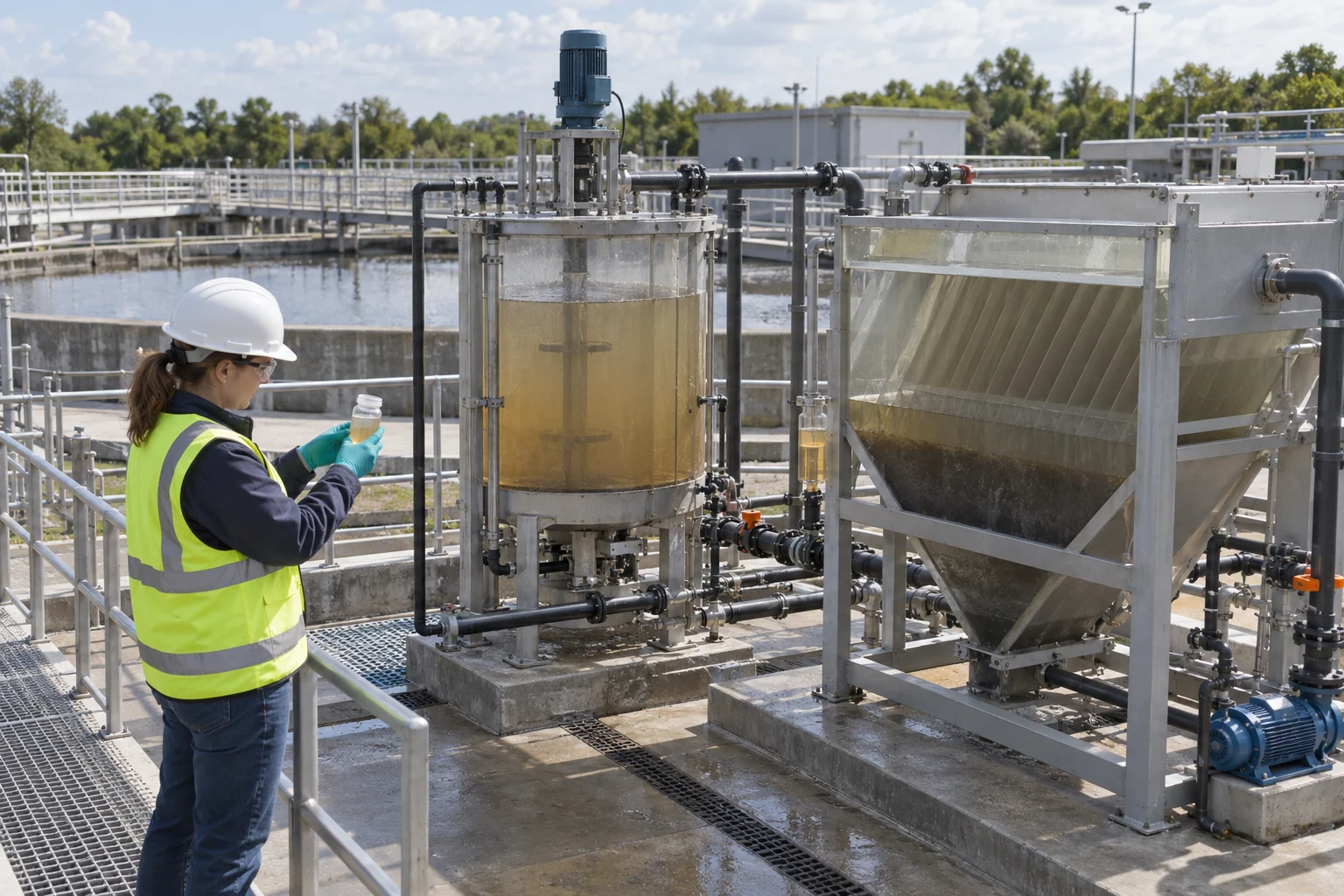
Score the solids route as carefully as the water. Record sludge volume, settling or flotation behavior, carryover and a practical dewatering observation. Note whether the selected chemistry changes final pH or conductivity and whether returned solids or filtrate could affect the biological process. A route that meets color but destabilizes sludge handling may be more expensive and less reliable than a slightly different chemistry window.
Confirm the full Product → Process → Evidence → RFQ path
Take the leading window into a guarded pilot or plant confirmation. Map the actual injection point, mixing energy, order of addition, reaction time, separator loading, recycle paths and variable biological-effluent states. Define baseline and treated periods, sample locations and stop conditions. Confirmation should include the production campaigns that change color, not only the easiest day.
The primary Money Page for a persistent filtered-color route is the Water Decoloring Agent page. Use the coagulants and flocculants range when the decision centers on destabilization and solids capture, with PAC and PAM as candidate families only after the matrix and role are defined. The paper-mill decoloring jar-test video demonstrates a sequence in a different matrix; it is not evidence that the same sequence or grade will work in this effluent.
For a useful RFQ, send the industry and process source, biological-treatment configuration, sampling point, filtered/unfiltered color and COD where available, pH, conductivity, TSS/turbidity, current additions, separator, sludge constraints, accepted test method, destination and expected quantity. Ask for the exact grade’s current TDS and SDS and a lot-linked COA where available. Discuss a residual-color route →
Frequently asked questions
Why is effluent still colored after biological treatment?
Biology may leave dissolved color bodies or degradation products, while the secondary clarifier can also pass fine biological solids and colloids. Compare filtered and unfiltered samples and review the biological/clarifier state before choosing a tertiary chemical route.
Does a water decoloring agent also remove COD?
It may change measured COD for a particular wastewater and test condition, but color response does not prove COD removal. Measure filtered and unfiltered COD when it is part of the decision and do not infer compound destruction or toxicity reduction from appearance.
When should PAC or another metal salt be screened?
Screen a metal-salt coagulant when color is associated with fine solids or when a controlled test shows that destabilization and solids capture improve the combined endpoints. The useful pH and dose window is wastewater-specific.
Is PAM a decoloring chemical?
PAM is generally screened as a flocculant aid that builds separable floc after particles or color-bearing matter have been destabilized. Do not assume it removes dissolved color by itself; test its incremental role and the exact grade.
What is the minimum evidence before a plant trial?
Use a representative sample, an untreated control, filtered/unfiltered diagnosis, a documented pH and primary-chemistry screen, a polymer screen only where justified, plant-relevant separation, repeat results, complete endpoints and current documents for the exact candidate grade.
Sources
- US EPA, Best Management Practices for Pollution Prevention in the Textile Industry — wastewater color context, ADMI examples and source-reduction perspective.
- Bilińska et al., Treatments for color removal from wastewater: State of the art — mechanism-level comparison of physical, chemical, electrochemical and biological routes.
- Verma, Dash and Bhunia, coagulation/flocculation for color removal from textile wastewaters — color-removal coagulation review and matrix-specific limitations.
- ASTM D2035-19, Coagulation-Flocculation Jar Test of Water — systematic comparison of coagulants, aids, concentration and order of addition.
Sources and current search results were reviewed on 4 October 2026. They support the route-selection framework and stated limitations, not a universal dose, product performance claim or discharge result.