
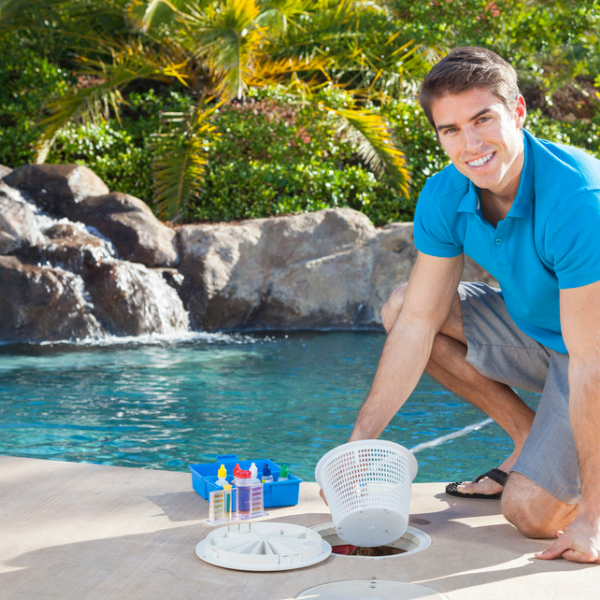
Pool Water Chemistry: pH, Free Chlorine & Cyanuric Acid
TL;DR Balanced pool water means holding five things in range: pH 7.2–7.6, free chlorine 2–4 ppm, cyanuric acid (CYA) 30–50 ppm outdoors, total alkalinity 80–120 ppm and calcium hardness 200–400 ppm. They interact — pH controls how much of your chlorine is active, CYA protects chlorine from sunlight but too much stalls it, and alkalinity buffers pH — so you adjust them in the right order, guided by regular testing.
The five parameters that matter
Safe, clear, non-corrosive pool water comes down to five measurements. Get them in range and chlorine works efficiently, swimmers are comfortable, and surfaces and equipment last. The public-health targets below align with common guidance from bodies such as the US CDC; always follow your local pool code.
pH (target 7.2–7.6)
pH decides how much of your chlorine is the active form (hypochlorous acid). At pH 7.2–7.6 a good fraction of free chlorine is active; above ~7.8 chlorine is far weaker and scale forms; below ~7.0 water turns corrosive and stings eyes. The CDC operating range is pH 7.0–7.8, with 7.2–7.6 the practical sweet spot. Raise pH with soda ash, lower it with muriatic acid or sodium bisulfate.
Free chlorine (target 2–4 ppm)
Free chlorine is the disinfectant residual that kills germs. Keep it at 2–4 ppm for residential pools. The CDC minimum is at least 1 ppm without cyanuric acid, or at least 2 ppm when stabilized chlorine (TCCA/SDIC) is used. Supply it with TCCA tablets for steady outdoor dosing, SDIC for quick adjustment, or calcium hypochlorite for shock.
Cyanuric acid / stabilizer (target 30–50 ppm)
CYA shields chlorine from UV sunlight — without it, an unstabilized outdoor pool can lose most of its chlorine in a couple of hours. Aim for 30–50 ppm outdoors. But too much CYA (above ~80–100 ppm) over-binds chlorine and slows disinfection even when a chlorine test looks fine, so if you dose stabilized chlorine daily, watch CYA and dilute when it climbs. Indoor pools need little or no CYA.
Total alkalinity (80–120 ppm) and calcium hardness (200–400 ppm)
Total alkalinity buffers pH — keep it 80–120 ppm so pH stays stable (raise with sodium bicarbonate). Calcium hardness should be 200–400 ppm: too low and water leaches calcium from plaster and grout (corrosive); too high and it scales. Together with pH and temperature these set the water's saturation (Langelier) balance between corrosive and scaling.
Adjustment order and testing
- Test 2–3× a week (chlorine and pH more often in heavy use/heat).
- Order: total alkalinity first → pH → calcium hardness → CYA → then chlorine.
- Shock the pool periodically to clear combined chlorine (chloramines) that cause the "chlorine smell" and eye irritation.
- Never mix pool chemicals together; add each to water separately.
Ideal pool water levels
| Parameter | Ideal range | Why it matters |
|---|---|---|
| pH | 7.2–7.6 | Controls chlorine activity & comfort |
| Free chlorine | 2–4 ppm | Disinfectant residual (CDC ≥1, ≥2 with CYA) |
| Cyanuric acid (CYA) | 30–50 ppm (outdoor) | UV stabilizer; >80–100 stalls chlorine |
| Total alkalinity | 80–120 ppm | pH buffer / stability |
| Calcium hardness | 200–400 ppm | Corrosion vs scale balance |
Watch

Frequently asked questions
What are the ideal pool water chemistry levels?
For most residential pools: pH 7.2–7.6, free chlorine 2–4 ppm, cyanuric acid 30–50 ppm (outdoor), total alkalinity 80–120 ppm and calcium hardness 200–400 ppm. The CDC operating ranges are pH 7.0–7.8 and free chlorine at least 1 ppm (2 ppm with cyanuric acid). Always follow your local pool regulations.
Why is cyanuric acid important, and can there be too much?
Cyanuric acid (CYA) stabilizes chlorine against sunlight, so outdoor pools hold a chlorine residual instead of losing it in hours. The target is 30–50 ppm outdoors. But above roughly 80–100 ppm, CYA over-binds chlorine and slows disinfection even when a chlorine test reads normal, so dilute the water when CYA climbs too high. Indoor pools need little or none.
Why does pool pH affect chlorine?
Free chlorine exists as hypochlorous acid (the strong disinfectant) and hypochlorite ion (much weaker); the balance depends on pH. At pH 7.2–7.6 a useful fraction is the active form. Above about 7.8, most chlorine is the weak form and disinfection drops sharply while scale risk rises, which is why pH is controlled before relying on the chlorine reading.
In what order should I balance pool water?
Adjust total alkalinity first (it buffers pH), then pH, then calcium hardness, then cyanuric acid, and finally chlorine. Balancing in this order stops later adjustments from undoing earlier ones. Test two to three times a week, and more often in hot weather or heavy bather loads.
Where can I buy pool disinfection chemicals?
VCYCLETECH supplies TCCA, SDIC and calcium hypochlorite plus pH adjusters and algaecides for pools, factory-direct from China with current COA information on request, sample availability and OEM/ODM service. Email sales@vcycletech.com for pool-chemical supply and dosing guidance.
About the manufacturer
VCYCLETECH is a China-based manufacturer of water treatment chemicals — disinfectants, biocides, coagulants, flocculants, antiscalants, scale & corrosion inhibitors and paper chemicals — ISO 9001 / 14001 / 45001 certified, with current COA information on request and OEM/ODM service. See our quality & certifications.
References
- Home pool water treatment & testing — US CDC
- Cyanuric acid — Wikipedia
- Langelier saturation index — Wikipedia
Related: TCCA · SDIC · Calcium Hypochlorite · Swimming-pool chemicals · TCCA vs SDIC vs cal-hypo