
Industrial wastewater · DAF front-end chemistry
Oily Wastewater DAF: How to Select Coagulant and Flocculant
Choose DAF chemistry from the wastewater in front of the unit, not from a generic oil-removal recipe. Start by separating free oil from a stable emulsion, then note suspended solids, pH, salinity, surfactants, temperature and how quickly the stream changes. A coagulant’s job is to destabilize the particles or emulsion; a flocculant then builds a light, bubble-friendly floc. If the oil is still protected by detergents, cutting-fluid additives or a stable emulsion, test the emulsion-breaking step before judging the polymer. Run a staged bench test that keeps mixing and air-flotation conditions realistic, then verify the best candidates at the DAF inlet. This approach identifies whether the next move is a coagulant family, a flocculant family, a pH/demulsification route or a mixing correction.
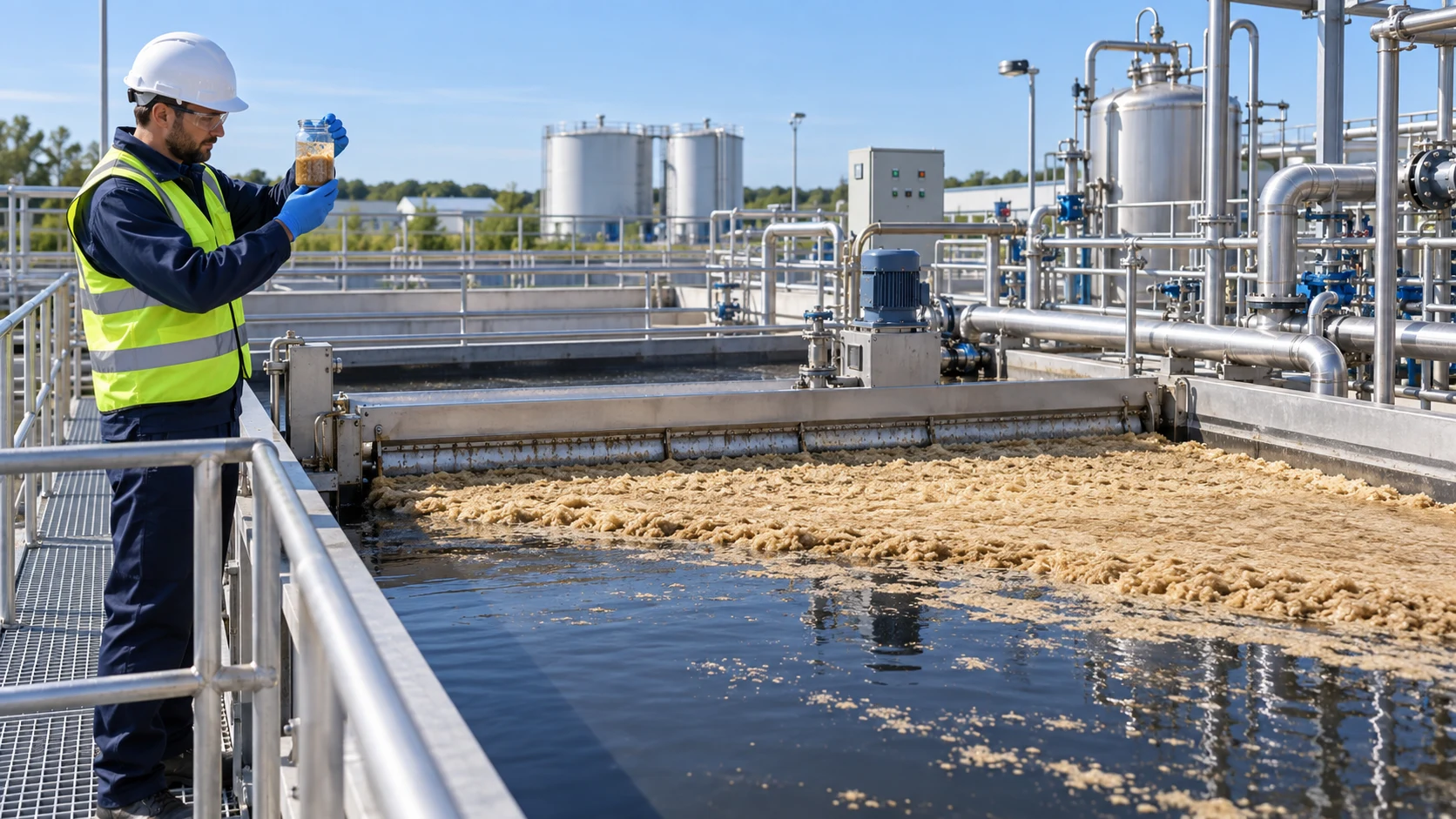
Classify the oil before selecting chemistry
DAF works by attaching fine bubbles to particles and low-density material so they rise to the surface. The EPA describes it as a process used for suspended solids and dispersed oil and grease; this is why the feed’s physical form matters.1 Free oil that separates in a quiescent sample is not the same chemistry problem as an oil-in-water emulsion that remains cloudy after standing. A stable emulsion may be held together by surfactants, detergents, salts, temperature or process additives. It may need an emulsion-breaking step before either a conventional coagulant or a polymer aid can create a floatable floc.
Take a fresh composite across the normal production cycle where possible. Record pH, conductivity or salinity, temperature, oil-and-grease method, turbidity or suspended solids, and the source process. Identify recent changes to cleaners, lubricants, coolants or batches. Those inputs let an application engineer choose a useful screening matrix; they are more valuable than guessing a single product from a photograph of the DAF blanket.
| Feed observation | What it suggests | First test branch | What not to assume |
|---|---|---|---|
| Free oil separates quickly | Bulk separation may carry part of the load. | Compare physical separation with a light coagulation/flocculation screen. | That all remaining turbidity is oil. |
| Persistent milky emulsion | Fine droplets or surfactants are stabilizing the water. | Screen pH or demulsification route before polymer optimization. | That more flocculant alone will break the emulsion. |
| High suspended solids with oil | Solids can help or hinder floc formation and flotation. | Evaluate coagulant plus flocculant and assess floated solids handling. | That the clearest beaker makes the best DAF blanket. |
| High salinity or changing pH | Charge behavior and hydrolysis response can shift. | Keep the actual water matrix in every comparison. | That a result from tap-water dilution will transfer. |
The EPA’s metal-finishing development document also notes that emulsified oils need chemical treatment before separation and that mixing is needed to bring added chemistry into contact with the emulsion.2 The exact pH route and product family depend on the stream, so the purpose of a first trial is to narrow the chemistry path—not to declare a universal dose.
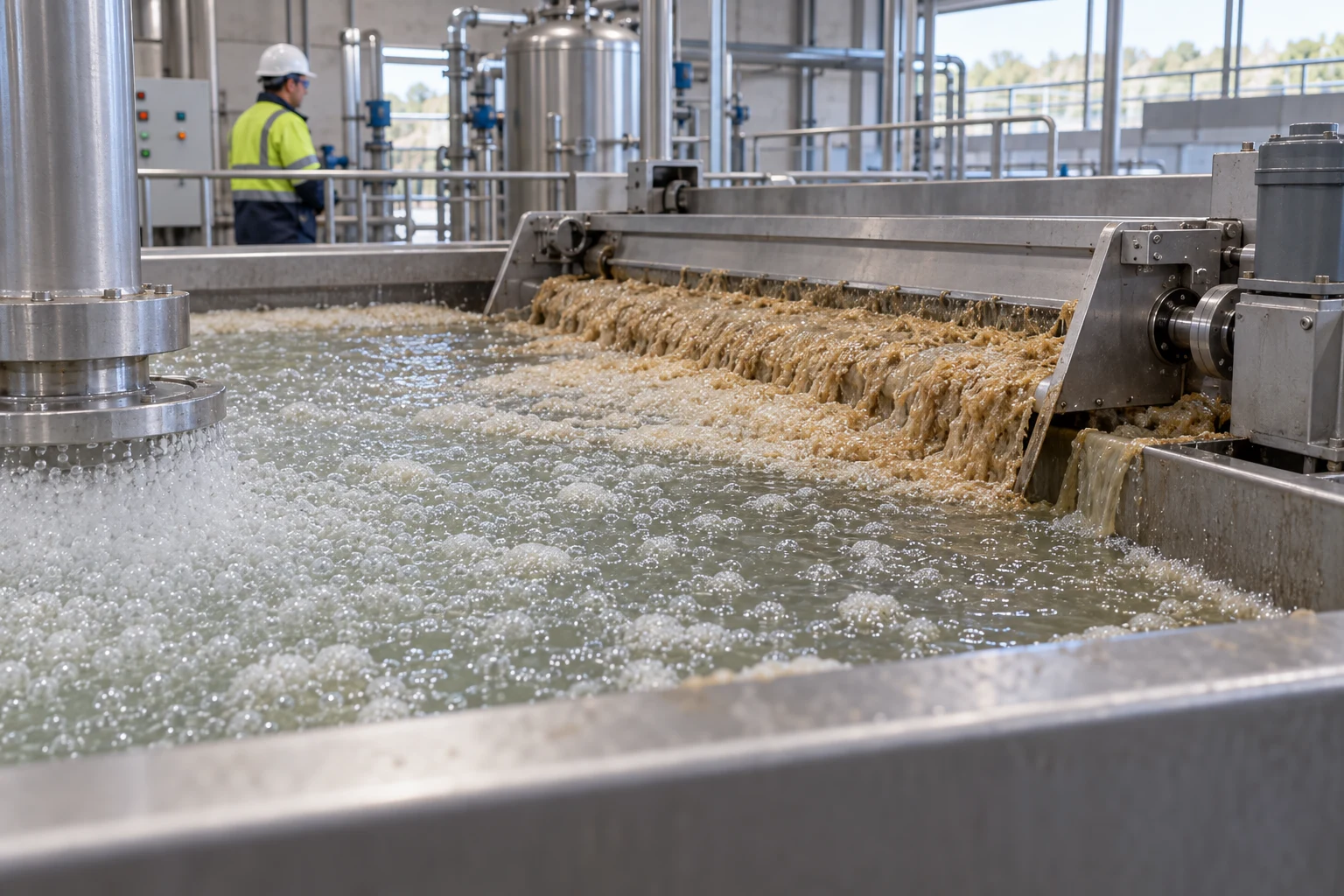
Give coagulant and flocculant different jobs
Coagulation and flocculation are sequential decisions. The first step reduces the stability of fine particles or droplets; the second step grows a floc that can survive the pipe run and meet DAF bubbles. Treating both as interchangeable leads to overdosing one chemical to compensate for an unfinished first step. The oily-wastewater literature consistently identifies feed pH, oil concentration, temperature and the coagulant/flocculant type as material influences on performance.3
Begin with a coagulant or emulsion-breaking screen appropriate to the feed. After selecting a small set of promising first-stage conditions, compare a flocculant screen at the same water condition and mixing sequence. A practical outcome can be: “the emulsion must be destabilized first,” “this inorganic/organic coagulant family is the better next screen,” or “the chemistry looks sound but the plant’s mixing and contact time need attention.” It should not be a hard-coded grade or numerical dose without a representative trial and verified product information.
Run a test sequence that answers the plant question
A good screen changes one decision at a time. Use the untreated wastewater as the control. First compare a small, defined set of first-stage routes while holding the rapid-mix condition and settling observation consistent. Then hold the best first-stage condition and compare flocculant candidates with the same gentle-mix time. Finally, test the best combinations in a way that reflects the real DAF contact zone. The aim is to see whether the floc is light, coherent and buoyant—not simply large.
- Set the baseline. Photograph and record the untreated sample, pH, conductivity/salinity indicator, temperature, turbidity/solids and oil method used.
- Screen the first stage. Compare the relevant coagulant or demulsification paths at a fixed mixing condition, observing clarity and how quickly droplets or solids respond.
- Screen floc formation. Add each candidate flocculant after the first stage and use a reproducible gentle mix. Note floc size, density, breakage and whether it resists re-dispersion.
- Confirm flotation behavior. Where possible use a bench DAF or a representative bubble-contact test. A settling-only jar test can miss a floc that is too dense, too fragile or poorly suited to bubble attachment.
- Verify one change at the unit. Use a controlled, documented plant trial under a comparable feed; compare inlet/outlet quality, blanket, skimmer load and downstream impact.
The EPA notes that pressurized, air-saturated water releases microscopic bubbles at the flotation chamber; their attachment to oil and suspended particles is the separation mechanism.1 That is why a DAF trial must preserve the transition from chemical conditioning to bubble contact. Do not judge a flotation program only from a beaker that would never see a recycle stream.
Protect the floc between dosing point and DAF
A correct chemistry choice can still fail if the sequence or hydraulic conditions are wrong. Coagulant needs enough rapid dispersion to contact the emulsion. Flocculant needs a lower-shear zone after it is introduced. Excess turbulence after floc growth can reduce the very structure that needs to meet the bubbles. Conversely, poor dispersion leaves pockets of untreated emulsion and makes a product comparison look inconsistent.
Walk the physical path from dosing pumps to the DAF inlet. Check chemical-feed calibration, dilution quality, injection locations, static or mechanical mixing, pipe distance, recirculation/recycle conditions and sudden flow changes. If a combination forms a useful floc in the same wastewater at the bench but not at the DAF, inspect that path before discarding the chemistry. The related oily-wastewater PAC and PAM flocculation video can help teams visually distinguish the two conditioning stages; it is not a dosage or performance claim.
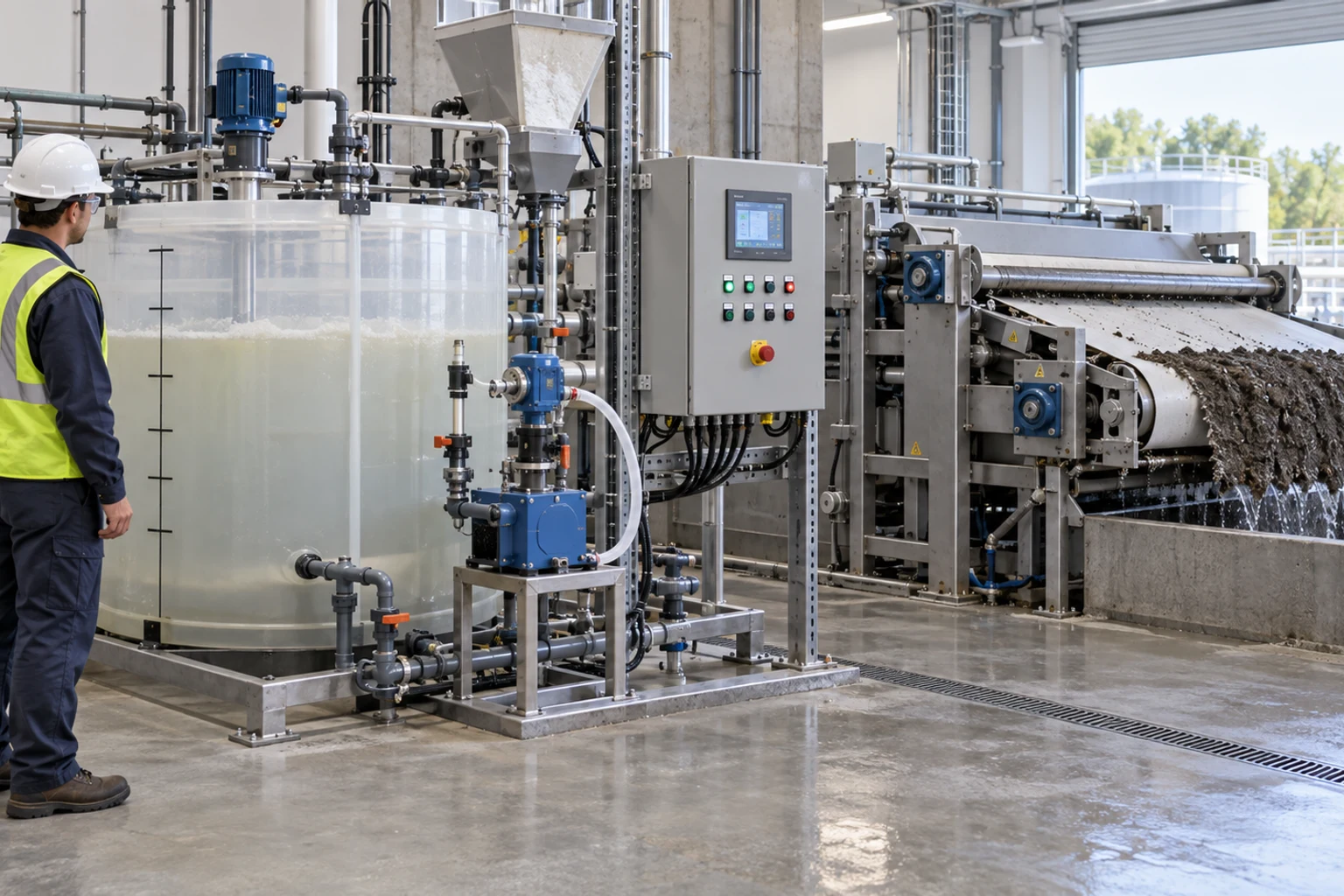
Read the result as a process decision, not a beauty contest
Compare the treated-water sample, the floated blanket, the skimming behavior and the downstream solids burden together. A clear water phase with a fragile, watery blanket may move the problem to sludge handling. A dense floc that settles well may not be the best candidate for flotation. A stable result across representative samples is more useful than an excellent result from one short-lived batch.
When a shortlisted program reaches the DAF, record the sample time, source process, pH, water temperature, inlet solids/oil indicators, mixing condition and recycle/air operating state. Pair those notes with the outcome: clarified-water appearance and analyses, blanket depth/consistency, skimmer removal and downstream response. This makes it possible to distinguish a feed change from a true chemistry or hardware change. The product category coagulants and flocculants page is the appropriate route to discuss available families after that operating context is known; the industrial wastewater application page maps the broader process path.
Bring the inputs that shorten a DAF selection trial
To discuss a trial, share the source industry and process, whether the oil is free or emulsified, recent cleaner/coolant changes, a representative water analysis, pH, conductivity or salinity, temperature, solids/oil targets, DAF flow and existing conditioning sequence. Include pictures of the DAF inlet and blanket if available. That gives a technical team enough context to recommend a relevant screen rather than a generic “more polymer” response. If the floated solids then become a dewatering concern, follow the separate PAM preparation and aging guide; it addresses the downstream make-down decision rather than DAF chemistry selection.
Frequently asked questions
Should DAF use coagulant, flocculant, or both?
Many oily streams need two distinct conditioning steps: a first-stage route to destabilize droplets or particles and a second-stage flocculant to build a bubble-friendly floc. The right sequence depends on the actual wastewater, not on the equipment name alone.
Why does an oily wastewater jar test look good but the DAF still performs poorly?
The bench test may not reproduce chemical injection, shear, contact time, recycle water or bubble attachment. Compare the route from dosing point to DAF inlet and run a controlled confirmation at representative operating conditions.
Can a flocculant break a stable oil emulsion on its own?
Sometimes it can assist after the emulsion is destabilized, but a stable emulsion often needs the first-stage chemistry or pH route addressed first. Test that branch before increasing flocculant.
Does higher salinity change the chemical selection?
It can. Salinity and conductivity are part of the water matrix and can change how an emulsion and conditioning chemistry behave. Keep the actual water matrix in the trial rather than diluting it with a different water source.
What should be measured during a DAF chemistry trial?
Track the feed source and condition, pH, temperature, conductivity or salinity, oil/solids indicators, mixing sequence, clarified-water result, floated blanket and skimmer/sludge response. Those observations show which part of the process caused the change.
Sources
- U.S. EPA, Dissolved Air Flotation Fact Sheet — flotation mechanism and application to oil and suspended solids.
- U.S. EPA, Metal Finishing Development Document — emulsified-oil conditioning and the role of adequate mixing.
- Science of the Total Environment review of coagulation/flocculation for oily wastewater — factors influencing treatment and combined routes.
Source check: 22 September 2026. These sources describe process principles, not a verified result for a specific VCYCLETECH product or wastewater.