
Molybdate vs Phosphonate vs All-Organic Inhibitors
To narrow the available grades, share the industry, water or process conditions, treatment objective, current program, required quantity, packaging and destination. Representative sample results are helpful when performance depends on site water chemistry.
What is the difference between the three programs?
Molybdate, phosphonate/phosphate and all-organic programs solve overlapping steel-corrosion problems through different passivation, precipitation and film-forming mechanisms. Molybdate is commonly used as a passivating component; phosphate/phosphonate and zinc programmes combine passivation, threshold control and cathodic effects; all-organic programmes use organic phosphorus compounds, polymers and film-formers without inorganic phosphate or zinc. The programme boundary is more important than the label on the drum.
The existing all-organic versus stabilised-phosphate guide owns the two-way comparison. This article adds the three-way procurement matrix: which element is constrained, what control range is documented, what discharge evidence is needed and what copper protection remains outside the steel-inhibitor choice.
Typical control windows: use the source boundary
| Program | Published control window or operating note | Procurement interpretation |
|---|---|---|
| Molybdate | Veolia describes 200-300 ppm as MoO4 in closed recirculating systems; its open-system discussion describes roughly 2-20 ppm when molybdate is used in a blend. | Closed-loop and open-tower values are not interchangeable. State the system boundary and whether the number is maintenance or passivation. |
| Phosphonate / phosphate | Veolia lists general open-system ranges around 2-10 ppm for phosphonate and orthophosphate, with organic phosphate around 3-8 ppm in a higher-pH programme. | Use the exact product basis and analytical method. Phosphorus in blowdown remains a permit and receiving-water question. |
| All-organic, non-P / non-Zn | Veolia describes all-organic programs as using organic inhibitors and typically operating around pH 8.7-9.2 to use calcium carbonate as a cathodic inhibitor. | Lower P/Zn loading does not equal zero environmental review. Confirm polymer, film-former, biodegradation and copper protection. |
| Nitrite benchmark | For closed systems, Veolia describes 600-1,200 ppm as NO2- for iron/steel, with higher levels for steel-copper couples. | Nitrite is a separate closed-loop option, not one of the three primary columns; check SDS, storage, biological and discharge/reporting requirements. |
These are control windows from a named technical handbook, not a recommendation for your plant. A high molybdate number from a closed-loop maintenance programme cannot be copied into an open cooling tower, and an open-tower phosphonate range cannot be used to set a closed-loop passivation target.
How to read phosphorus, zinc and molybdenum numbers
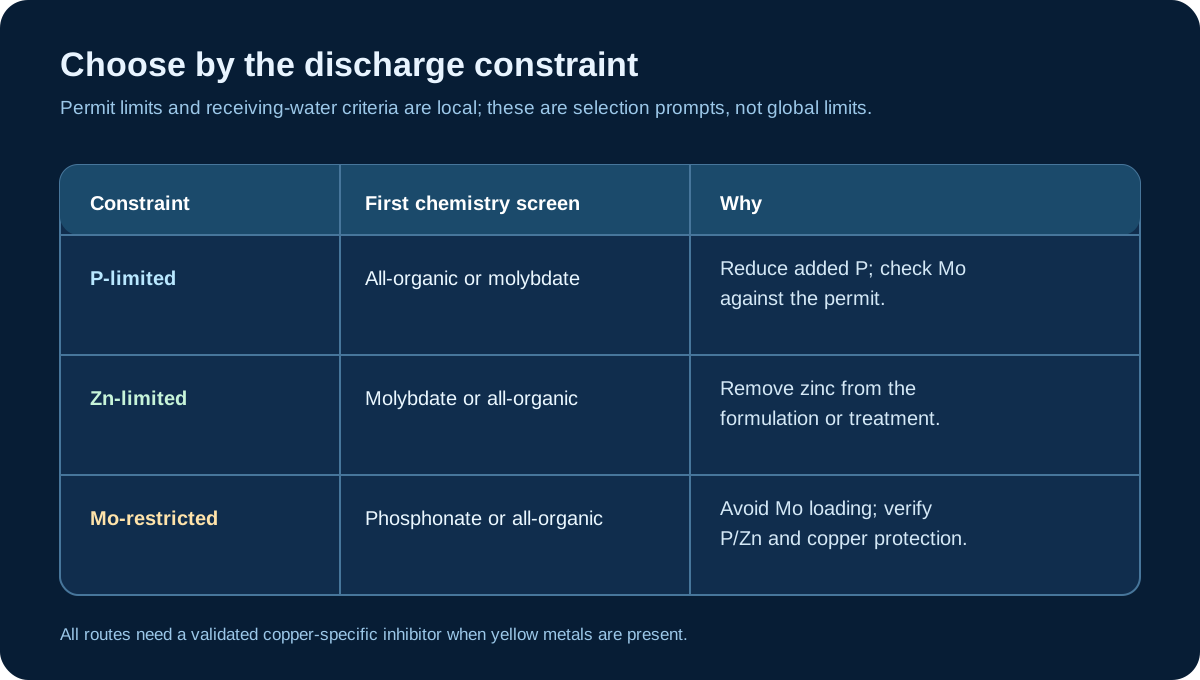
There is no single global discharge limit for cooling-tower blowdown. A permit may regulate total phosphorus, dissolved or total zinc, molybdenum, toxicity, temperature, pH or a mass loading. A receiving-water criterion is not automatically an effluent limit. For example, the U.S. EPA aquatic-life table lists a zinc criterion around 120 micrograms per litre under its stated freshwater/hardness framework; it is not a universal NPDES number for every site. Similarly, the WHO molybdenum value of 70 micrograms per litre is a drinking-water guideline, not a cooling-tower wastewater limit.
For phosphorus, the correct procurement action is to obtain the facility’s permit, identify the regulated form and calculate mass loading from blowdown flow and concentration. “Phosphate-free” only answers one formulation question; it does not prove that a product meets a site permit.
| Constraint | First screen | Do not assume |
|---|---|---|
| Phosphorus-limited permit | All-organic or molybdate, then verify Mo, polymer and copper controls. | That a 0-P product has no other discharge or toxicity issue. |
| Zinc-limited permit | Remove zinc from the formulation; compare molybdate and all-organic options. | That an aquatic-life criterion is the plant’s permit limit. |
| Molybdenum-restricted sewer or receiving water | Phosphonate/all-organic, subject to P and organic-load review. | That WHO drinking-water guidance applies to industrial discharge. |
| No routine discharge / closed loop | Molybdate or nitrite may be technically attractive if compatible with metals and fluid. | That closed-loop chemistry can be transferred to an open tower. |
Why all three routes still need copper protection
Molybdate, phosphate/phosphonate and many all-organic packages primarily address ferrous corrosion and scale-control interactions. They do not automatically create a durable copper/brass film. In systems with copper, brass, bronze or admiralty metal, add a validated yellow-metal inhibitor such as BTA/TTA or another copper-specific chemistry. The exact choice must consider chlorine/bromine exposure and the environmental review described in the BTA/TTA REACH and alternatives guide.
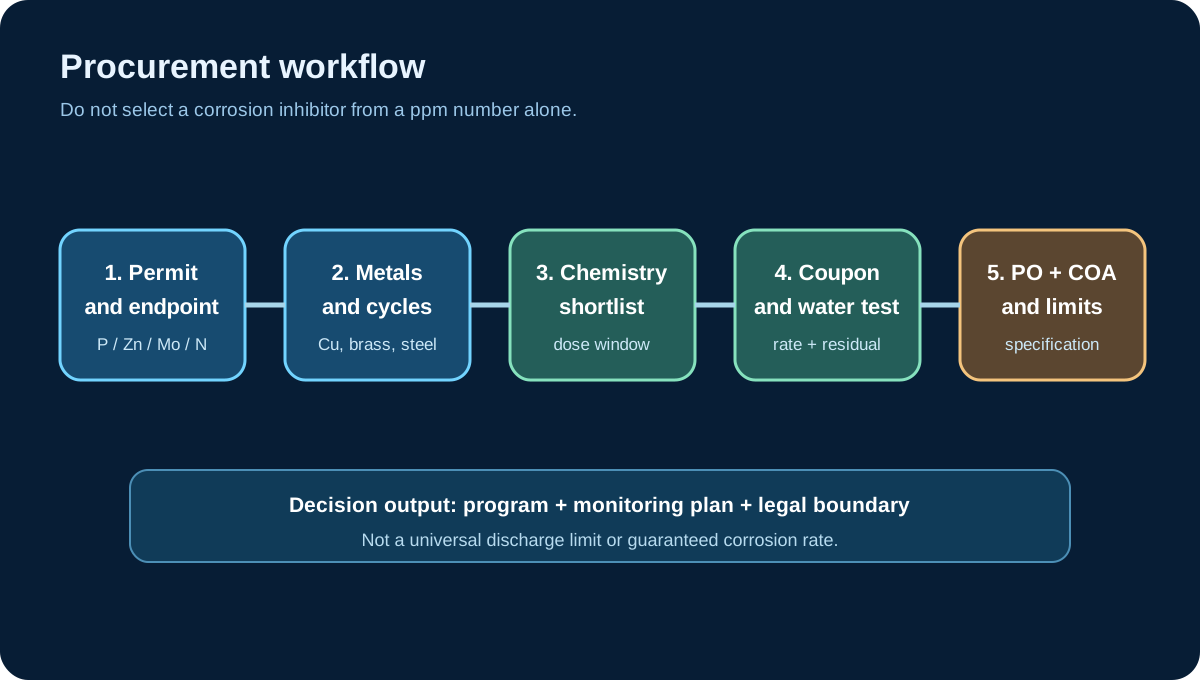
Procurement data to send for a real comparison
- Identify open tower, closed loop, once-through or process cooling; provide system volume, makeup and blowdown flow.
- List carbon steel, stainless steel, copper, brass, bronze, aluminium, galvanised steel and elastomers in contact with water.
- Send pH, alkalinity, hardness, chloride, sulfate, silica, conductivity, temperature, cycles and current biocide/oxidant programme.
- Attach the discharge permit or sewer acceptance criteria, including parameter, sample basis, averaging period and mass limit.
- Request TDS, SDS, active-content basis, batch COA, recommended analytical method and a controlled coupon/jar test plan.
For a tailored quotation, use VCYCLETECH corrosion inhibitor options and send the operating and permit data with the inquiry. We can compare a phosphonate, molybdate or all-organic starting formulation, but the final dose and legal fit remain site-specific.
Frequently asked questions
What is the difference between molybdate, phosphonate and all-organic cooling-water programs?
They use different combinations of steel passivation, scale control and film-forming chemistry. A molybdate program uses molybdate as a passivating component; phosphonate/phosphate programs combine scale and corrosion control with other additives; all-organic programs rely on organic components without inorganic phosphate or zinc. Compare your discharge limits, makeup-water chemistry and metallurgy, then check how each proposed program protects copper alloys as well as steel.
What is the typical molybdate dosage in cooling water?
Veolia describes 200-300 ppm as MoO4 for closed recirculating systems and lower roughly 2-20 ppm use when molybdate is part of an open-system blend. These are source-specific control windows, not a universal dose. Confirm the basis, system type, passivation step and discharge route before specifying a number.
What is the discharge limit for phosphorus in cooling-tower blowdown?
There is no single global limit. The applicable value depends on the site permit, receiving water, parameter definition, averaging period and mass loading. Obtain the permit and calculate the phosphorus contribution from makeup, chemical feed, cycles and blowdown rather than copying a number from another jurisdiction.
Is molybdate environmentally safe to discharge?
Molybdate cannot be labelled universally safe to discharge. It may avoid zinc and reduce phosphorus, but it adds molybdenum to the discharge review. A WHO drinking-water guideline is not a wastewater limit; compare the actual molybdenum mass load with the local permit or sewer acceptance criteria.
Do all-organic programs protect copper and brass?
Not automatically. All-organic steel-control chemistry can reduce phosphorus and zinc, but copper and brass still need a validated copper-specific inhibitor or another proven yellow-metal protection mechanism. Test the actual metallurgy, oxidant residual and water chemistry before removing BTA/TTA or another azole.
About the manufacturer
VCYCLETECH is a China-based manufacturer of water-treatment chemicals and process-support formulations. We provide technical documents, batch COA support and OEM/ODM service; buyers remain responsible for confirming market-specific legal status, permit conditions and product fit.
References
- Veolia Water Handbook: closed recirculating cooling systems
- Veolia Water Handbook: open recirculating cooling systems
- US EPA: national aquatic-life criteria table
- WHO: molybdenum chemical fact sheet
Related: corrosion inhibitor chemicals · all-organic vs stabilised phosphate guide · BTA/TTA REACH and alternatives · yellow-metal protection guide