
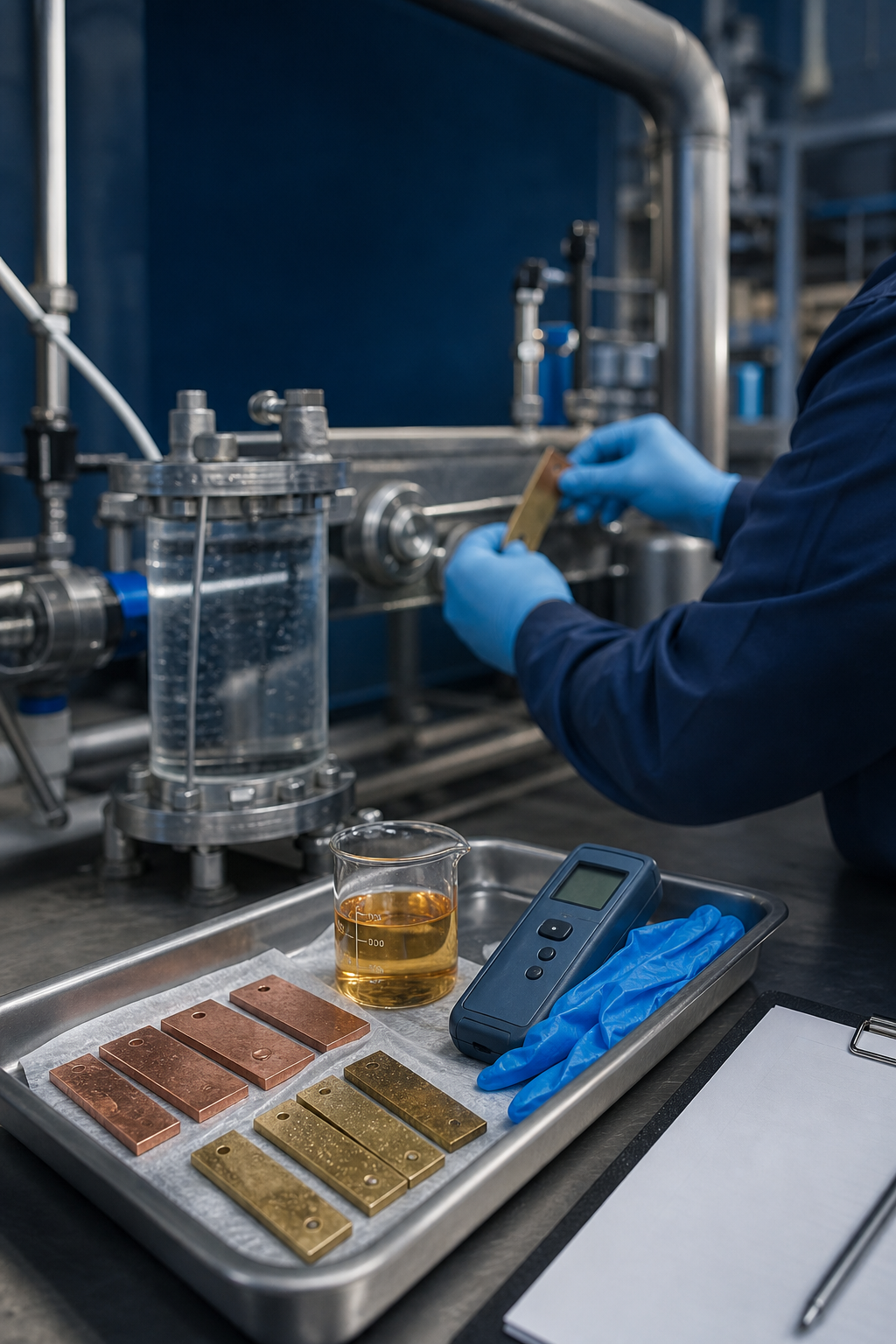
Tolyltriazole & Benzotriazole: REACH & Alternatives
Benzotriazole (BTA) and tolyltriazole (TTA) are widely used copper and brass corrosion inhibitors, but they should not be described as REACH SVHCs simply because German regulators are reviewing benzotriazoles for PMT/vPvM concern. The current procurement question is three-part: confirm the ECHA Candidate List status by CAS/EC number, assess the UBA environmental concern and discharge pathway, then compare azole and non-azole candidates in the actual water and metallurgy. A common cooling-water screen is around 1-3 mg/L active azole, but the final residual must be set by water chemistry, oxidant exposure, metal mix and corrosion data.
Are BTA and TTA REACH SVHCs?
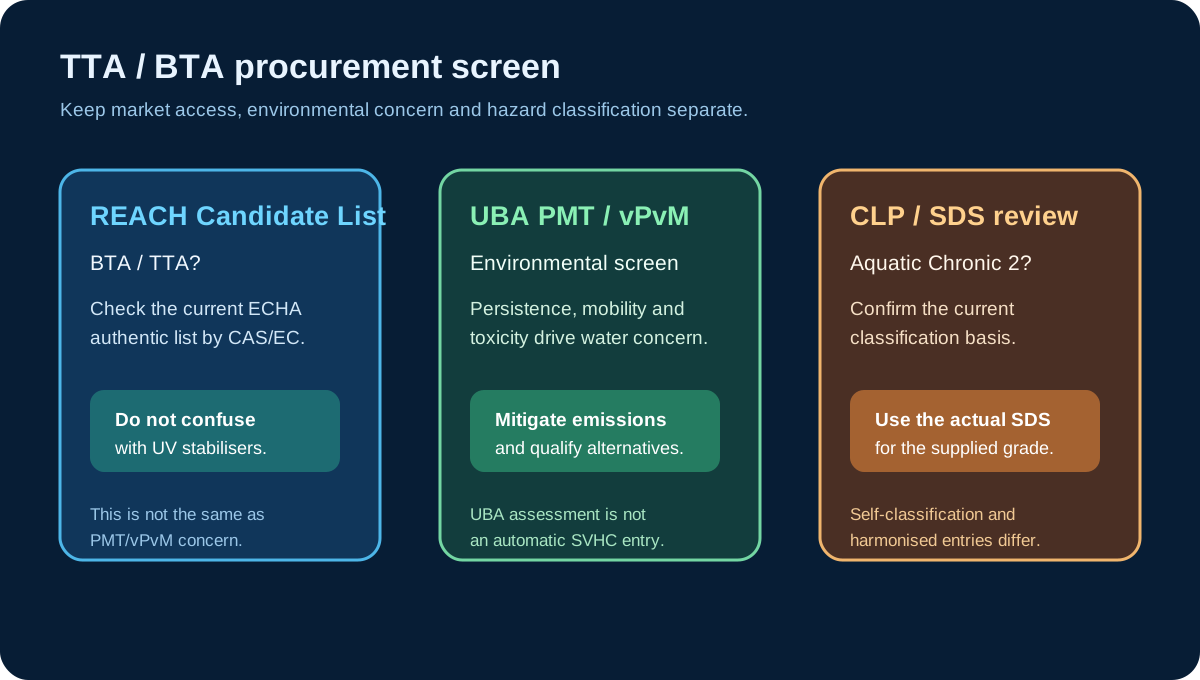
No: do not write that ordinary benzotriazole (BTA, 1H-benzotriazole) or tolyltriazole (TTA, methylbenzotriazole) is on the REACH SVHC Candidate List unless the current ECHA entry for the exact CAS/EC number says so. The current ECHA Candidate List is the authentic legal list, and the procurement check should be made against that list rather than against a supplier blog or a similarly named substance.
The confusion comes from phenolic benzotriazole UV stabilisers. UV-328, UV-327, UV-326, UV-329 and related ultraviolet stabilisers are separate substances used to protect plastics and coatings from sunlight. Some of those substances have SVHC and/or POP regulatory histories. They are not the same chemical family entry as the BTA/TTA corrosion-inhibitor actives used to protect copper and brass in water.
For a purchase file, save the exact CAS/EC identifier, current REACH registration evidence, current SDS and an SVHC declaration. A name such as “benzotriazole” is not enough to identify a regulatory entry.
What PMT/vPvM scrutiny changes
German Environment Agency (UBA) work treats 1H-benzotriazole and methylbenzotriazoles as relevant to the PMT/vPvM discussion because persistence and mobility can allow these substances to move through water cycles. UBA’s environmental assessment is a risk-prioritisation and emissions-management signal; it is not the same legal step as inclusion on the REACH SVHC Candidate List.
That distinction matters to buyers. A substance can be REACH-registered, have a supplier self-classification such as Aquatic Chronic 2 (H411), and still not have a harmonised Annex VI entry or Candidate List inclusion. Confirm the current classification in the supplier SDS and ECHA data for the exact substance. Do not turn “PMT/vPvM concern” into the inaccurate sentence “BTA is an SVHC.”
| Question | What it tells procurement | What it does not prove |
|---|---|---|
| REACH Candidate List | Whether the exact substance is an SVHC entry with legal information duties. | It does not replace a registration, SDS or product-use review. |
| UBA PMT/vPvM assessment | Whether persistence/mobility and water-resource exposure deserve emission mitigation. | It is not an automatic SVHC listing or universal discharge limit. |
| CLP / SDS classification | How the supplied grade is classified and labelled, including aquatic hazard language. | A supplier self-classification is not necessarily a harmonised Annex VI entry. |
Why chlorine and bromine change the BTA/TTA decision
TTA and BTA protect copper and brass by forming an adsorbed copper-azole film. Oxidising biocides can attack the film or consume inhibitor in the bulk water, especially during high residuals, long contact time or an upset. Published cooling-water work reports degradation of TTA in the presence of free chlorine and shows that the actual result depends on oxidant, dose, contact time, copper surface and water matrix.
Therefore “halogen resistant” is a test claim, not a generic identity claim. Ask for the test method, free-chlorine/free-bromine range, pH, temperature, exposure time, residual azole measurement and copper/brass corrosion result. A formulation that survives one oxidant programme may not survive another.
BTA vs TTA for cooling-water procurement
| Screening factor | BTA | TTA | Buyer control |
|---|---|---|---|
| Yellow-metal function | Copper/brass film-forming azole. | Copper/brass film-forming methylbenzotriazole. | Confirm alloy mix, pH, chloride, ammonia and oxidant exposure. |
| Regulatory wording | Do not call it an SVHC without the exact current ECHA entry; UBA PMT/vPvM concern is separate. | Do not infer SVHC status from the “benzotriazole” name or from UV-stabiliser entries. | Use CAS/EC, SDS, REACH registration and current Candidate List. |
| Typical screen | Low mg/L active residual, often beginning around 1-3 mg/L in cooling-water trials. | Set dose by residual analysis and corrosion coupons, not a universal number. | |
| Oxidant exposure | Chlorine and bromine can damage the protective film or consume residual. | Test the real oxidant programme; do not accept an unsupported “halogen stable” label. | |
What can replace TTA or BTA?
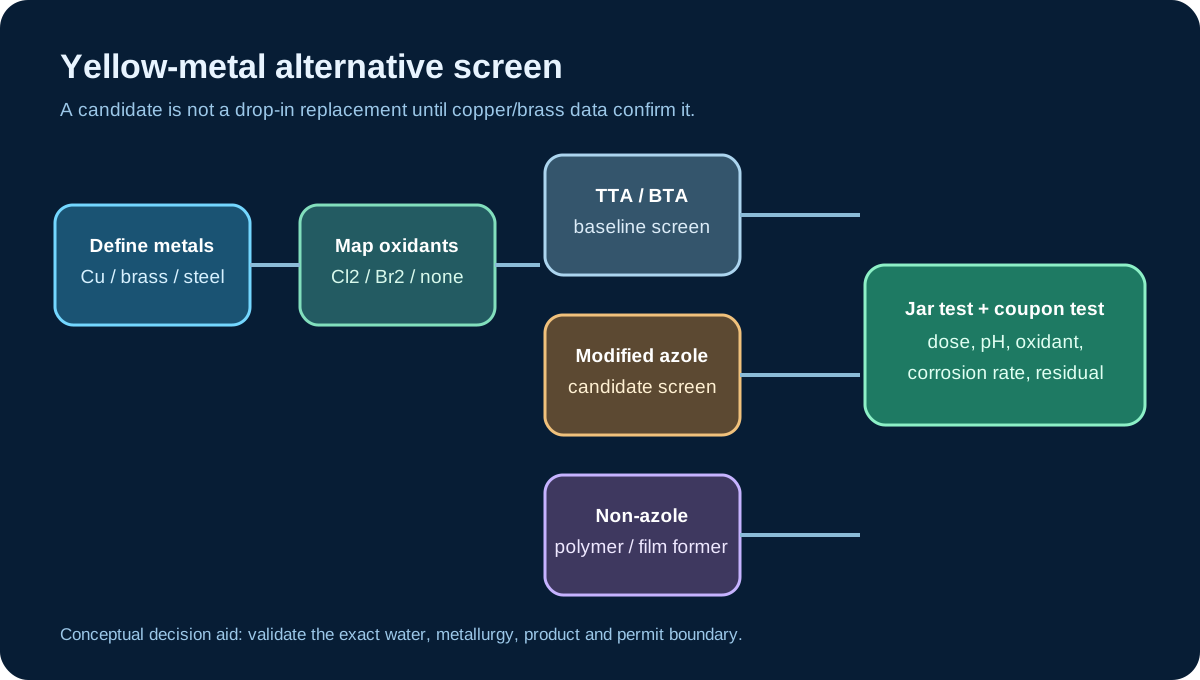
There is no single drop-in alternative. The best shortlist depends on whether the buyer is trying to reduce PMT/vPvM concern, survive an oxidising programme, protect mixed metallurgy or manage a supply interruption.
| Candidate route | Why it may be screened | What must be proved |
|---|---|---|
| Modified or alkyl benzotriazoles | May preserve copper-specific film chemistry while changing performance or supply options. | Exact identity, environmental profile, oxidant response and copper/brass coupon data. |
| Mercaptobenzothiazole or another heterocycle | Different yellow-metal film chemistry can be useful in a constrained formulation. | Hazard profile, odor/handling, compatibility, residual analytics and market acceptance. |
| Polymeric or organic film-formers | Can reduce reliance on a triazole in some programmes and may fit a non-azole brief. | Long-term copper and brass protection, steel compatibility, shear and oxidant performance. |
| Silicate/phosphate/polymer blend | Can support steel protection where phosphorus or silica is acceptable. | Separate yellow-metal protection; scaling, permit and blowdown consequences. |
Buyer checklist for a yellow-metal inhibitor quote
- Send metallurgy, system type, volume, temperature, pH, chloride, sulfate, ammonia, cycles and oxidising-biocide residual.
- Specify whether the requirement is BTA, TTA, modified azole or non-azole and state the reason for the change.
- Request CAS/EC identifiers, current SDS, REACH registration or Only Representative evidence, SVHC declaration and batch COA.
- Set a starting residual only for a controlled trial; measure active azole, copper release and corrosion rate during the trial.
- Record the accepted oxidant window, replenishment rule, discharge route and change-control trigger.
For product and documentation discussions, see corrosion inhibitor options, tolyltriazole, benzotriazole, and the related direct-to-chip yellow-metal protection guide. Buyers should request the current grade documents and application data before replacing an existing inhibitor.
Frequently asked questions
Is benzotriazole (BTA) on the REACH SVHC Candidate List?
Do not describe ordinary 1H-benzotriazole as an SVHC without an exact current ECHA Candidate List entry. BTA is discussed by UBA in PMT/vPvM and water-resource work, while the SVHC/POP confusion usually concerns separate phenolic UV stabilisers such as UV-328 and UV-327.
What is the difference between BTA and TTA as corrosion inhibitors?
Both are azoles used to form protective films on copper and brass. TTA is a methylbenzotriazole; BTA is the unsubstituted benzotriazole. The correct choice depends on alloy, pH, ammonia, chloride, oxidant exposure, residual analytics and the current supply and regulatory file.
Why can chlorine degrade tolyltriazole in cooling water?
Free chlorine and bromine are oxidising conditions that can attack an existing azole film or consume inhibitor in the water. The severity depends on residual, contact time, temperature, pH, copper surface and water matrix, so a halogen-stability claim requires a defined test rather than a generic promise.
What dose of tolyltriazole is used in cooling water?
A controlled screening trial may begin around 1-3 mg/L active azole in some cooling-water programmes, but this is not a universal dose. Set the final residual from metallurgy, water chemistry, oxidant exposure, corrosion coupons and an analytical control method.
What should I request when replacing TTA or BTA?
Request the exact CAS/EC identity, current SDS, REACH registration evidence, SVHC declaration, hazard classification basis, batch COA, halogen-stability data and copper/brass coupon results. Also provide your water analysis, metallurgy and oxidant programme so the candidate can be tested in the actual system.
About the manufacturer
VCYCLETECH is a China-based manufacturer of water-treatment chemicals and process-support formulations. We provide technical documents, batch COA support and OEM/ODM service; buyers remain responsible for confirming market-specific legal status, permit conditions and product fit.
References
- ECHA: current REACH Candidate List
- UBA: benzotriazole mobility and PMT/vPvM assessment
- ECHA: 1H-benzotriazole CLP/CoRAP justification
- ACS: TTA protection in chlorine and ammonia cooling water
Related: corrosion inhibitor chemicals · TTA product · BTA product · direct-to-chip corrosion control