
MINING · PROCESS WATER REUSE
Mining Process Water Reuse: Test Recycle Chemistry Before Changing the Blend
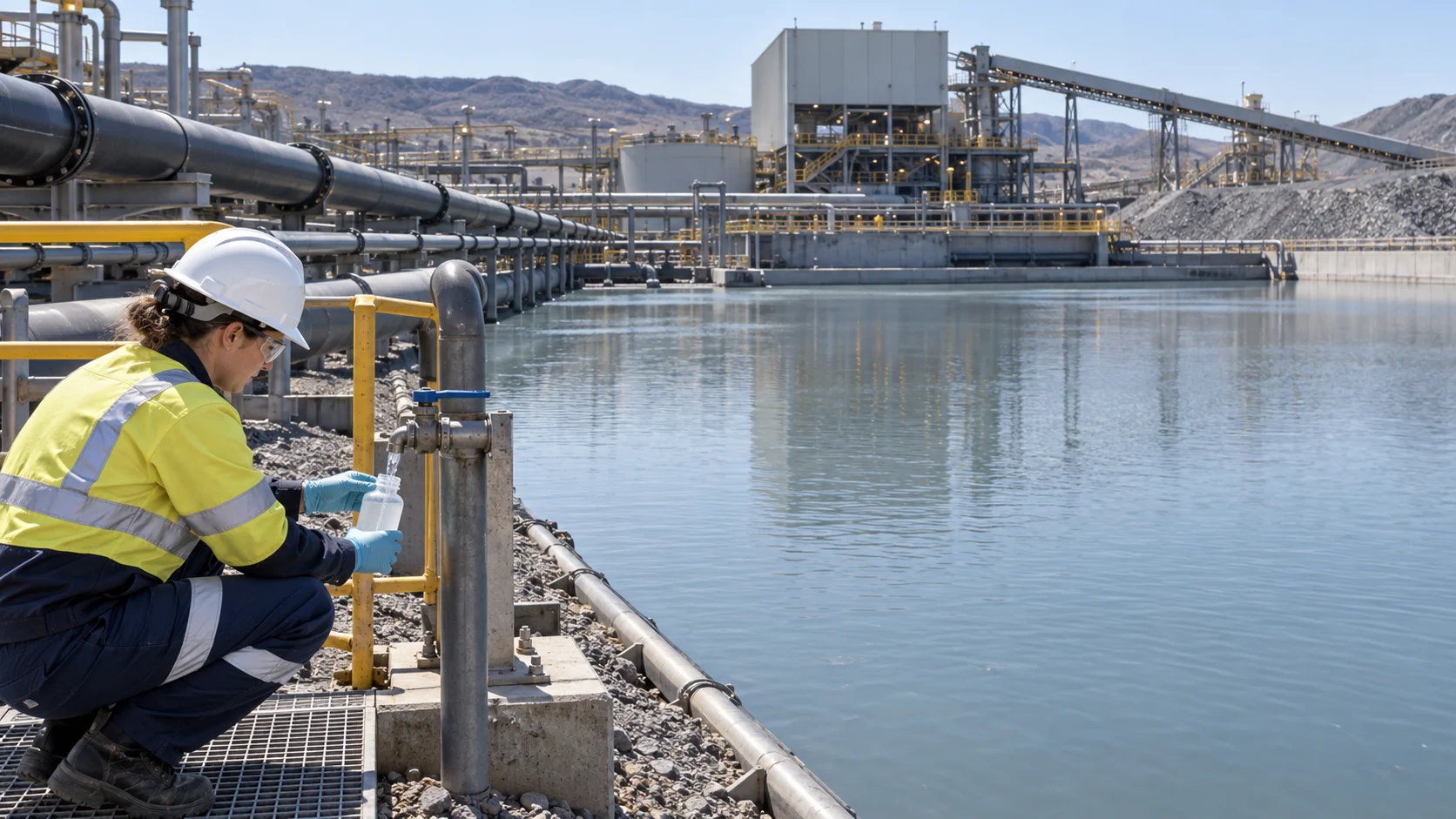
Treat clarified tailings water as a process stream whose chemistry and solids history can change the next operation. Before increasing reuse or changing a blend, sample fresh make-up, return water and the proposed mixed water separately; record pH, alkalinity, conductivity, hardness, major ions, suspended fines, dissolved metals, organics and relevant flotation or dewatering reagents. Then test the intended downstream step with the actual ore and reagent sequence over repeated recycle cycles. A single clean-looking blend or one-pass jar test cannot show whether salts, fines or residual coagulant, flocculant, collector or depressant will build up or change flotation, settling or filtration. Adjust the return point, pretreatment, blend or bleed only when the measured constraint identifies which action can help.
Map each water source and the point where it will be reused
Start with a simple water-flow sketch. Identify fresh make-up, thickener overflow, tailings-pond return, filter filtrate, seepage recovery and any external mine water that may enter the circuit. Mark where each stream joins, its storage time, any treatment between return and reuse, and the unit operation that receives it. A sample of the final blend cannot reveal which source supplied a changing ion or residual reagent.
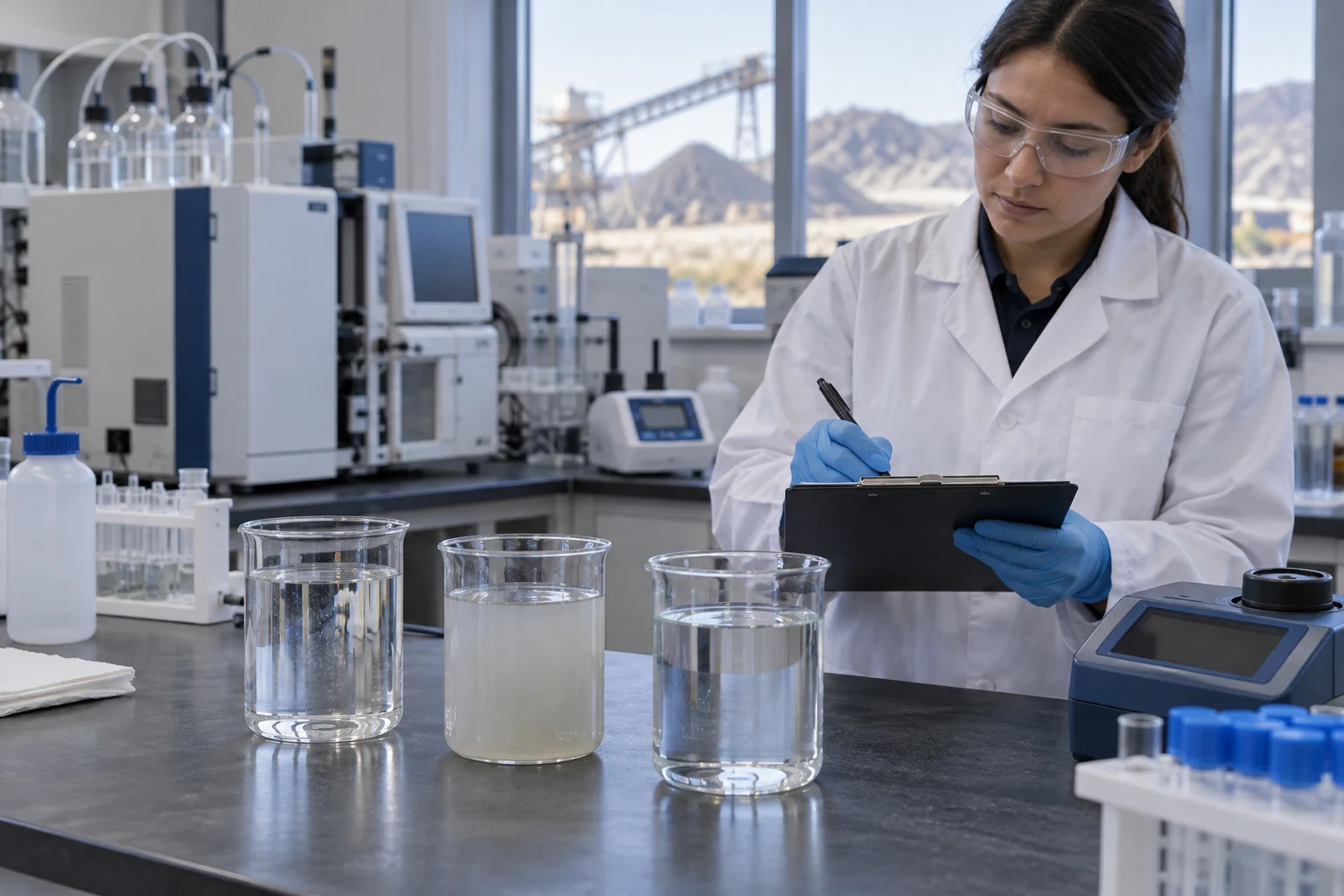
Collect paired samples from each source and the proposed blend under representative operating conditions. Record the time, flow context, ore campaign, upstream reagent changes, solids separation, storage and weather or seasonal factors when relevant. Analyze pH, alkalinity, conductivity, hardness, calcium, magnesium, sulfate, chloride and other ions that the ore or reagent scheme makes relevant. Include total suspended solids, turbidity, particle-size context, iron and other dissolved or total metals, and organic indicators where they can change the process. Track residual flotation and dewatering chemicals when they may reach the return stream. Use filtered and unfiltered fractions where distinguishing dissolved constituents from particles changes the treatment choice.
| Stream | Record at source | Questions for the next use |
|---|---|---|
| Fresh make-up | Major ions, pH, alkalinity, hardness, conductivity, suspended matter and seasonal range | Does new water change reagent demand, scaling tendency or flotation chemistry? |
| Thickener overflow or filter return | Fines, turbidity, dissolved metals, residual coagulant or flocculant, storage and flow | Does the solids-separation step leave carryover that affects the next unit? |
| Tailings-pond return or recovered mine water | Salts, metals, organics, oxidation state, fine particles and recycle history | Has storage or repeated circulation changed the water beyond a one-pass sample? |
| Proposed blended feed | Actual source proportions and the same measurements after mixing | Does the mixed water shift surface chemistry, flotation, settling, filtration or corrosion/scaling? |
Link every water measurement to operating data from the receiving process. This makes a trend in chemistry interpretable alongside the process response rather than turning one conductivity reading into a reuse decision.
Separate salt, fines and reagent effects before selecting treatment
Recycle streams can carry both dissolved and particulate material, and the remedies differ. Calcium, magnesium, sulfate, chloride, alkalinity and other dissolved species can alter ionic strength, mineral-surface interactions, scaling potential or the response to flotation reagents. Clarification may remove suspended particles but will not, by itself, remove dissolved salts. Iron and other metals can occur in dissolved, precipitated or particle-bound forms; the sample method and oxidation state affect what the laboratory reports.
Fine solids can increase turbidity, change rheology, carry adsorbed reagents or affect flotation and filtration. Their effect depends on particle type and size, not just the turbidity reading. Residual flotation reagents can be beneficial in one circuit stage and harmful in another. A 2020 industrial and laboratory study of internal process-water reuse found that locked-cycle recycling accumulated reagents and changed flotation performance in its tested system; the authors then adjusted the reagent regime and validated that ore-specific approach. Those findings support testing the full cycle and reagent sequence, not importing that mine’s adjustment elsewhere.2
Residual coagulants or flocculants deserve the same attention if thickener overflow or a polishing step returns upstream. A 2024 study on a selected Cu-Ni-PGM ore examined residual dewatering aids and reported changes in flotation and tailings settling for its tested ore and conditions.3 It does not establish that every residual polymer harms flotation or that a fixed removal step is needed. Instead, it shows why the actual chemical history belongs in the test record.
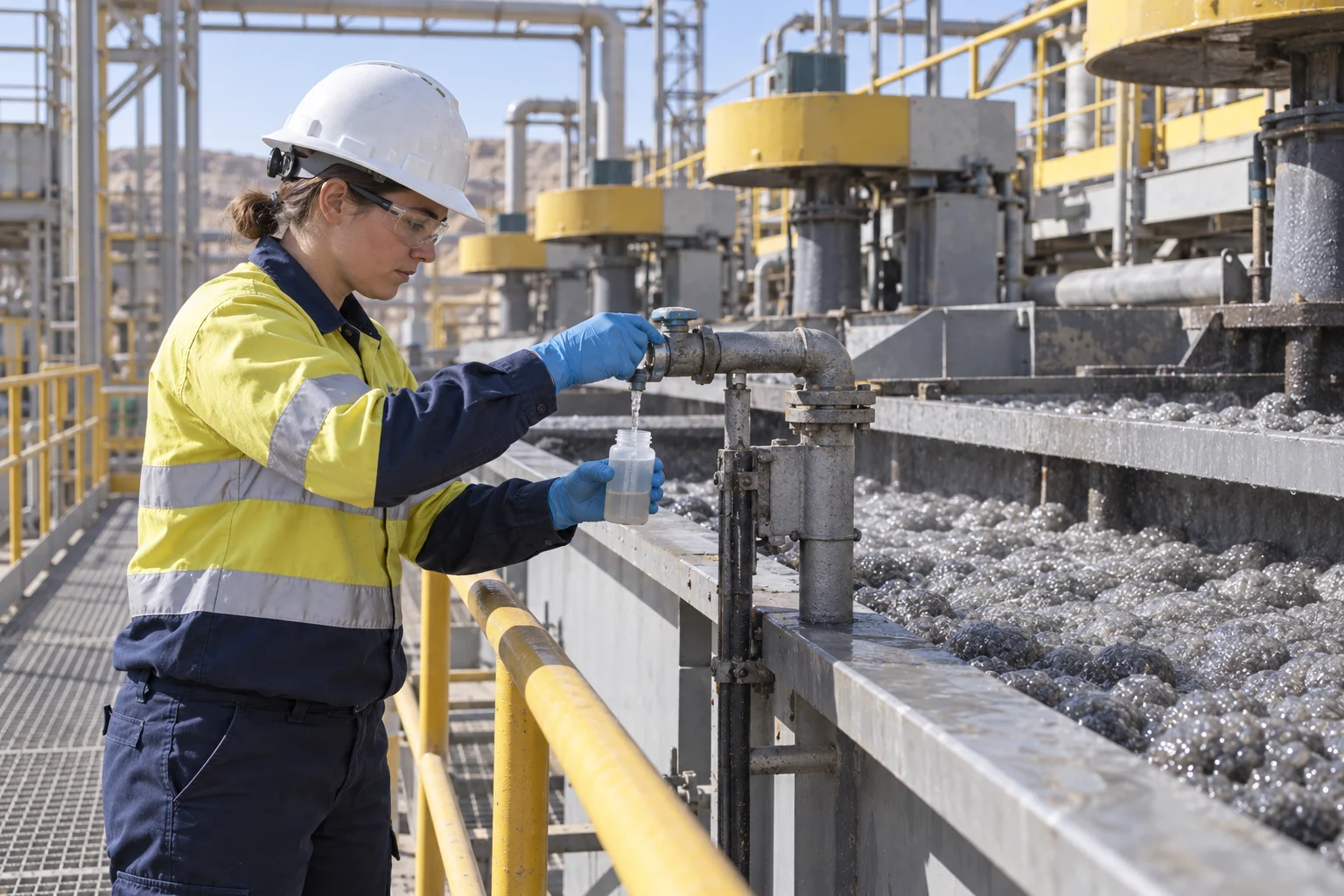
A review of treatment techniques for flotation-reagent residues discusses adsorption, oxidation and biological routes, while emphasizing that the relevant residual compounds and their transformation products must be understood first.4 Treatment selection should therefore begin with a verified constituent and receiving-process effect. Avoid selecting broad treatment from a conductivity or visual-clarity change alone.
Test the recycle history, not just one blend ratio
A one-pass blend test answers only what happens immediately after the selected waters mix under that test condition. It does not reproduce repeated return, reagent circulation, solids contact, oxidation, storage or gradual accumulation. When the plant decision changes the loop, use a sequence that represents the expected water path and recycle history. The number and duration of cycles should reflect process residence and data availability; document them rather than presenting a short laboratory series as proof of long-term steady state.
Use representative ore or tailings and keep the plant’s reagent addition order. Compare a baseline water case, the current return water and the proposed blend. If a water source varies, include samples or blend conditions that bound the expected range. Track water chemistry each cycle and pair it with process outcomes: flotation kinetics or recovery and grade where measured, froth and entrainment observations, reagent response, tailings settling and overflow quality, filter response, and relevant pressure or plugging trends. Use controls so that a changed ore or reagent dose is not mistaken for a water effect.
Choose sample points that bracket the suspected change: source water, before and after solids removal, the blend point and the receiving operation. Keep sample preservation, filtration, analytical method and timing consistent. Otherwise, differences between bottles can come from handling rather than the circuit.
Choose a response by the constituent and the process limit
If fine suspended solids or residual floc are driving the problem, compare improved solids capture, a filter or another targeted separation step and confirm that the treated water works in the receiving circuit. If dissolved salts, hardness or sulfate are the constraint, evaluate source selection, blend management, a controlled bleed or a specific dissolved-solids treatment against water balance, waste handling and permit conditions. If residual flotation organics are implicated, first confirm which compounds or process response changed; targeted adsorption or oxidation may affect useful reagents as well as unwanted ones.
Changing blend ratio can reduce a measured constituent but may also reduce available water or change another ion. A bleed can limit accumulation but creates a stream that still needs an approved destination. Pretreatment can improve one downstream response while adding residuals or solids that must be managed. Reordering chemical feed can change adsorption and carryover, so test the actual sequence and point of addition. Set a decision rule that names the variable to change, the expected signal, the observation period and the condition for reverting.
- Separate source baselinesMeasure fresh, return and external waters before combining them.
- Map the receiving operationLocate the return point, mixing time, downstream unit and process acceptance signals.
- Identify the limiting constituentDistinguish dissolved ions, suspended fines, metals and residual reagents.
- Run repeated-cycle testsKeep ore, reagent order and water sampling consistent; track each cycle.
- Compare targeted actionsAdjust blend, source, bleed, pretreatment or feed sequence against the same endpoints.
- Validate and monitorUse a controlled plant trial with limits, stop conditions and water-balance records.
Water stewardship and local permitting place reuse within the mine’s water balance and discharge context. The European Commission issued mining-sector guidance on implementing the Water Framework Directive in May 2026; its jurisdiction and permitting scope do not create a universal flotation-water limit.4
Set monitoring and change control around the water loop
Once a route is selected, maintain a compact record that couples water state to process state: source flow and blend, pH, conductivity, alkalinity, key ions, suspended solids, metals and selected residual reagents; ore or tailings domain; process reagent changes; and the downstream signals that define success. Use laboratory confirmation where online measurements cannot identify the constituent that drives a response. Trend both the leading indicator, such as a source-water shift, and the lagging process outcome.
Define what triggers a new blend test or review: a new ore domain, a changed reagent program, a different return point, a solids-separation upset, seasonal make-up variation or a process trend outside the site’s acceptance range. A mine-water reuse assessment should be tied to site-specific metallurgical tests and local rules rather than a generic ratio.
There is no universal reuse percentage, salinity ceiling or treatment dose that can be safely transferred across ore bodies and circuits. The useful outcome is a decision boundary the plant can monitor and retest when its water balance changes.
See the Mining and Municipal Water Treatment application and the coagulant and flocculant range for relevant treatment routes. The tailings flocculant selection guide covers the upstream solids-separation decision. The site video library currently has no mining-specific recycle-water demonstration. For a technical inquiry, share the water sources, recycle history, ore, receiving unit and measured process signal so product and trial discussions stay tied to the actual use.
Frequently asked questions
Does a clear tailings thickener overflow mean it is ready for flotation reuse?
No. Clarity describes suspended material, not dissolved ions, residual reagents or metallurgical compatibility. Test the water in the intended flotation sequence and track the relevant response.
Why is one blend-ratio test not enough?
One blend tests immediate mixing under one condition. It does not show changes caused by repeated circulation, reagent carryover, solids contact, storage or gradual accumulation.
Which water measurements should be compared before reuse?
Compare each source and the proposed blend for pH, alkalinity, conductivity, hardness, relevant ions, suspended solids, metals, organics and residual process chemicals, then link those measurements to the receiving process.
Should mining process water always be treated before it is reused?
No. The need and treatment depend on the constituent that limits the next use. A solids separator may address fines but not dissolved salts, while broad treatment can also remove useful reagent residues.
Can a universal recycle-water percentage or salinity limit be used?
No. The acceptable range depends on ore, reagent scheme, water sources, recycle history, equipment, downstream use and local permit conditions. Establish it through representative tests and operating evidence.
Technical references
- Lin et al., “Minimizing beneficiation wastewater through internal reuse of process water in flotation circuit,” Journal of Cleaner Production, 2020. Findings concern the tested ore, circuit and reagent changes.
- Manono et al., “Residual Dewatering Aids in Process Water on Flotation Performance of a Selected Cu-Ni-PGM Ore,” Minerals Engineering, 2024. Ore-specific study of residual coagulant and flocculant effects.
- “An overview of treatment techniques to remove ore flotation reagents from mining wastewater,” Journal of Environmental Chemical Engineering, 2023. Review of treatment options and residual flotation-reagent considerations.
- European Commission Notice 2026/C 2836, 26 May 2026, guidance on Water Framework Directive implementation for mining-sector permitting. EU permitting guidance; it does not set a global process-water chemistry limit.