
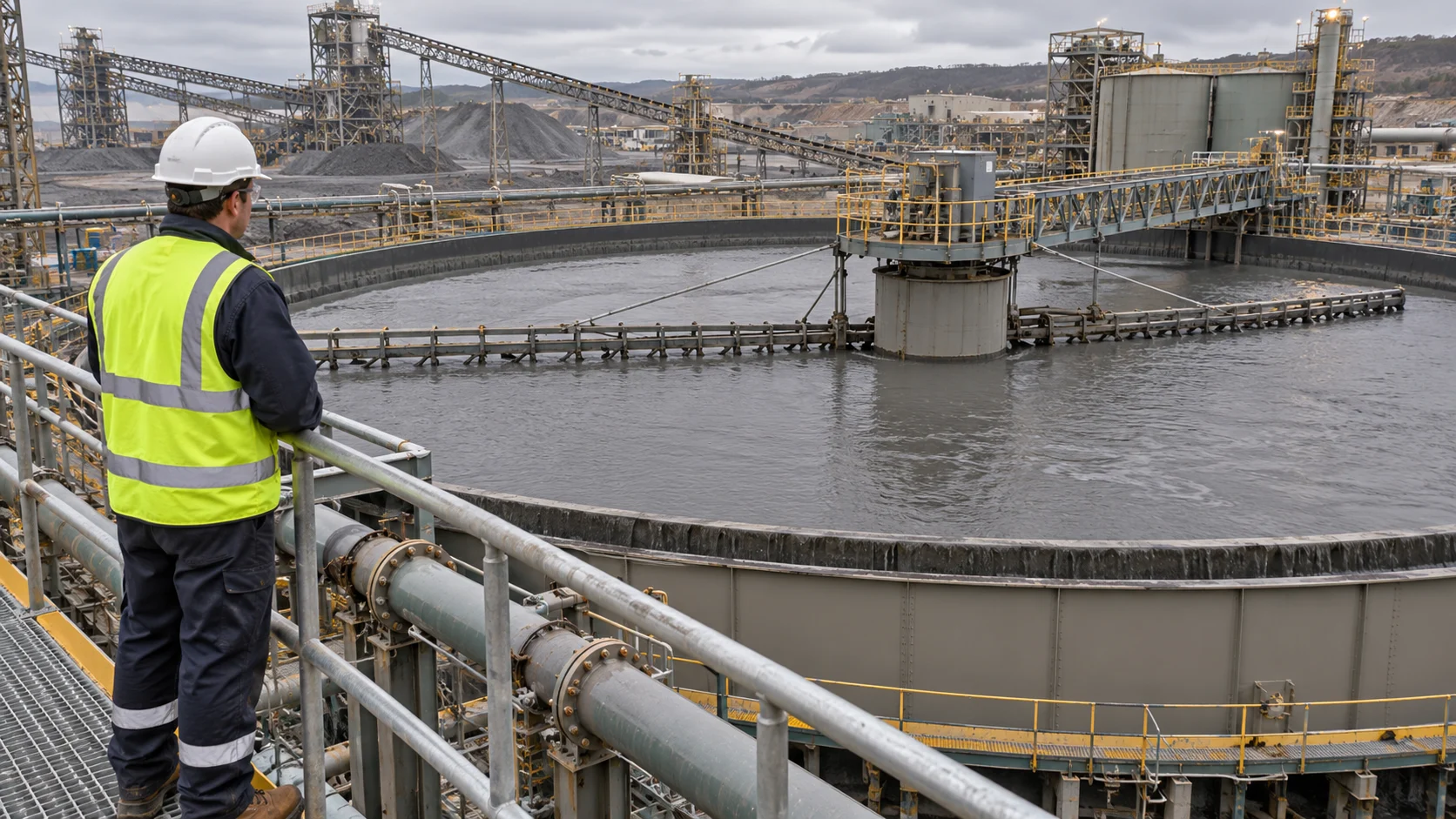
MINING · TAILINGS THICKENING
Tailings Flocculant Selection: Match Slurry, Shear and Thickener Goal
Choose a tailings flocculant by matching a representative slurry and water matrix to the separation job the plant must perform. Start with mineralogy or practical clay indicators, particle-size distribution, solids concentration, pH, salinity, hardness and upstream reagents. Then define whether the priority is overflow clarity, settling flux, bed stability, underflow rheology, filtration or transport; these outcomes can move in different directions. Screen polymer charge and form as candidate variables, not as a substitute for test work. Reproduce solution preparation, feed dilution, contact and the shear history around the thickener feedwell. Advance a promising bench result only when continuous or site testing confirms the selected endpoint under the real feed and equipment envelope.
Define the tailings and water envelope before comparing polymers
“Tailings” is not a single feed. Ore domain, grind, classification, flotation and water circuits can change the solids arriving at a thickener. Record the sample location and time, ore or campaign context, solids concentration, particle-size distribution and the mineral or clay indicators that are available. Kaolinite, illite and swelling clays do not behave as interchangeable fines. A particle-size number alone may miss platy particles, agglomerates or a small colloidal fraction that controls overflow turbidity.
Measure the water that actually accompanies the feed. At minimum, keep pH, conductivity, temperature and a useful hardness or dissolved-ion profile with the sample. Include process reagents that may remain in the slurry when they could affect particle surfaces or polymer adsorption. The purpose is not to create an oversized laboratory panel: it is to explain the variables that can change the response and to reproduce their operating range. Liu and co-authors’ review of clay-rich tailings describes the combined influence of clay structure, salinity, polymer properties and shear, and cautions that laboratory preparation methods can make reported salinity effects difficult to compare.1
Take paired samples when the plant varies by ore campaign, shift or upstream condition. Preserve the process-water fraction and record whether the sample settled, was agitated, or was diluted before testing. A composite may be useful for routine screening, but retain individual samples if a short-lived clay-rich or high-solids feed can control the operating risk.
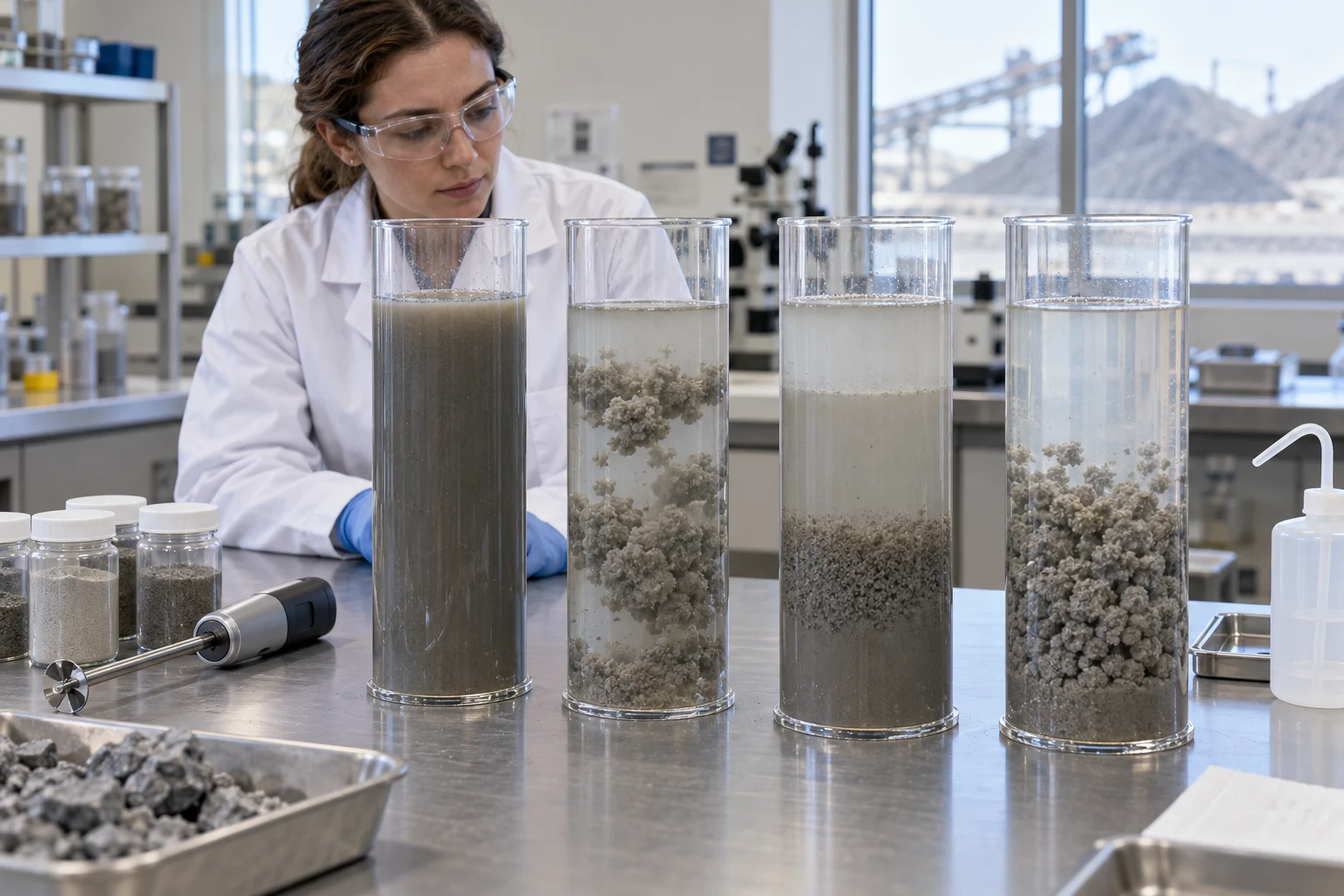
Measure the process objective, too. A thickener may be limited by overflow carryover, bed inventory, rake torque, underflow pumping, filtration capacity or water return quality. The feed and endpoint together define what counts as a useful floc.
Choose the separation endpoint before choosing a flocculant
Polymer screening is often reduced to “which sample settles fastest?” That question is incomplete. A large, open floc can settle rapidly but trap water, shear apart in a feedwell, produce a weak bed or create a difficult underflow. A denser, slower structure may improve compaction or pumping while leaving the overflow too cloudy. Metso’s thickener guidance treats particle properties, feed rate, bed depth, underflow withdrawal and measurable operating signals as a coupled system; it also notes that ore changes can alter settling and flocculant demand.2
| Plant decision | Compare in screening | Confirm at scale | Common false positive |
|---|---|---|---|
| Overflow clarity | Supernatant turbidity or suspended solids using the same settling window | Overflow trend, sampling location, feed variation and carryover events | A clear upper layer in a quiet cylinder despite poor feedwell distribution |
| Settling capacity | Interface movement or settling response at controlled solids and mixing | Continuous solids loading, dilution, residence and feedwell conditions | Comparing velocity from tests with different solids concentration or timing |
| Bed and underflow | Sediment height, compaction time, solids content and rheology where relevant | Bed inventory, rake load, underflow pumpability and stable withdrawal | Maximizing underflow solids without checking torque or transport limits |
| Filtration or conveyance | Filter response, cake handling or slurry flow after defined conditioning | Actual downstream filter, pipeline and deposition constraints | Assuming fast settling proves a filterable cake or transportable paste |
| Return-water use | Overflow quality plus residual fine particles or treatment carryover | Next process unit’s water and metallurgy acceptance criteria | Calling recovered water suitable solely because it looks clear |
FLSmidth describes tailings test work that considers grind size, ultrafines, dewatering and conveyability, and its feedwell materials emphasize the effect of mixing and shear on floc growth.3 These supplier materials are useful equipment context, not universal specifications. Set priorities with operations, metallurgy and tailings handling together; an endpoint that improves water recovery can still be unacceptable if it overloads a rake, filter or pump.
The illustration compares evidence categories, not a ranked product test. A site may need a compromise among them rather than maximizing one endpoint.
Make the screening test represent preparation, contact and shear
Keep the sample, water and polymer preparation method consistent. Record whether the product is supplied as powder, emulsion or another form only after confirming the candidate’s actual product documentation. Make-down concentration, wetting, maturation, dilution-water quality, solution age and transfer shear can change the active polymer presented to the slurry. Avoid assuming that a laboratory-prepared solution behaves like a plant solution merely because both carry the same generic PAM label.
Run an untreated control and vary one factor at a time during the first screen: polymer charge family, molecular structure or form when documented; addition point; dilution; contact; mixing intensity; or the shear step. Use fresh, representative aliquots and the actual process water. Hold the solids basis, addition sequence and observation times constant. If a coagulant or pH adjustment is under consideration, test it as an explicit sequence and compare it with polymer alone; do not assume a second chemical is automatically beneficial.
Small jar and cylinder tests cannot reproduce every feedwell, pipe, pump and thickener condition. They are useful for eliminating poor candidates and identifying response trends. A test with gentle hand mixing may preserve floc that would break in a transfer line; an aggressive stirrer may destroy aggregates that would survive the actual process. Include a shear step only when it represents a real process location, then observe whether the floc reforms or the separation endpoint remains changed.
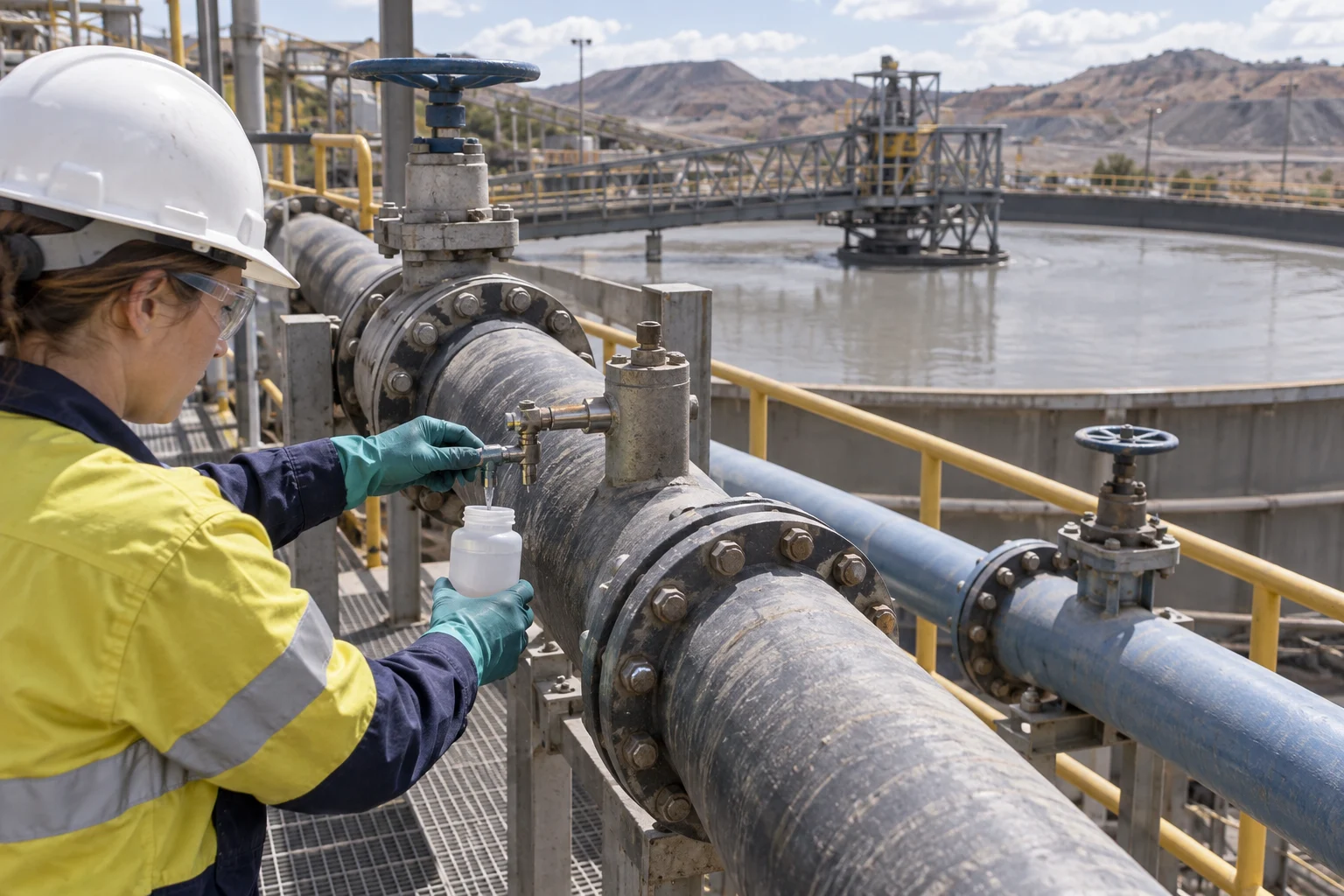
Metso’s feedwell discussion and a peer-reviewed study on clay tailings in seawater and industrial water both reinforce that mixing, particle surface state and water chemistry interact; that study’s results are specific to its tested clay mixtures and waters, not a transferable field dose.4
Advance from bench screening to continuous and site evidence
Use a staged decision. First, repeat the best candidates on independently collected samples that span the expected feed variation. Then use dynamic or continuous testing when the selected outcome depends on solids loading, feedwell dilution, residence, bed compression or underflow withdrawal. A continuous unit provides more representative material and water balances than a single cylinder, but it still needs the plant’s relevant feed, shear and equipment context. Confirm the operating envelope with a controlled site trial before turning a screening result into a set point.
- Characterize feed and waterOre or clay context, size distribution, solids, pH, salinity and residual reagents.
- Set the limiting endpointOverflow, settling capacity, bed, underflow, filtration, transport or reuse.
- Screen under controlled preparationCompare candidates and mixing sequences with a control and consistent timing.
- Reproduce process shearTest feed dilution, addition point and the pump or feedwell conditions that matter.
- Verify dynamically, then at siteTrack feed, overflow, bed, underflow and downstream response before changing routine operation.
During a trial, log feed solids and rate, ore or process state, make-down conditions, solution age, dilution, addition point, mixing or shear changes, overflow quality, bed level or mass, rake load, underflow solids and rheology. Add filtration, pipeline or deposition evidence when that is the limiting endpoint. Record both the desired improvement and any adverse movement in the other metrics.
Use the results to select a route, not just a product label
Choose the candidate that meets the pre-agreed acceptance criteria across the plant’s limiting outcomes and remains stable across the feed conditions tested. If settling improves but clarity worsens, investigate fines carryover, charge demand, dose sequence and separation rather than increasing polymer by reflex. If the bench result is strong but the continuous test fails, check preparation, feed dilution, residence, short-circuiting and shear history before blaming the polymer family. If underflow performance is the constraint, include pumpability, rake load and downstream filtration in the same comparison.
The current coagulant and flocculant range and PAM product page establish relevant product routes; they do not establish a mine-specific grade, charge, dose or outcome. See the Mining and Municipal Water Treatment application, review the video and evidence library, then send a technical inquiry with the ore or tailings source, process-water data, equipment, limiting metric and test conditions. That information makes the next product discussion more useful than a request for a universal dose.
Frequently asked questions
Is the fastest settling flocculant the best choice for tailings?
Not by itself. Compare overflow clarity, bed behavior, underflow rheology, filtration or transport, and the operating constraint that matters to the site.
Should I choose anionic, cationic or nonionic PAM from mineral type alone?
No. Mineralogy can guide screening, but polymer response also depends on particle size and surface state, process water, pH, solids, preparation, shear and the separation endpoint.
Can a jar test predict thickener performance?
A controlled jar or cylinder test can screen candidates. Continuous or dynamic testing and a controlled site trial are needed when feedwell mixing, solids loading, bed compression or underflow handling govern performance.
What should be recorded during a tailings flocculant trial?
Record representative feed and water conditions, solids rate, polymer preparation and age, dilution, addition point, mixing and shear, overflow quality, bed or inventory, rake load, underflow solids and rheology, plus any relevant filtration or transport response.
Does a clearer thickener overflow prove the recovered water is suitable for flotation?
No. Visual clarity does not establish dissolved-ion or residual-reagent compatibility. Test the returned water in the intended process and track its effect on the next operation.
Technical references
- Liu et al., “Improved water recovery: A review of clay-rich tailings and saline water interactions,” Powder Technology, 2020. Review scope: clay-rich mineral tailings, salinity, polymer flocculation and shear; not a universal operating prescription.
- Metso, “Beginners guide to thickeners,” updated March 2024. Supplier guidance on thickener operation and instrumentation; equipment-specific context applies.
- FLSmidth, “Tailings management,” 2019. Supplier brochure covering tailings dewatering, feedwell mixing and shear; product claims are supplier statements.
- Clay Tailings Flocculated in Seawater and Industrial Water: Analysis of Aggregates, Sedimentation, and Supernatant Quality, 2024. Laboratory findings are specific to the tested clays and water matrices.