
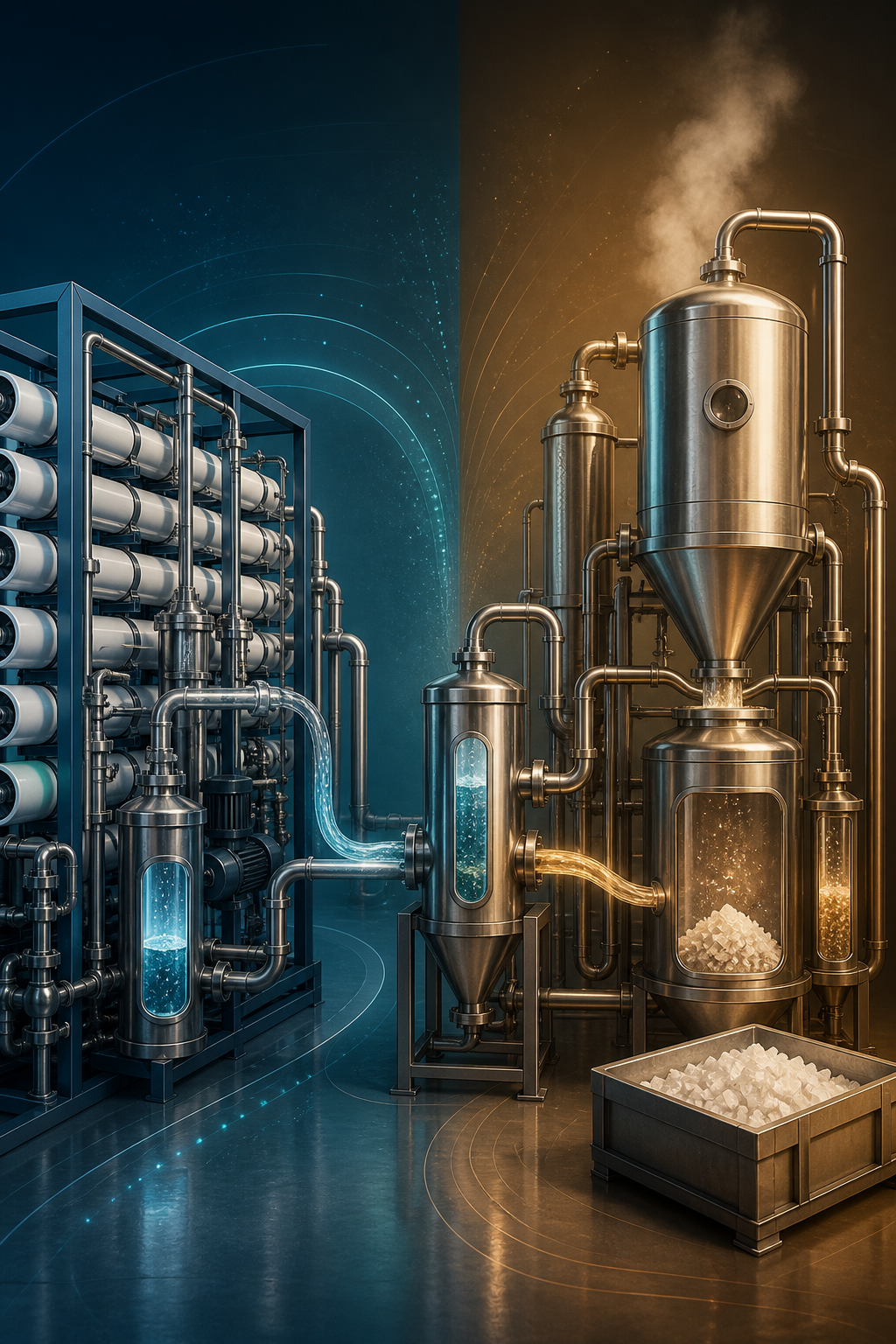
Minimal Liquid Discharge (MLD) vs ZLD
TL;DR MLD and ZLD are endpoints in a treatment train, not two universal equipment packages. MLD uses membranes and other concentration steps to reduce liquid discharge while retaining a residual brine route; ZLD adds the final thermal and crystallization steps needed to leave no liquid discharge and produce solids. A 2024 Nature Water analysis modelled recoveries from 32.6% to 98.6% and found wide cost and energy ranges, so a single $/m³ or kWh/m³ claim is not portable between projects.
MLD vs ZLD: the practical difference
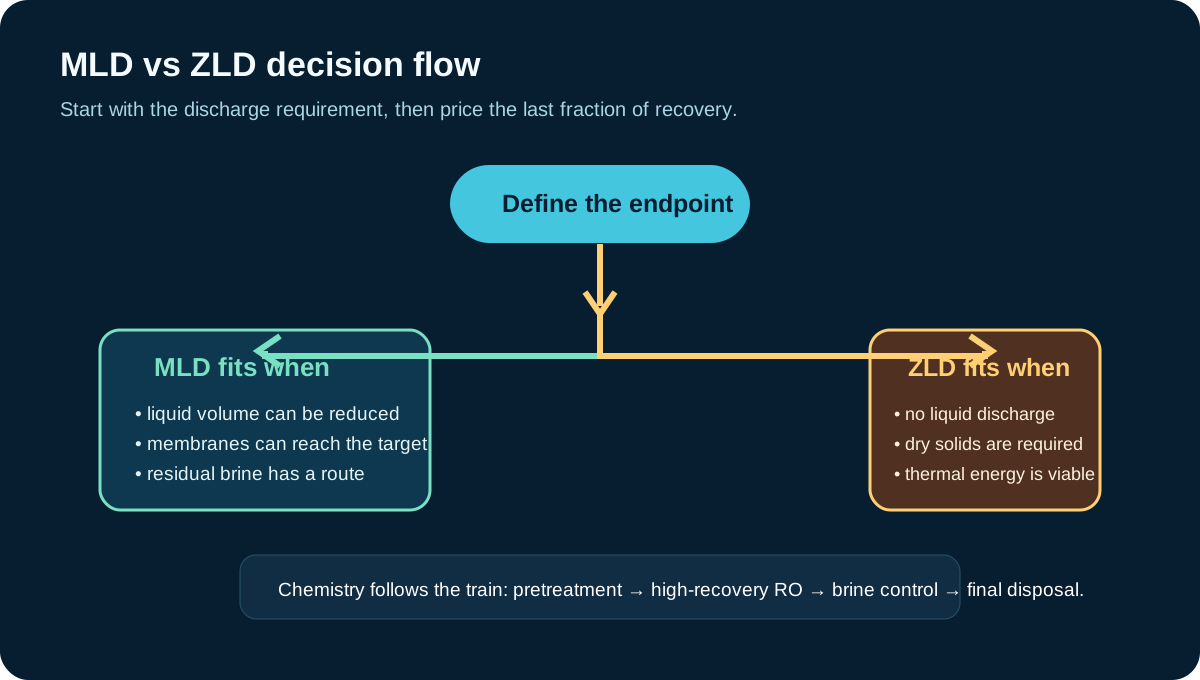
Minimal liquid discharge (MLD) reduces the volume and/or salinity of a liquid waste stream, often with high-recovery RO, CCRO, high-pressure RO, nanofiltration, brine concentrators or other membrane-led steps. MLD may still send a smaller concentrate to permitted discharge, deep-well injection, evaporation pond, off-site disposal or a later thermal step.
Zero liquid discharge (ZLD) is the stricter endpoint: the treatment train is designed so that no liquid effluent leaves the site. The final brine is normally sent through a thermal concentrator and crystallizer, with dry or dewatered solids handled as a waste or recovered product. “ZLD” therefore describes the discharge outcome, not one specific antiscalant or membrane.
Recovery, cost and energy: what the evidence actually supports
The strongest current evidence is not a universal MLD price. A 2024 Nature Water techno-economic and life-cycle analysis evaluated 75 treatment-train configurations. It reported water recoveries from 32.6% to 98.6%, with no single configuration minimizing cost, energy and maximizing recovery at the same time. Its discussion summarizes earlier ranges of roughly US$1–4/m³ and 3–20 kWh/m³ for low-salt-rejection RO, US$0.8–10/m³ and tens of kWh/m³ for mechanical-vapour compression, and less than US$1/m³ with 25–66 kWh/m³ for crystallization; those are literature ranges with different boundaries, not a quote for your plant.
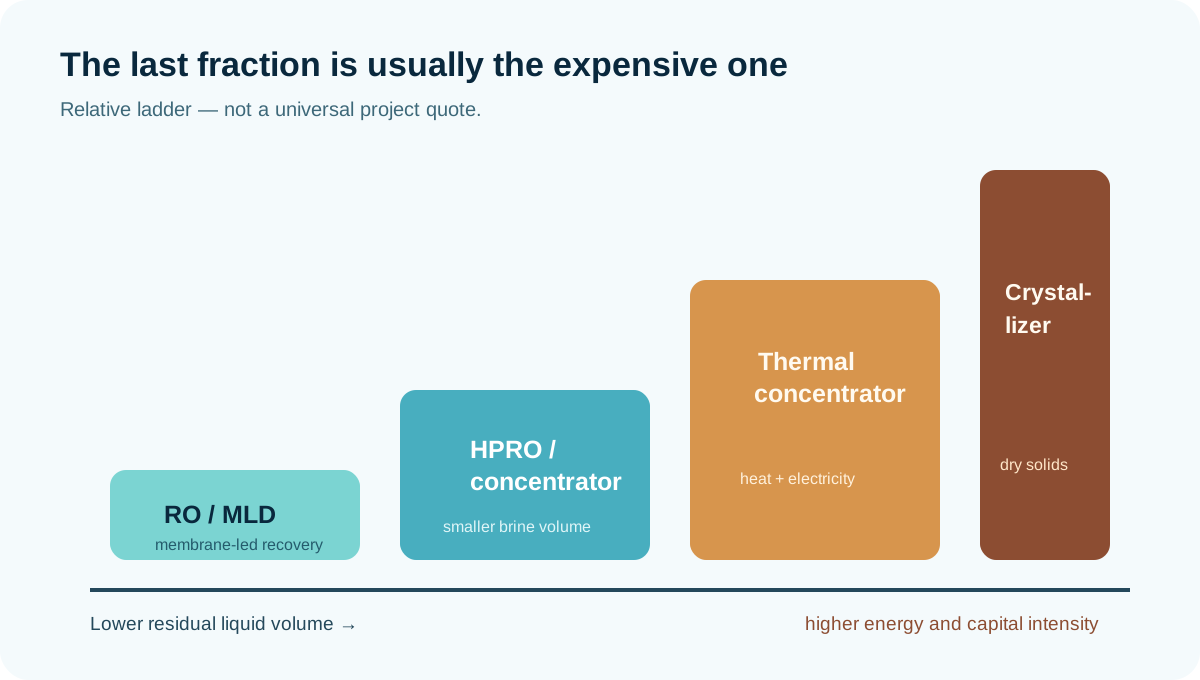
Commercial suppliers often show lower membrane-led MLD figures than thermal ZLD because membranes recover water before the expensive final step. That direction is sound, and DuPont positions its Fortilife elements as a way to reduce concentrate volume sent to thermal treatment. But the final comparison must include feed salinity, recovery target, pretreatment, electricity and heat prices, disposal fees, solids value, cleaning, membrane replacement and whether the cost is per m³ of feed, brine or usable product water.
Why the last fraction costs more
Membranes stop being economical when osmotic pressure, scaling or the required pressure exceeds the design window. Thermal concentration can keep removing water, but it adds heat-transfer surfaces, vapour compression or steam, corrosion-resistant materials, scaling control and more difficult cleaning. Crystallization adds the final solid–liquid separation and solids handling. That is why “recover another 5%” is not a linear upgrade: the last fraction can change the unit operations and energy boundary entirely.
What chemistry changes between MLD and ZLD?
- Membrane-led MLD: control carbonate, sulfate, silica, iron, aluminium and organic fouling in the RO/NF/CCRO train. Use pretreatment and a high-recovery antiscalant selected against the projected concentrate.
- Thermal concentration: manage calcium sulfate, silica, carbonate and corrosion at higher temperature and ionic strength. The membrane antiscalant is not automatically suitable for the evaporator.
- Crystallization: control nucleation, slurry handling and the composition of the recovered or disposed solids; chemical compatibility must be checked against heat, concentration and downstream use.
- Every train: account for acid, caustic, softening, coagulant/flocculant and cleaning chemicals in the mass balance and life-cycle cost, rather than comparing only the antiscalant line.
MLD or ZLD: a buyer's specification checklist
- State the endpoint: permitted liquid discharge, maximum residual flow, no liquid discharge, or dry solids with a defined disposal or reuse route.
- Define the basis for every number: m³ of feed, m³ of brine or m³ of usable water; include the recovery boundary and whether disposal is inside the calculation.
- Provide a full water analysis and variability range: TDS, major ions, silica, hardness, alkalinity, organics, suspended solids, temperature and pH.
- Request a staged process model: pretreatment → membrane recovery → brine concentrator → thermal finish → crystallizer/solids handling.
- Require a sensitivity table for energy price, heat integration, disposal fee, membrane replacement, cleaning and solids management before approving an MLD-to-ZLD decision.
MLD vs ZLD comparison
| Criterion | MLD | ZLD |
|---|---|---|
| Endpoint | Much less liquid discharge; residual brine may remain | No liquid discharge; solids must be managed |
| Typical train | High-recovery RO/CCRO/HPRO, NF or brine concentrator | MLD front end plus thermal concentrator and crystallizer |
| Recovery | Project-specific; membrane and disposal limits apply | Project-specific; highest recovery usually needs thermal/solid separation |
| Energy profile | Usually membrane-led, but pressure rises with salinity | Adds heat, vapour compression and crystallization duties |
| Chemistry focus | Scale, silica, fouling and pretreatment carryover | All MLD risks plus hot, concentrated brine and solids control |
| Best fit | Water reuse and brine minimization with an acceptable residual route | Regulatory or site conditions that prohibit liquid discharge |
Frequently asked questions
What is the difference between MLD and ZLD?
MLD minimizes liquid discharge but can retain a smaller residual brine stream with a permitted or engineered disposal route. ZLD is the stricter endpoint: no liquid effluent leaves the site, so the remaining brine is concentrated and crystallized into solids.
Is MLD cheaper than ZLD?
Often, when membrane-led recovery avoids or reduces thermal treatment, but there is no universal percentage or price. Cost depends on feed salinity, recovery, disposal, energy, pretreatment, heat integration, cleaning and solids handling. Compare on the same m³ basis and system boundary.
How much water can MLD recover?
There is no single MLD recovery number. A 2024 Nature Water analysis modelled ZLD/MLD treatment trains from 32.6% to 98.6% recovery across different configurations. Your target is limited by water chemistry, osmotic pressure, scaling, disposal and the selected train.
Why is ZLD so energy-intensive?
ZLD pushes beyond the pressure and scaling limits of membrane recovery, then uses thermal concentration and crystallization to remove the final liquid. Heat, vapour compression, corrosion-resistant equipment, scaling control and solids handling add energy and capital duties.
Can MLD replace ZLD?
Yes when the site can legally and operationally manage the residual concentrate. No when the discharge endpoint requires zero liquid and dry solids. The correct decision starts with the discharge permit and disposal route, then tests whether membrane-led MLD meets that endpoint.
About the manufacturer
VCYCLETECH is a China-based manufacturer of water-treatment chemicals—phosphonates and their salts, RO antiscalants and dispersants, chelants, biocides, coagulants and defoamers—with batch COA support and OEM/ODM service. See our quality and certifications.
References
- Nature Water: analysis of ZLD/MLD cost, energy and recovery
- DuPont FilmTec Fortilife MLD application
- DuPont FilmTec Fortilife XC220 for MLD/ZLD
- Saltworks MLD/ZLD process overview
Related: RO chemicals · ZLD process & chemicals · CCRO antiscalant at 95–98% recovery · RO silica scaling control · WTASD-200 antiscalant