
RO Silica Scaling: Control, Solubility & Antiscalants
TL;DR Silica is the hardest scale to control in reverse osmosis: amorphous silica (SiO₂) has a solubility of only about 120–150 mg/L at neutral pH and 25 °C, and once the concentrate exceeds it, silica polymerizes into a glassy, near-impossible-to-clean membrane scale. You control it by keeping concentrate silica below its solubility (limit recovery), running warmer or higher-pH water (solubility rises), dosing a specialty silica antiscalant/dispersant, or removing silica in pretreatment.
Why silica scaling is so difficult
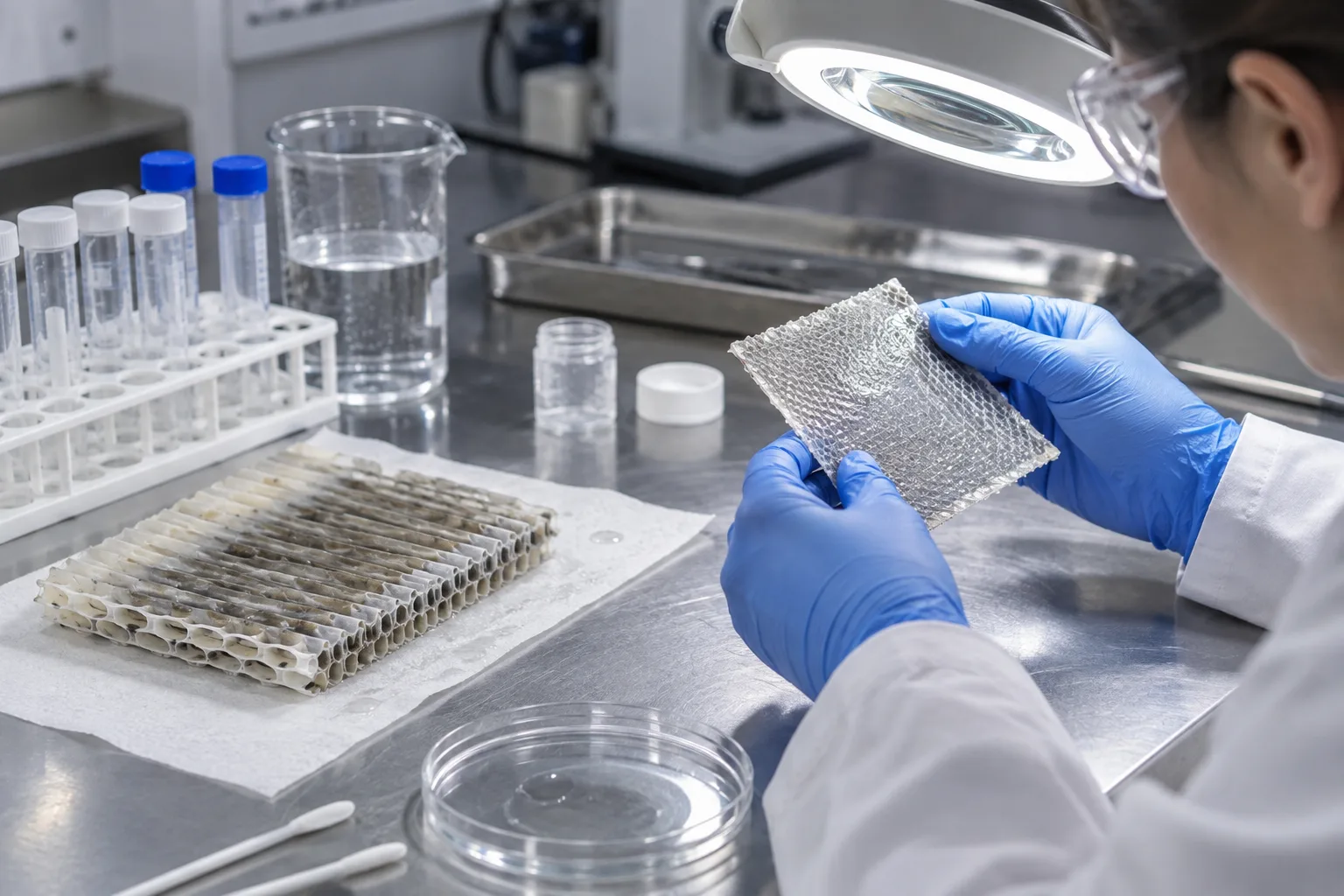
As feedwater is concentrated through an RO array, dissolved silica (silicic acid) concentrates too. When it passes its solubility limit it polymerizes and deposits as amorphous silica on the tail-end membranes — a hard, glassy layer that ordinary acid or alkaline cleaning barely touches. Unlike carbonate scale, silica scale is largely a prevention problem, not a cleaning one, so RO design keeps the concentrate below the silica limit.
Silica solubility and what changes it
Amorphous silica solubility is roughly 120–150 mg/L (as SiO₂) near neutral pH and 25 °C, and it moves with conditions:
- Temperature ↑ → solubility ↑ (warmer water holds more silica).
- pH: solubility is fairly flat 6–8 but rises sharply above pH ~9–10 (silica ionizes), which high-pH RO exploits.
- Iron, aluminium and manganese catalyze silica polymerization, so even trace metals sharply worsen silica scaling — remove them first.
How to control silica scaling
- Limit recovery so concentrate silica stays under the solubility limit — the primary lever.
- Raise temperature and/or pH to lift the solubility ceiling where the process allows.
- Dose a specialty silica antiscalant/dispersant — ordinary anionic scale inhibitors do little for silica; a purpose-made silica dispersant keeps polymerized silica dispersed and lets you run higher recovery.
- Remove silica in pretreatment — lime softening with a magnesium salt co-precipitates silica (used ahead of high-recovery and ZLD systems).
- Remove iron/aluminium/manganese first, since they catalyze silica scale.
Antiscalant selection and dosing
Choose a silica-specific antiscalant and dose it continuously to the RO feed; general programs also carry a AA/AMPS or PCA dispersant for co-precipitated metals. Confirm the maximum safe recovery and dose with a projection and your feed analysis — see our RO antiscalant selection & dosing guide. If silica scale does form, it is removed only by prolonged high-pH cleaning (RO membrane cleaning).
What raises or lowers silica solubility
| Factor | Effect on silica solubility | Practical use |
|---|---|---|
| Higher temperature | Increases | Warm feed tolerates more silica |
| pH > ~9.5 | Increases sharply | High-pH RO for silica |
| pH 6–8 | ~Flat (low) | Standard RO — limit recovery |
| Iron / aluminium / Mn | Catalyze polymerization | Remove in pretreatment |
| Silica antiscalant | Keeps silica dispersed | Run higher recovery |
Watch

Frequently asked questions
What is the solubility limit of silica in RO?
Amorphous silica dissolves to about 120–150 mg/L (as SiO₂) near neutral pH and 25 °C. Reverse-osmosis systems keep the concentrate silica below this limit (by limiting recovery, raising temperature/pH, or dosing a silica antiscalant) because once it is exceeded, silica polymerizes into a hard scale that is very hard to remove.
How do you prevent silica scaling in reverse osmosis?
Keep concentrate silica under its solubility by limiting recovery; raise temperature or pH where possible (solubility rises, especially above pH ~9.5); dose a specialty silica antiscalant/dispersant; and remove iron, aluminium and manganese in pretreatment because they catalyze silica polymerization. High-recovery and ZLD systems also remove silica by lime softening with magnesium.
Do normal antiscalants stop silica scale?
Not well. Ordinary anionic scale inhibitors are effective against carbonate and sulfate scale but do little for silica, whose deposition mechanism is different. Silica control needs a purpose-made silica antiscalant/dispersant, plus recovery, temperature and pH management and removal of catalytic metals.
How is silica scale removed from RO membranes?
Silica scale is very difficult to clean. It is removed only by prolonged high-pH (alkaline) cleaning, sometimes warm, and even then incompletely — which is why silica is managed by prevention rather than cleaning. See our RO membrane cleaning guide for the procedure.
Does VCYCLETECH supply RO antiscalants for silica?
Yes. VCYCLETECH supplies RO antiscalants and dispersants — including silica and metal-oxide dispersants — factory-direct from China with current COA information on request, sample availability and OEM/ODM service, plus projection support. Email sales@vcycletech.com with your feed-water analysis.
About the manufacturer
VCYCLETECH is a China-based manufacturer of water treatment chemicals — RO antiscalants & membrane cleaners, scale & corrosion inhibitors, coagulants, flocculants, biocides and defoamers — ISO 9001 / 14001 / 45001 certified, with current COA information on request and OEM/ODM service. See our quality & certifications.
References
Related: RO chemicals · AA/AMPS · PCA · Reverse osmosis · RO antiscalant selection