
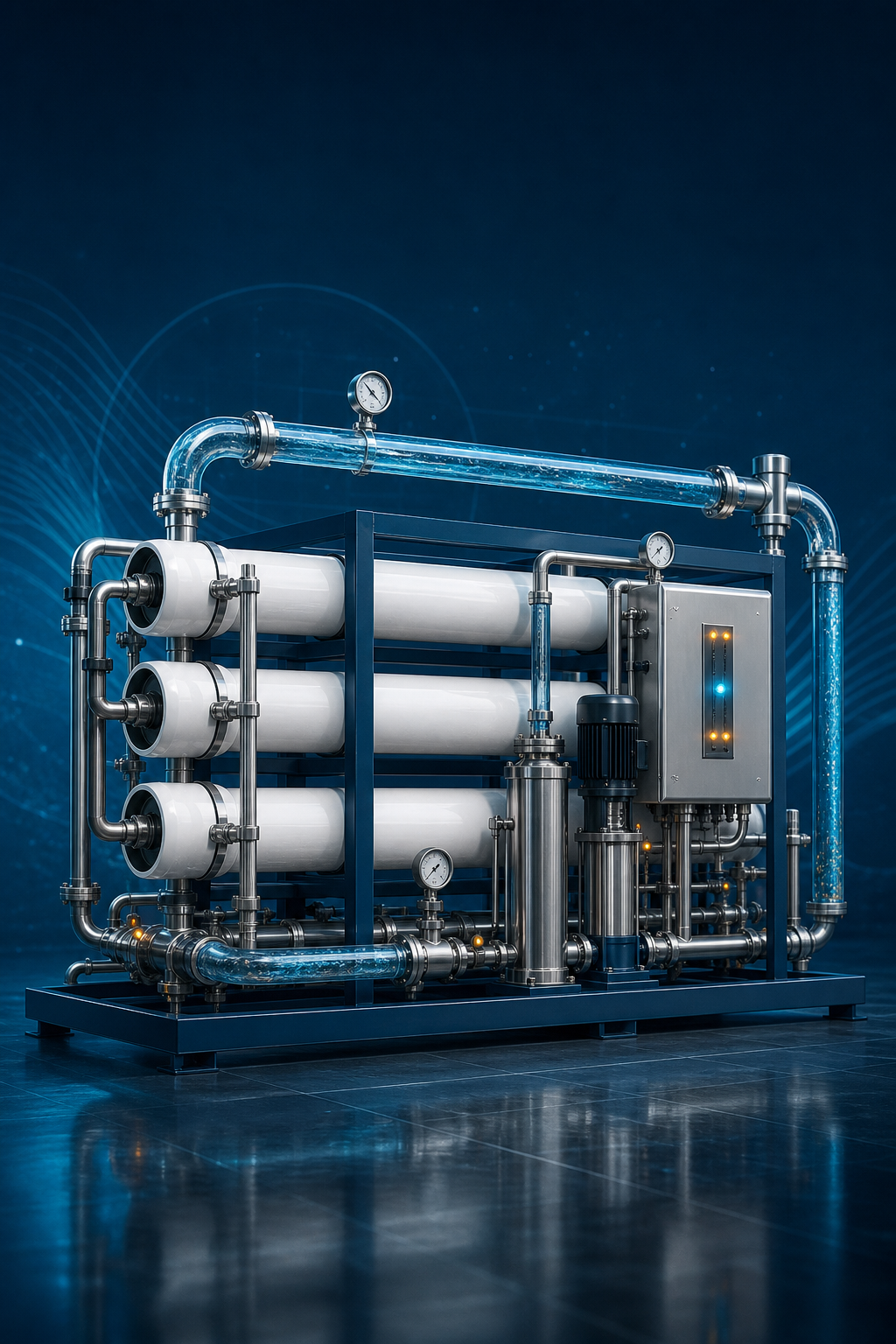
High-Recovery RO Antiscalant: CCRO at 95–98%
TL;DR CCRO can be designed in the 95–98% recovery range, but the antiscalant dose is not a universal number. At 95% recovery the concentration factor is about 20×; at 98% it is about 50×. Select the chemistry from the actual feed and concentrate analysis, model the saturation and silica risk, then validate the dose in a pilot or controlled commissioning run. A public CCRO pilot reported a 3 ppm AWC A-119 dose, while its conventional high-recovery comparison used 1 ppm AWC A-119 or 2.5–3.0 ppm Avista Vitec-4000; those are case data, not a recipe for every plant.
What changes at 95–98% recovery?
Closed-circuit reverse osmosis (CCRO) recirculates concentrate through a short membrane array and periodically flushes the concentrated loop. That semi-batch pattern gives the operator a recovery setpoint and a way to disrupt continuous concentration at the membrane surface. DuPont's current CCRO guidance lists a recommended design range of 75–98%, and its technical material reports demonstrations above 98%; the achievable target still depends on osmotic pressure, scale chemistry, pretreatment and permeate-quality limits.
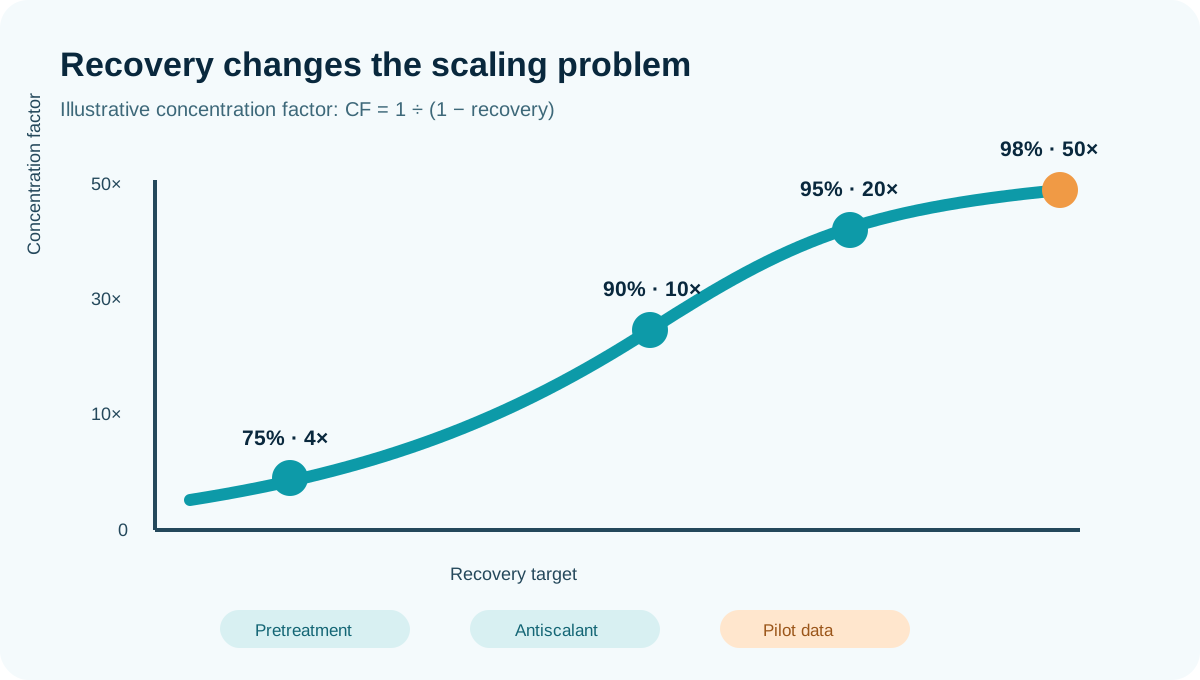
The arithmetic is simple but the operating consequence is not: concentration factor = 1 ÷ (1 − recovery). At 90% recovery the factor is 10×, at 95% it is 20×, and at 98% it is 50×. That factor is a screening calculation, not a substitute for a membrane projection model, because different ions, pH, temperature and selective removal change the real saturation path.
Choose the antiscalant by failure mode
Do not start with a brand name. Start with the species that will reach its limit first in the final CCRO cycle:
- Calcium carbonate: check pH, alkalinity, calcium and the concentrate LSI. Acid may help carbonate control, but it does not solve sulfate or silica scale and adds a corrosion and handling burden.
- Calcium sulfate, barium sulfate or strontium sulfate: use the relevant saturation projections and ask the antiscalant supplier for compatibility and threshold-inhibition evidence at the projected ionic strength.
- Silica: distinguish dissolved silica from colloidal silica, then evaluate pH, temperature, iron/aluminium carryover and the product's silica-dispersion mechanism. A generic carbonate inhibitor is not automatically a high-silica CCRO product.
- Aluminium, iron or cationic polymer carryover: treat pretreatment carryover as a separate fouling risk. DuPont's membrane manual warns that incompatible anionic and cationic polymers or multivalent-metal contamination can form difficult-to-remove deposits.
For a buyer, this points toward a high-recovery RO antiscalant or antiscalant/dispersant package whose technical sheet states the target scale mechanisms and operating window. Compare RO chemicals by active chemistry and application evidence, not by the lowest price per drum.
How much antiscalant should CCRO use?
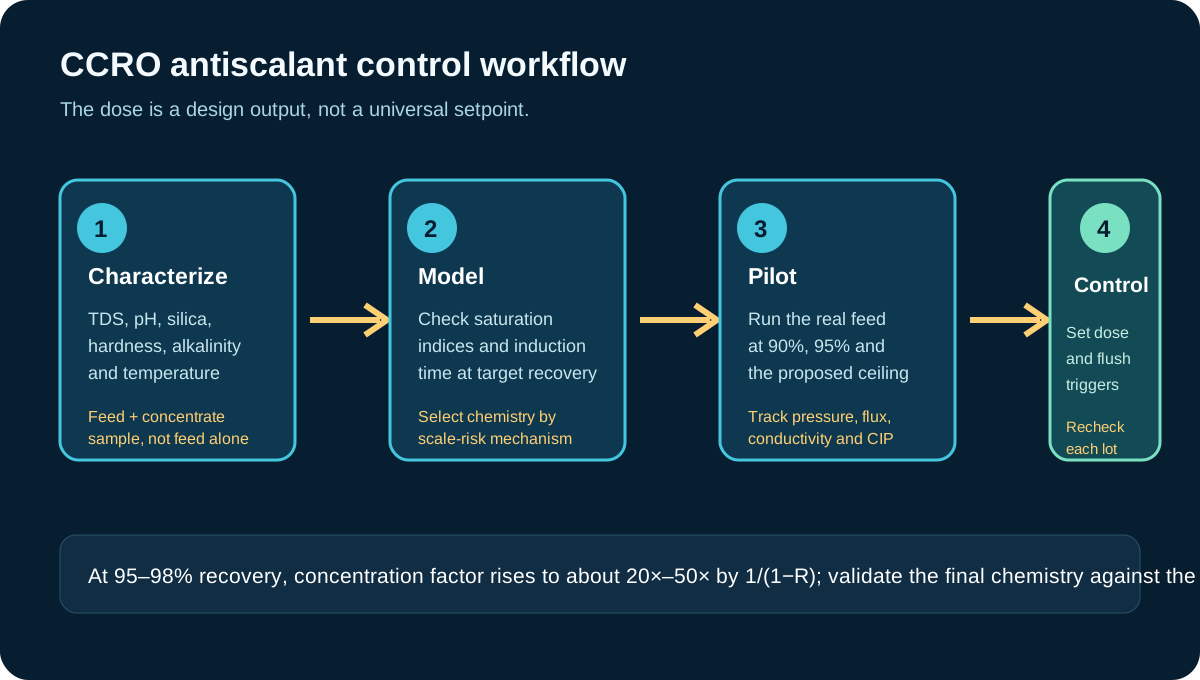
There is no defensible “95% recovery dose” that can be copied from one plant to another. Dose depends on feed composition, temperature, pH, recovery profile, membrane element, concentrate flush trigger, pretreatment and the product's active strength. The correct sequence is:
To narrow the available grades, share the industry, water or process conditions, treatment objective, current program, required quantity, packaging and destination. Representative sample results are helpful when performance depends on site water chemistry.
Can CCRO run without acid?
Sometimes, but “without acid” is a design outcome rather than a sales claim. CCRO's recirculation, crossflow and flush sequence can interrupt the time available for nucleation and reduce the need to force carbonate chemistry with acid. The final decision still belongs to the projection: if carbonate saturation is the limiting constraint, acidification or softening may remain necessary; if sulfate or silica is limiting, acid alone is the wrong lever.
Commissioning checklist for 95–98% recovery
- Record feed, permeate and final-cycle concentrate: conductivity, TDS, pH, temperature, silica, calcium, alkalinity, sulfate, barium, strontium, iron and aluminium.
- Calculate the concentration factor and set an operating ceiling below the first unresolved precipitation risk.
- Confirm the antiscalant active content, product density, dilution water quality and dosing-pump calibration on the lot actually delivered.
- Trend normalized permeate flow, salt passage, differential pressure, final-cycle conductivity and CIP frequency; a stable pressure trend is stronger evidence than a single clean membrane.
- Revalidate after a feedwater change, pretreatment upset, seasonal temperature shift or change in membrane element.
CCRO antiscalant selection at a glance
| Decision | What to verify | Do not assume |
|---|---|---|
| 95–98% recovery | CCRO design range, osmotic pressure and cycle/flush setpoints | Every feed can sustain 98% |
| Dose | Projection + pilot/commissioning trend on active basis | One ppm value fits every plant |
| Silica control | Dissolved/colloidal silica, pH, Fe/Al and dispersion evidence | A carbonate inhibitor covers silica automatically |
| Acid decision | Carbonate saturation and corrosion/handling impact | Acid fixes sulfate or silica |
| Supplier qualification | Current TDS, SDS, batch COA, compatibility and sample support | Price per drum equals treatment cost |
Frequently asked questions
What recovery rate can CCRO achieve?
CCRO is commonly designed across a broad range; DuPont's current WAVE guidance lists 75–98% as the recommended range, and DuPont reports demonstrations above 98%. The sustainable target for a site depends on osmotic pressure, scale chemistry, pretreatment and permeate quality.
Does CCRO use more antiscalant than conventional RO?
Not as a universal rule. CCRO changes the concentration profile and flush timing, so the required dose must be calculated for the actual feed and product. A public CCRO pilot reported 3 ppm of one product, but that case value should not be copied without projection and validation.
Can high-recovery RO run without acid?
Sometimes. CCRO's recirculation and flush sequence can reduce carbonate scaling pressure, but acid may still be needed when carbonate saturation is limiting. Acid does not replace sulfate or silica control, so decide from the full saturation model.
What antiscalant works at 95% recovery?
The right product is the one whose chemistry is compatible with the projected carbonate, sulfate, silica and metal risks at the final-cycle ionic strength. Ask for a high-recovery RO antiscalant recommendation tied to your water analysis, then verify it in a pilot or controlled start-up.
What is the concentration factor at 98% recovery?
The simple screening factor is 1 ÷ (1 − 0.98) = 50×. At 95% it is 20× and at 90% it is 10×. This is a bulk-water calculation; membrane-surface concentration and precipitation risk still require a projection model and operating data.
About the manufacturer
VCYCLETECH is a China-based manufacturer of water-treatment chemicals—phosphonates and their salts, RO antiscalants and dispersants, chelants, biocides, coagulants and defoamers—with batch COA support and OEM/ODM service. See our quality and certifications.
References
- DuPont WAVE CCRO module
- DuPont FilmTec RO/NF technical manual
- Orange County Water District high-recovery RO webinar
Related: RO chemicals · WTASD-200 antiscalant · RO antiscalant selection & dosing · RO silica scaling control · MLD vs ZLD