
WASTEWATER · TEST DESIGN
High-Salinity Industrial Wastewater: Design a Representative Coagulation-Flocculation Test
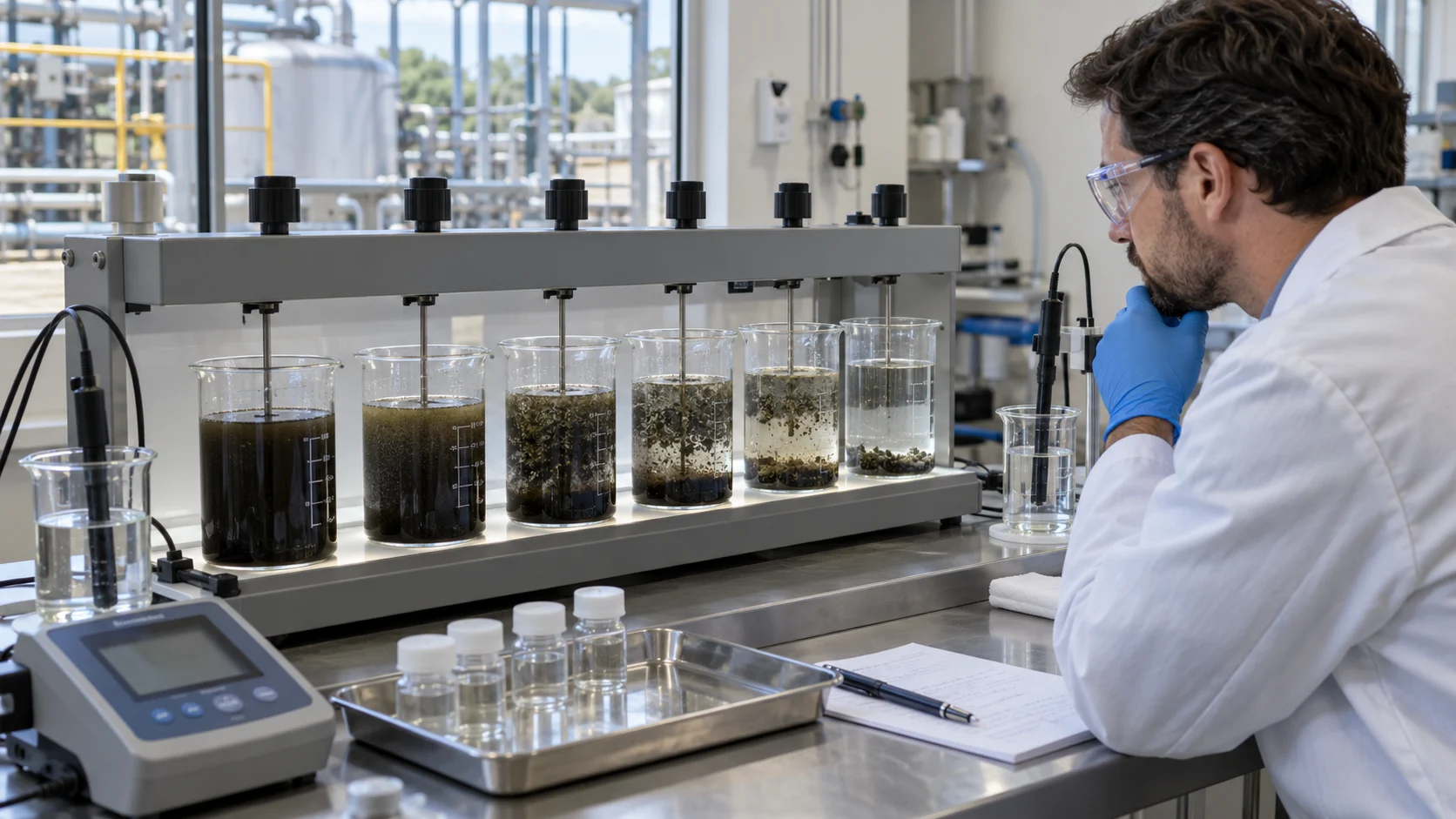
A useful high-salinity coagulation-flocculation test must preserve the water matrix and reproduce the plant’s mixing and separation task. Collect representative wastewater before salts precipitate, phases separate or production changes the blend. Record conductivity or total dissolved solids, major ions where available, pH, alkalinity, temperature, turbidity, suspended solids and the required endpoint. Then screen pH and metal-salt coagulants before adding a polymer aid, keeping order, mix energy, contact time and sampling depth constant. Evaluate the same separation the plant will use—settling, flotation or filtration—not merely the largest visible floc. The output should be a repeatable operating window and a scale-up plan, never a universal product dose.
Define the plant decision before filling the jars
The first design question is not “which coagulant works in salt water?” It is “what must the full-scale step remove, and how will the plant separate what the chemistry creates?” A pretreatment step protecting a membrane, a clarifier removing fine mineral solids and a flotation unit handling light floc have different useful endpoints. Write the decision in one sentence: for example, select a chemistry and operating window that produces water and solids suitable for the existing separator without transferring an unacceptable load downstream.
Describe the normal and difficult water states that drive that decision. High-salinity industrial streams often change with production campaigns, cleaning, evaporation, brine blending or recycle. Conductivity alone shows that the ionic environment changed; it does not reveal whether chloride, sulfate, hardness, alkalinity, dissolved organics, oil or suspended solids changed with it. A recent mechanistic study of model hypersaline waters reported different coagulation behavior under concentrated chloride and sulfate conditions. That result is a reason to retain ion context in the test, not a transferable product ranking for every wastewater.1
This page owns representative high-salinity test design. Use the coagulation-failure guide when a previously stable plant has already drifted, or the jar-test purchase-acceptance guide when the route is known and the task is converting results into procurement criteria.
Build a sample that preserves the salt and solids story
Choose a sampling plan before the test day. A grab sample can represent a stable batch at a known production state; a time- or flow-weighted composite may be more useful when several sources enter an equalization tank. Record where and when each aliquot was taken, production state, recycle contribution, equalization level and any chemical already added upstream. If oil, dense solids or crystals separate during transport, note the change and decide whether gentle remixing reflects what the plant actually sees.
Measure the sample promptly and document storage time and temperature. At minimum, record pH, conductivity or total dissolved solids, temperature, turbidity and suspended solids when they affect the decision. Add alkalinity and the major ions available from the site laboratory—particularly when chloride, sulfate, calcium or magnesium can change between campaigns. Include the decision pollutants, such as unfiltered and filtered COD, color, metals, oil or a downstream fouling indicator, only when the plant’s objective requires them.
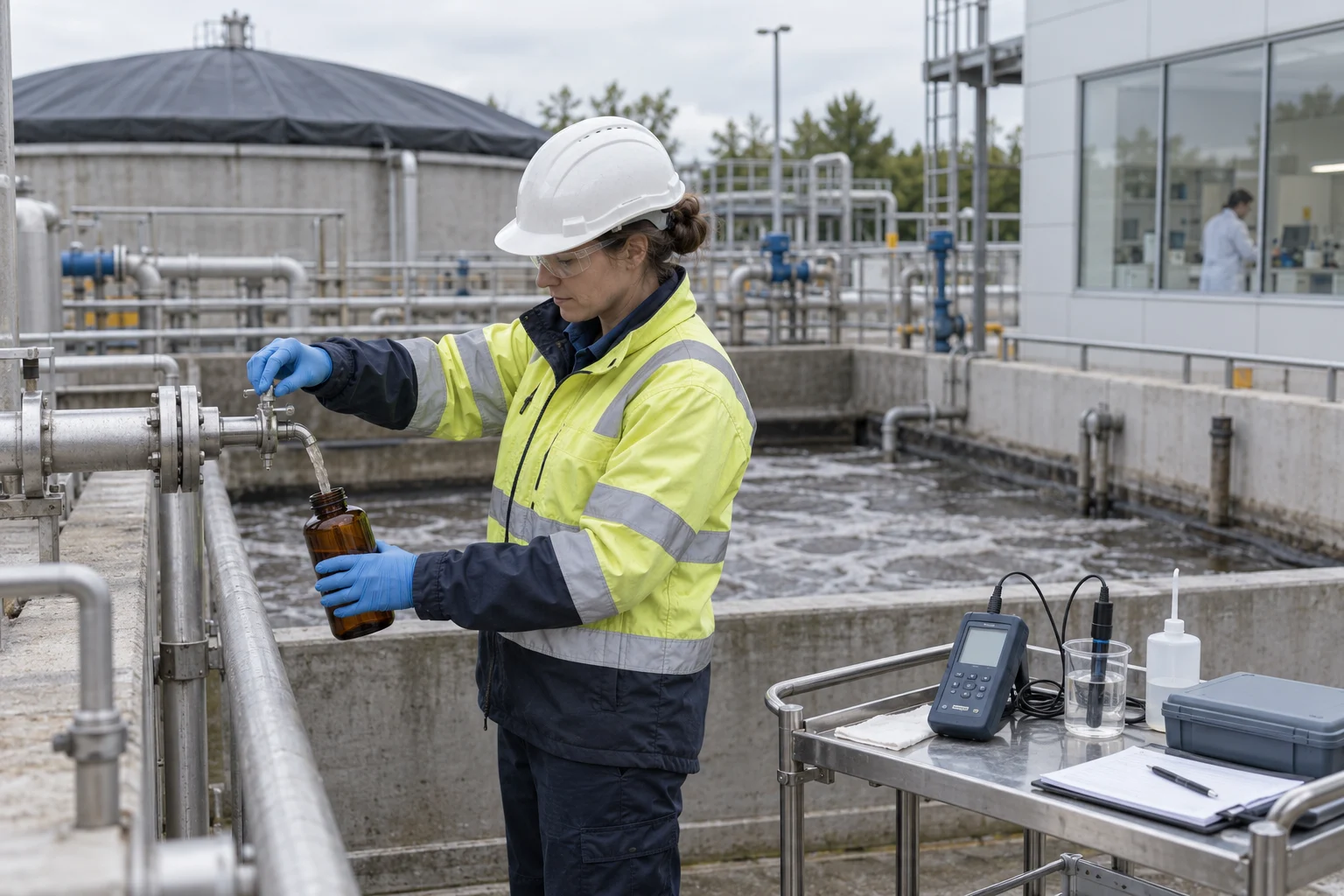
Keep one well-mixed source container for each comparable run. Pour all jars from that container in a short sequence and remix gently between pours if solids settle. Do not “correct” salinity by diluting the wastewater unless dilution is an actual plant operating option. A synthetic salt solution can help isolate a mechanism, but it cannot replace the real wastewater for selection because it omits the organics, colloids, oils and solids that consume chemistry and influence separation.
Design the matrix in stages, not as one crowded experiment
ASTM D2035 describes jar testing as a way to evaluate coagulants, aids, concentration and order of addition under the same water and experimental conditions. US EPA design guidance adds two practical disciplines: vary one parameter at a time and choose reaction and flocculation conditions that mirror the plant.23 Those principles are especially important in high salinity, where a change in pH can also change metal-salt hydrolysis, mineral precipitation and polymer response.
| Stage | Change | Hold constant | Decision |
|---|---|---|---|
| Water-state screen | Representative low, normal and difficult conductivity/ion states when available | Sampling point, analytical methods and untreated control | Does one matrix define the route, or are separate operating windows needed? |
| pH and coagulant family | A bounded pH sweep and a small set of supported metal-salt candidates | Water batch, rapid mix, flocculation, separation time and sample depth | Which region gives stable destabilization without unacceptable residual or sludge? |
| Coagulant dose window | Candidate dose within the useful pH region | All mixing and separation settings | Where does the endpoint improve, flatten or deteriorate? |
| Polymer aid | Charge family, grade candidate, addition point and bounded amount | Selected coagulant condition and make-down procedure | Does the aid improve floc strength and plant-relevant separation? |
| Hydraulic screen | Rapid mix, gentle mix, contact and separation conditions | Leading chemistry and representative sample | Is the apparent chemical result robust to the plant’s mixing and residence window? |
| Repeat | A second representative sample and duplicate leading condition | Recorded method and endpoints | Is the window repeatable enough for pilot or plant confirmation? |
Begin with an untreated, mixed control. It reveals what mixing and settling alone do and protects the team from crediting normal phase separation to a reagent. Next, screen metal-salt candidates over a reasoned pH region. Do not introduce a polymer until the coagulant screen shows which conditions produce useful destabilization. When polymer is added, prepare and age the exact candidate as directed by its current technical documentation, and record the preparation water. High ionic strength can change polyelectrolyte conformation and adsorption, so a polymer that works in a low-conductivity make-down water may behave differently if the plant dilutes it with process water.
A published study on saline, high-strength slops illustrates why results stay matrix-specific: it evaluated aluminum and iron salts plus anionic and cationic polyelectrolytes for that wastewater and downstream treatment context.4 The useful lesson is the structured comparison and downstream objective, not its dose, mixing recipe or reported removal.
Match the jar to settling, flotation or filtration
Conventional jar tests normally finish with gravity settling, but the plant may not. If the full-scale separator is DAF, add a flotation-relevant confirmation rather than selecting solely by settled supernatant. If filtration protects the next step, measure the filtered endpoint and observe headloss or filterability with the site’s test method. For lamella or conventional clarification, use a consistent sample depth and settling interval, then record the solids blanket, carryover and the ease of withdrawing clear water.
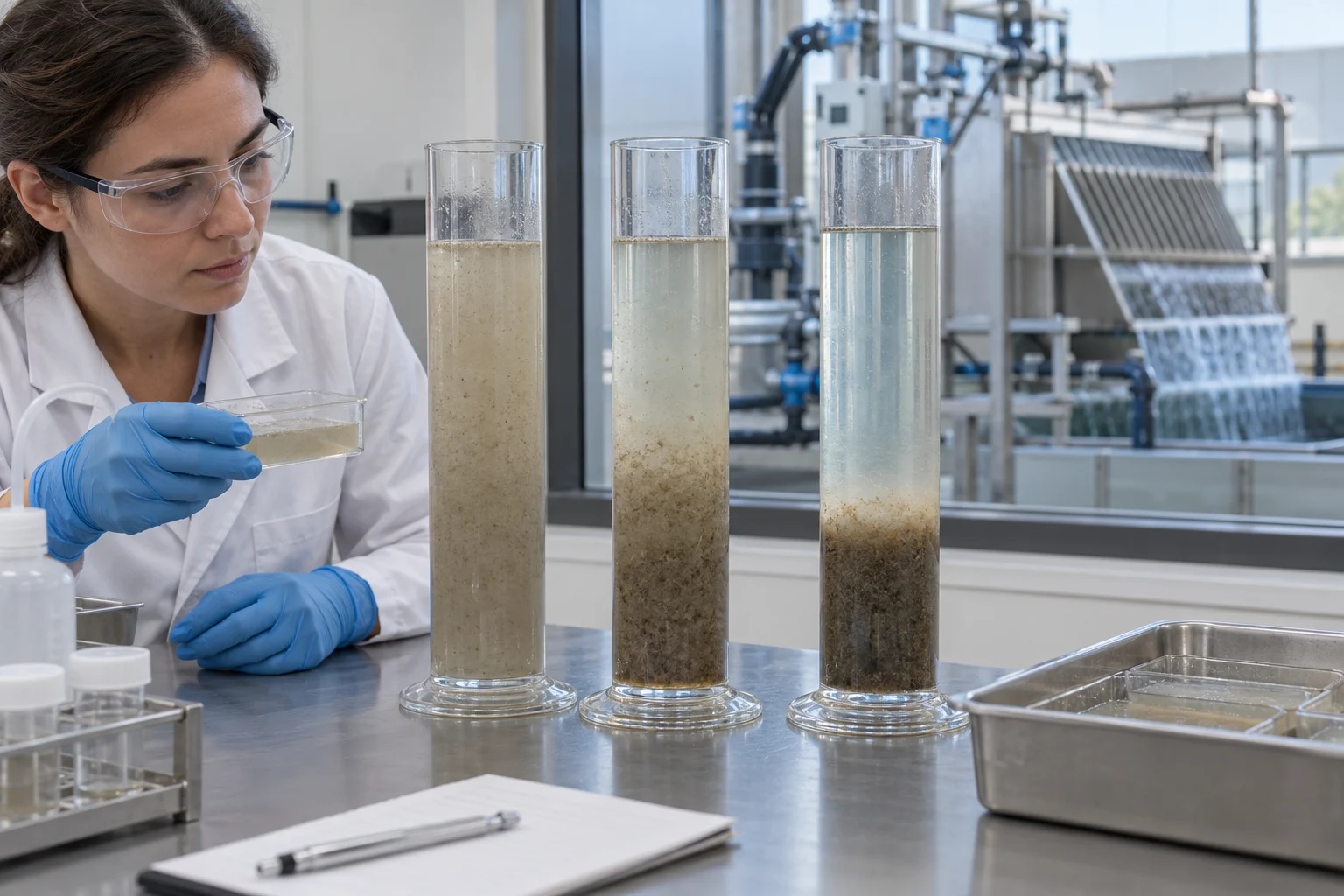
Score the treated water and the solids separately. For the water, use the parameters tied to the decision—perhaps turbidity, suspended solids, filtered and unfiltered COD, color, metal, oil or a downstream fouling signal. For the solids, record floc size only as an observation; add settling or rise behavior, shear recovery, sludge volume, dewaterability screen and visible carryover where relevant. Measure final pH and conductivity so a result is not accepted after silently moving the water outside the downstream operating window.
Avoid a single composite “best jar” score. A condition can improve turbidity while increasing sludge, leave dissolved COD unchanged, or form floc that the plant cannot separate. A practical decision table should show every acceptance endpoint, its test method, the sample location and whether it is a target or a stop condition.
Scale up a window, not a laboratory dose
Translate the leading condition into the plant’s equipment terms. Record the point of first contact, available mixing energy, chemical sequence, delay between additions, temperature, residence time, recycle paths and the separator loading. Check whether the proposed feed equipment can deliver the candidate form reliably and whether the dilution water is compatible. Laboratory concentration in a beaker is not yet a pump setting because full-scale flow, product strength, density, mixing and control range still have to be reconciled.
Confirm the leading route during the water states that matter. A short pilot or guarded plant trial should include baseline and treated periods, stable sampling points and predefined stop conditions. Repeat after a normal production change if salinity or contaminant loading shifts. Keep the candidate grade identity, current TDS/SDS and lot-specific COA where available with the test record; do not assume that “PAC” or “PAM” alone defines equivalent products.
VCYCLETECH’s coagulants and flocculants range is the Money Page for discussing candidate routes. The PAC and PAM pages identify relevant product families, while the PAC–PAM jar-test video shows a different water matrix and is not proof for high-salinity performance. Share the representative analysis, separator, test matrix, endpoints and expected quantity before requesting an exact grade. Discuss a high-salinity test plan →
Frequently asked questions
Does high conductivity mean coagulation will fail?
No. Conductivity indicates an ionic environment, not a universal failure threshold. Salt species, pH, alkalinity, contaminants, coagulant chemistry, polymer and separation conditions all influence the result. Test representative water states instead of applying one conductivity rule.
Should I dilute a high-salinity sample for the jar test?
Only if dilution is a real plant option being evaluated. Otherwise dilution changes the matrix and can produce a result that the full-scale wastewater cannot reproduce. A synthetic or diluted sample may support mechanism work but should not replace the real selection test.
Should polymer be screened at the same time as the metal salt?
Screen the main coagulant and pH region first, then add a controlled polymer-aid stage. Changing both at once makes it difficult to know whether destabilization, bridging, preparation or order of addition produced the result.
Is the largest floc the best result?
Not necessarily. Select against treated-water quality, floc strength, carryover, sludge burden and the plant’s actual separator. Large fragile floc can shear or perform poorly in flotation, clarification or filtration.
What should I send with a coagulant or flocculant inquiry?
Send the sampling point and production state, conductivity or TDS, major ions where available, pH, alkalinity, temperature, solids and decision pollutants, the current treatment sequence, separator type, trial endpoints, destination and expected quantity. Request current documents for the exact candidate grade.
Sources
- Zhu et al., coagulation mechanisms under concentrated chloride and sulfate conditions — model hypersaline mechanism study; not a field recipe.
- ASTM D2035-19, Coagulation-Flocculation Jar Test of Water — systematic comparison of coagulants, aids, concentration and addition order.
- US EPA, Nutrient Control Design Manual — site-specific jar testing, one-variable discipline and plant-relevant mixing context.
- Di Bella, Giustra and Freni, saline wastewater coagulation-flocculation pretreatment — matrix-specific saline wastewater study and downstream-treatment context.
Sources and current search results were reviewed on 4 October 2026. They support the test-design principles and stated limitations, not a universal dose, product ranking or performance result.