
Industrial Wastewater Coagulation Failure: Find the Cause
TL;DR When industrial wastewater coagulation fails, locate the first step that changed before increasing chemical feed. Compare raw water with samples after rapid mix, flocculation and clarification or flotation. Check pH, alkalinity, solids and the actual product feed, then run a jar test with the same wastewater and a clear endpoint. If the jar test improves but plant effluent does not, look at feed delivery, shear and the separator. If both fail, screen chemistry and sequence against the current water. Use the comparison to choose a PAC or polymer trial and define what better treatment must look like.
Where to start when floc or clarity slips
Start with the symptom that matters at your plant: weak floc, color carryover, rising turbidity, unstable COD removal or difficult sludge handling. Compare the current water and operating conditions with a normal run, then identify whether the change begins at chemical feed, rapid mix, floc growth or separation. That tells you whether to adjust the installed process or screen another coagulant and flocculant combination.

Match the symptom to the process step
| Observed symptom | Check next | Best next decision |
|---|---|---|
| No visible floc or persistent haze | Influent pH, alkalinity, temperature, conductivity, color/turbidity, feed-pump delivery, product identity and one-variable jar screen. | Check water chemistry and delivered feed before screening another coagulant. |
| Good early floc, then pin floc or breakup | Mixing intensity and time by stage, pump/feed point, transfer shear, recycle streams and floc observations before and after each boundary. | Check mixing and transfer shear before changing the primary coagulant. |
| Floc forms but carries over | Settling or flotation behavior, surface loading, sludge blanket, recycle/air conditions, short-circuit evidence and solids loading. | Review separator hydraulics and solids loading alongside the chemical program. |
| Color improves but COD target does not | Filtered/unfiltered COD or other approved fractions, color method, soluble-versus-particulate context and downstream treatment role. | Compare COD fractions and the downstream treatment target separately from color. |
| Higher dose makes performance worse | Replicated dose-response curve, final pH/alkalinity, residual or charge evidence where valid, sludge volume and preparation quality. | Use a full response curve and final pH to distinguish the possible mechanisms. |
Color, turbidity and COD answer different questions
| Endpoint | What it describes | How to use the result |
|---|---|---|
| Color | The defined apparent or true-color measurement and its change through treatment. | Use the same color method and filtration state on both samples; track COD separately. |
| Turbidity | Light-scattering response from suspended or colloidal material under the chosen method. | Pair turbidity with solids or particle observations when selecting a correction. |
| COD | Oxidizable load measured by a defined analytical method. | Report the dissolved and particulate fractions to choose the downstream step. |
| Floc observation | Growth, strength, settling or flotation behavior across a documented sequence. | Connect floc observations to treated-water and sludge-handling targets. |
Keep the analytical basis comparable
Trend data is useful only when sample location, collection time, preservation, filtration state and analytical method remain visible. A color result taken on filtered supernatant cannot be compared casually with an unfiltered plant sample; the same caution applies to COD fractions and turbidity readings affected by settling time or carryover. Record detection limits, dilution and any sample treatment that changes the matrix. When the influent is highly variable, use repeated or composite evidence appropriate to the plant procedure rather than treating one grab sample as the whole operating window. These controls make the next jar test and plant response review reproducible.
Sample-to-correction workflow
- Freeze the timeline. Record production recipe, wastewater source, flow, recycle, pH adjustment, coagulant/polymer lot, preparation batch and equipment changes before touching the setpoint.
- Use named sample points. Pair influent, after rapid mix, after flocculation and clarified or floated effluent. Record time, temperature, filtration state, preservation and method so results can be compared.
- Verify delivery. Confirm correct product, usable storage condition, make-down or dilution, pump calibration, valves, injection point and actual flow pacing. A commanded feed rate is not proof of delivered active chemistry.
- Screen one variable at a time. EPA guidance treats jar testing as a site-specific simulation: representative sample, controlled mixing, pH/alkalinity and defined endpoint are more useful than copying another plant's recipe.
- Separate chemistry from separation. Observe where floc first weakens. A clarifier, DAF unit, filter or recycle problem can preserve good bench chemistry but lose solids in the plant.
- Define the decision gate. State treated-water, sludge, operability and repeatability criteria before a correction is accepted. Recheck after representative operating time.

What to send for a useful chemical recommendation
| Include | Why it matters |
|---|---|
| Dated influent and treated-water analyses | Connects the symptom to the actual water matrix and approved methods. |
| Process map and sample-point names | Shows where rapid mix, flocculation and separation can diverge. |
| Chemical identity, TDS/SDS/COA and lot history | Supports identity, safety and traceability; it does not prove performance. |
| Preparation, feed and calibration record | Tests whether the commanded chemistry reached the right point in a usable form. |
| Jar-test protocol and raw results | Allows comparison of sample, sequence, pH, mixing and endpoint without hiding failed jars. |
| Plant response and acceptance boundary | Separates a temporary visual improvement from a repeatable process decision. |
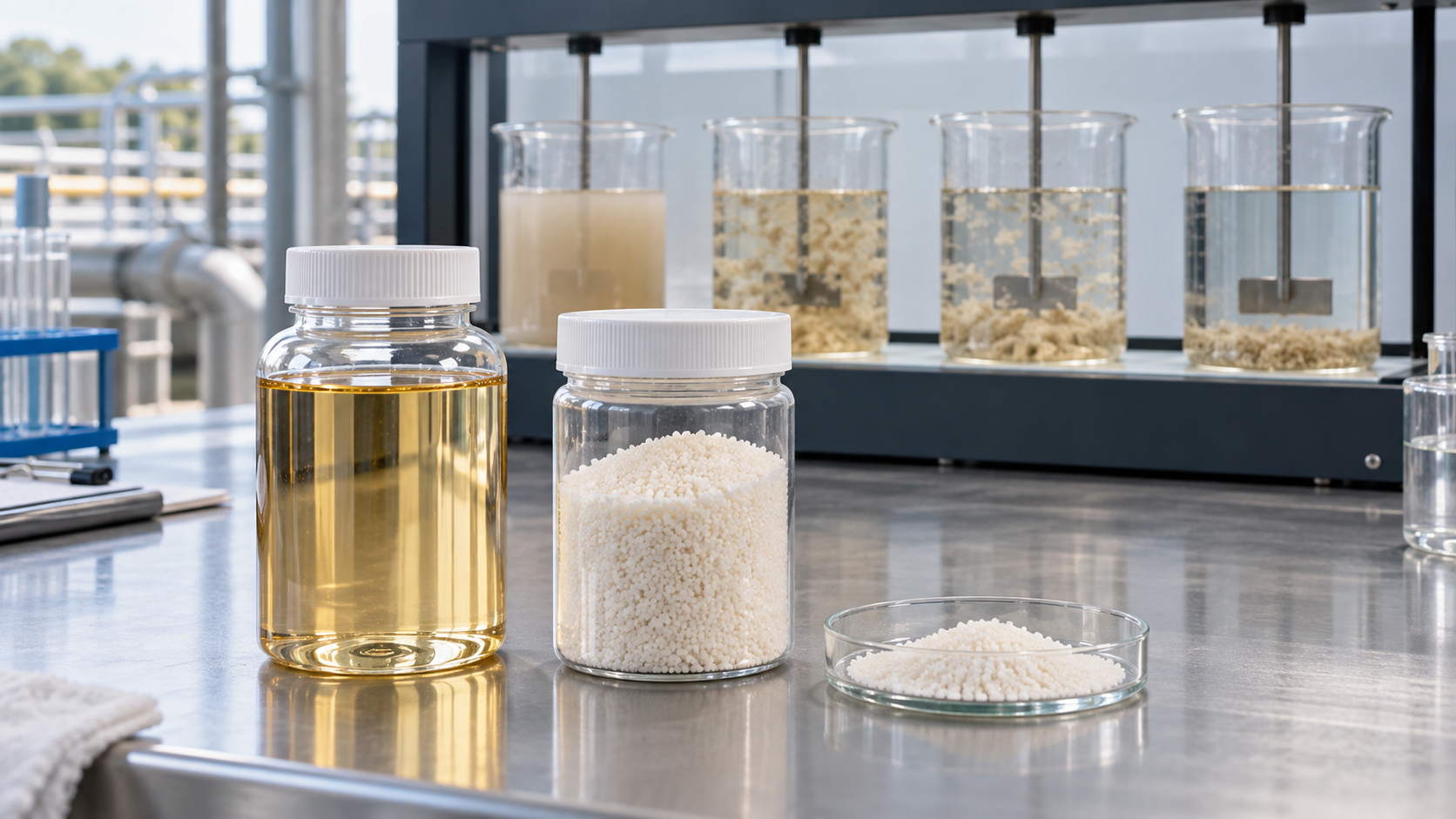
Compare coagulant and polymer families in the coagulants and flocculants range, then use the wastewater application to place each option in the right treatment step. The PAC + PAM video shows the sequence in a jar test. Share your water analysis, current products and separation target to discuss a practical trial.
Frequently asked questions
Why is my wastewater not forming floc?
Possible causes include a changed wastewater matrix, pH or alkalinity mismatch, incorrect chemical identity or delivery, poor preparation, inadequate rapid mix, wrong sequence, polymer mismatch or interfering contaminants. Confirm each branch with representative samples and controlled tests rather than increasing dose by assumption.
How can I tell whether coagulation chemistry or the clarifier is failing?
Compare a representative jar test with samples and observations across the plant. If controlled bench treatment succeeds but plant separation fails, inspect feed delivery, hydraulics, shear, sludge blanket and clarifier or flotation conditions. If both fail similarly, investigate matrix, pH, chemistry and sequence.
Does high turbidity after coagulation always mean underdosing?
No. High turbidity can follow underdose, overdose, pH or alkalinity shift, poor mixing, floc breakage, hydraulic carryover, solids overload or an unsuitable test endpoint. A documented dose-response screen and process-point samples are needed.
Can coagulation remove all wastewater COD?
No general claim is valid. Coagulation may remove a particulate or colloidal fraction under defined conditions, while dissolved oxidizable material may remain. Use the approved COD method, filtration context and downstream treatment objective to interpret the result.
What data should I send before changing coagulant or polymer?
Send dated raw and treated analyses, wastewater source and process timeline, flow and recycle conditions, sample-point map, chemical identity and lot documents, preparation and feed records, jar-test method and results, equipment constraints and pre-agreed acceptance criteria.
About this guide
Prepared by the VCYCLETECH Technical Team. Compare product options with your own water, equipment and operating goals; use current grade documents and a representative trial to confirm the final choice.
Sources
- US EPA Nutrient Control Design Manual: site-specific jar testing and controlled variables
- US EPA Office of Water: bench/pilot testing and scale-up boundary
- HydroChemix peer guide: current troubleshooting structure reviewed, not proof of universal settings
- Water & Wastewater Asia 2026: current industrial reuse and pretreatment context