
OILFIELD WATER · CLARIFICATION
Produced-Water Clarification: Choose the Treatment Sequence
Choose a produced-water clarification sequence by identifying what the separator must remove, not by choosing a coagulant first. Preserve a representative sample, separate free oil from dispersed oil, and distinguish settleable mineral solids from fine colloids, iron corrosion products and biological material. Remove bulk free oil or sand before chemical conditioning when they would consume reagent or damage the next unit. Then reproduce the intended fast mix, flocculation shear, residence time and actual DAF, settling or filtration endpoint in the test. Compare clarified water, recovered oil, sludge and filter response. Better visual clarity alone does not establish injection-water suitability; acceptance must use the downstream system’s defined solids, oil, plugging, compatibility and operating limits.
Classify the incoming burden before selecting chemistry
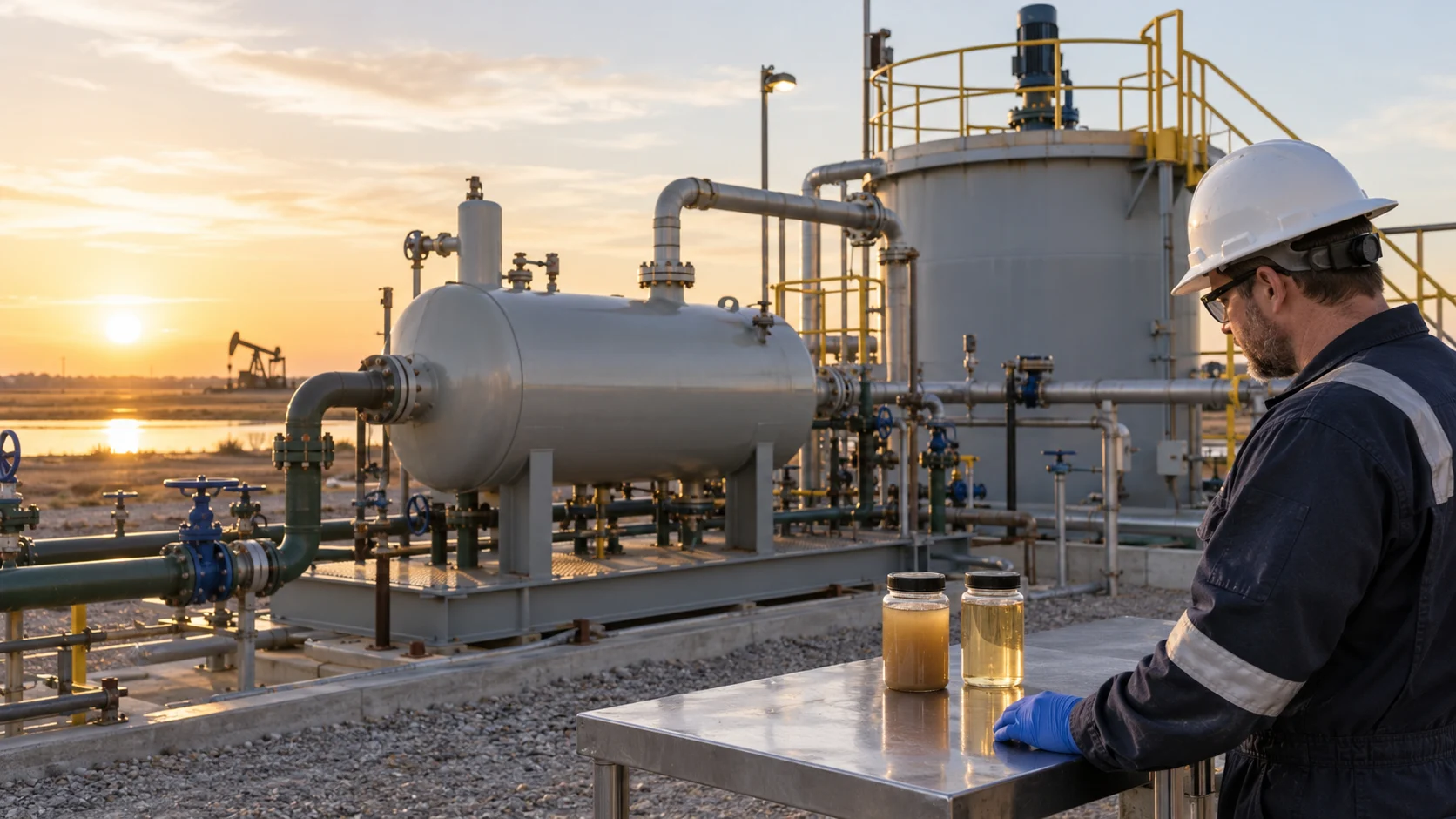
Produced water can carry formation minerals, corrosion products, scale fragments, biomass, completion residues and both free and dispersed oil. These fractions do not respond to one treatment mechanism. Begin with a process walkdown and a time-resolved sample plan: source wells or gathering streams, chemical injection points, separators, tank residence, recirculation, temperature and the proposed sample point. A grab from a quiet tank may lose the coarse material and free oil that the plant must handle; a violently shaken bottle can create an emulsion the plant never sees.
Observe free-water and free-oil separation without treating the bottle as a miniature separator. Measure or characterize oil and grease by an agreed method, total suspended solids, turbidity, particle-size distribution where useful, total and dissolved iron, pH, conductivity or salinity, temperature and visible settleable matter. Use filtered and unfiltered iron to help distinguish dissolved iron from particulate corrosion products, while recognizing that oxidation during collection can change speciation. Record sample age, headspace, agitation, preservation and temperature.
| Observed burden | Evidence to preserve | Likely first operation | Why chemistry alone can mislead |
|---|---|---|---|
| Free oil or large droplets | Undisturbed separation, oil layer, droplet distribution, separator conditions | Gravity separator, hydrocyclone or other bulk oil removal | Coagulant can waste capacity on oil that a primary separator should remove |
| Sand and coarse mineral solids | Settling rate, particle size, mass and abrasion context | Desanding, hydrocyclone or gravity removal | Jar mixing can resuspend a fraction that field equipment removes mechanically |
| Fine suspended minerals and colloids | Turbidity, TSS, particle size, charge response and filterability | Coagulation, flocculation and a matched separator | Good floc formation does not prove that the plant can separate it |
| Stable dispersed or emulsified oil | Oil method, droplet size, emulsion history, temperature and shear | Demulsification or coagulation followed by flotation as validated | Settling tests may reject a floc that would float well, or accept one that carries oil poorly |
| Iron or biological solids | Total/dissolved iron, redox context, microscopy or biological evidence as applicable | Source control, oxidation state control, conditioning and solids removal | Sampling oxidation or biocide carryover can change the apparent treatability |
Do not describe every brown particle as iron or every haze as oil. Microscopy, filtration, extraction or deposit analysis may be needed when the distinction changes the train. The objective is a defensible mass-and-mechanism picture, not a long analytical list detached from equipment.
Place oil and coarse-solids removal before fine clarification when the evidence supports it
A robust train usually removes the largest and least stable burden first. Bulk free oil, gas and coarse solids can consume chemical, blind filters and destabilize later mixing. Primary separation also produces a more representative feed for a fine-solids trial. However, avoid a rigid rule: a stable emulsion may need controlled chemical conditioning before flotation, while a water with heavy sand loading may need desanding before any jar test.
The U.S. Department of Energy’s NETL describes coagulation and flocculation as destabilization and aggregation steps, with flotation as one way to remove the resulting floc.1 That distinction matters. Coagulation changes surface interactions; flocculation grows separable aggregates; neither step is the final separation. The plant still needs buoyancy, settling velocity, filtration or another capture mechanism.
Keep the downstream use visible. Reinjection, disposal, reuse and discharge can impose different solids, oil, biological, chemical-compatibility and regulatory requirements. The U.S. EPA oil-and-gas extraction effluent guidelines illustrate that the regulatory boundary depends on the activity and jurisdiction.2 A locally applicable permit or injection specification—not this article—defines compliance.
Make the bottle or beaker test represent the plant
ASTM D2035 provides a useful laboratory framework for comparing water-treatment chemicals under consistent conditions and explicitly includes concentration, order of addition and gravity settling.3 It is not a universal produced-water recipe and must be adapted when the intended separator is flotation, filtration or a hydrocyclone. Write the field objective and test boundary before opening a reagent bottle.
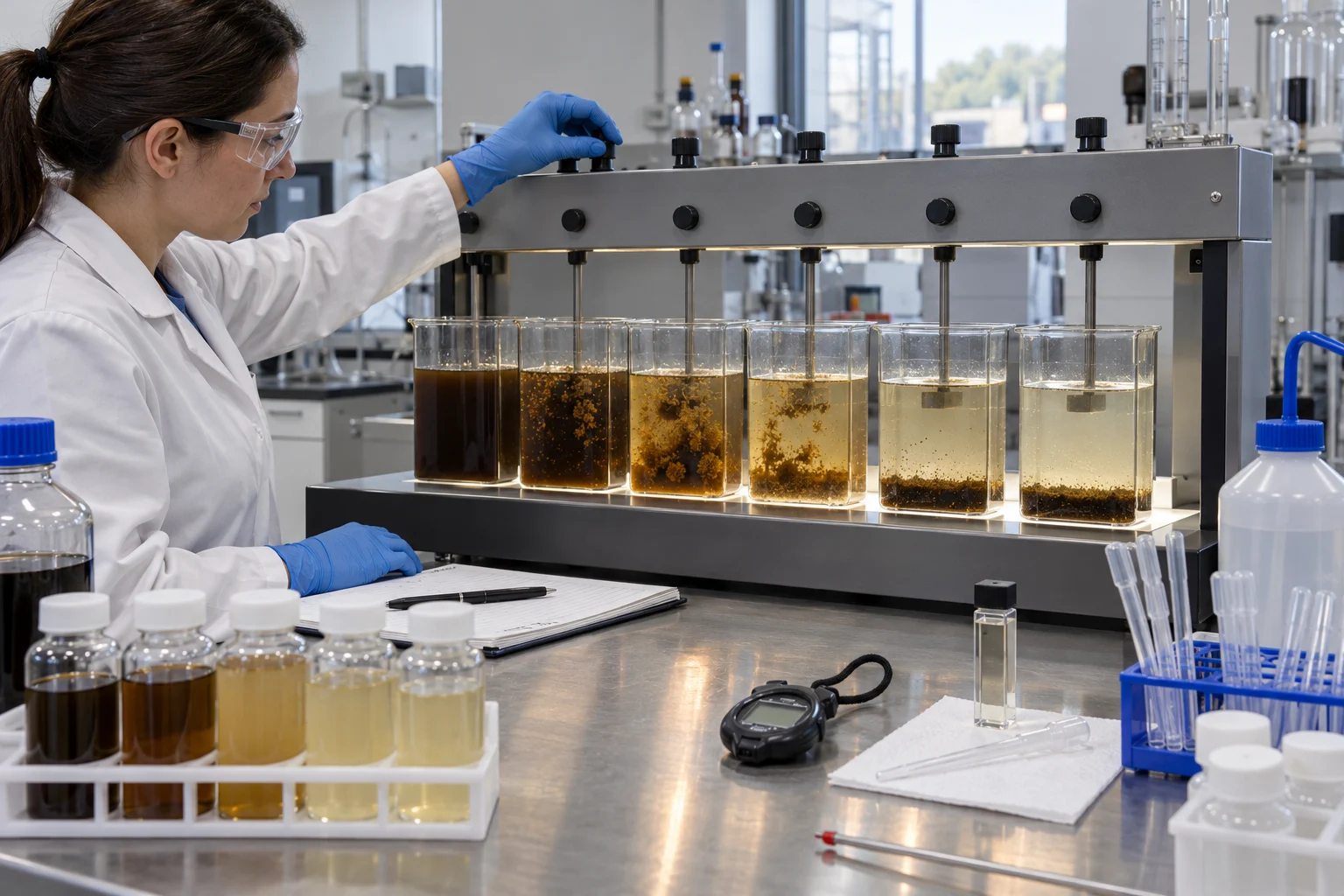
Use fresh, homogenized-with-purpose samples at a recorded temperature. Preserve the original oil and solids distribution without creating artificial shear. Run an untreated control and, when relevant, a primary-separated control. Screen pH only inside a defensible operating and materials envelope. Salinity and divalent ions can change polymer configuration and surface charge; temperature can change viscosity, oil behavior and reaction rate. A promising result under diluted room-temperature water may disappear at field salinity and process temperature.
Fast mix should disperse the candidate treatment without destroying the sample. Slow mix should reproduce the shear and time available before separation. Record speed or velocity-gradient proxy, mixing time, order and interval between additions, temperature, pH and visual floc chronology. If plant transfer pumps or control valves will act after conditioning, include a shear challenge rather than protecting fragile laboratory floc from the equipment it must survive.
| Stage | Record | Useful response | Common false conclusion |
|---|---|---|---|
| Feed | Source/time, temperature, pH, salinity, oil, TSS, turbidity, iron, particle context | Representative untreated baseline | One convenient bottle represents the operating range |
| Conditioning | Candidate identity, addition order, pH change, fast/slow mix and delay | Floc onset, growth, resilience and oil association | The largest visible floc is automatically best |
| Separation | Actual settling, flotation, filtration or combined endpoint and residence | Capture rate, carryover, float/settled phase and filter response | A gravity jar predicts DAF performance |
| Residuals | Supernatant/effluent oil, TSS/turbidity, iron, filtrate and relevant compatibility evidence | Defined downstream acceptance evidence | Clear appearance proves injectivity |
| Waste | Sludge/float volume, texture, dewaterability observations and recovered oil | Operability and disposal implications | A clean water phase has no waste penalty |
Match floc properties to DAF, settling or filtration
For dissolved- or induced-gas flotation, evaluate whether the conditioned particles attach to bubbles, rise within available residence time and form a skimmable float without excessive carryover. A dense floc designed only to settle can be the wrong target. For clarification by gravity, evaluate settling velocity, compaction and supernatant stability. For media or cartridge filtration, evaluate filterability, headloss or differential-pressure trend, filtrate quality and the risk of gummy oil-rich deposits.
A recent produced-water review describes coagulation/flocculation as part of a hybrid train and emphasizes that produced water remains compositionally variable.4 This supports using a train-specific test, not importing a successful combination from another basin. The same apparent turbidity can arise from different particle, oil and iron distributions.

Define a decision endpoint that the next unit can use. If the water will be filtered, report filter response as well as turbidity. If it will be injected, add the applicable particle-size, oil, compatibility, biological and plugging evidence. If it will be discharged or reused, use the governing permit and process requirements. Clarification is a treatment step, not an end-use certification.
Scale up with a mass balance and stop conditions
Advance a short list, not just the clearest beaker. Repeat across representative source mixes and operating temperatures. For a field trial, define feed sampling, treated-water sampling, recovered-oil observation, sludge or float handling, filter differential pressure and downstream response. Keep an untreated or prior-program baseline where operations permit. Track chemical addition by verified flow and concentration without converting a laboratory screening level into a universal field dose.
Set stop conditions for worsening oil carryover, rapid filter loading, excessive sludge, unstable pH, corrosion or materials concerns, loss of downstream acceptance, or unsafe operation. Review the whole train after a well mix, temperature, upstream chemical or separator condition changes. A stable program has an operating envelope and a re-test trigger.
The Oilfield Water Treatment application page is the main route for system and evidence mapping. The Coagulants and Flocculants category, PAC and PAM are candidate identity pages only; they do not establish grade, dose or compatibility for this water. Review the video and evidence library, then share the source profile, separator and acceptance endpoint →
Frequently asked questions
Should free oil be removed before coagulation and flocculation?
Usually remove bulk free oil first when a primary separator can do so reliably, because it reduces avoidable chemical and solids-handling load. Stable dispersed or emulsified oil may still need controlled conditioning before flotation. Confirm the sequence with representative samples and the actual separator.
Can a standard jar test predict DAF performance?
Not by gravity settling alone. A useful DAF screen must reproduce relevant conditioning, bubble contact, residence and skimming behavior. Jar testing can compare destabilization and floc formation, but the separation mechanism still requires its own endpoint.
How do salinity and temperature affect produced-water clarification tests?
They can change polymer conformation, charge interactions, viscosity, oil-droplet behavior, floc growth and separation rate. Test representative salinity and temperature ranges instead of diluting the water or relying only on room-temperature results.
Does clear treated water prove it is suitable for reinjection?
No. Visual clarity does not define oil, particle-size distribution, suspended solids, filterability, biological condition, mineral compatibility or formation-plugging risk. Apply the field’s stated injection-water and equipment acceptance criteria.
What should be included in a clarification-treatment inquiry?
Provide source and sampling details; water temperature, pH and salinity; oil, TSS, turbidity, iron and particle evidence; existing separators and residence times; mixing and shear conditions; downstream filters or injection equipment; waste-handling limits; and the acceptance endpoint.
Sources
- U.S. DOE NETL, Produced Water Treatment technology overview — coagulation, flocculation and flotation mechanisms.
- U.S. EPA, Oil and Gas Extraction Effluent Guidelines — jurisdiction- and activity-specific regulatory context.
- ASTM D2035-19, Coagulation-Flocculation Jar Test of Water — controlled comparison framework and gravity-settling boundary.
- Recent open-access review of produced-water treatment systems — variable feed and hybrid-train context.
Sources, current search results and question-form queries were reviewed on 9 October 2026 for the 8 October campaign slot. They support this decision framework, not a universal chemical, dose, removal rate, injectivity result or compliance guarantee.