
Boiler · source and mixing decisions
Boiler Feedwater Alkalinity: Separate Source Load from Cycles
When makeup alkalinity or the condensate-return share changes, compare the incoming streams and their actual flows before changing internal boiler treatment. A higher boiler-water alkalinity result may reflect a larger incoming load, greater concentration, a treatment contribution or a sampling difference; the same corrective action will not fit all four. Establish matched makeup, return, mixed-feedwater and boiler-water baselines, then check the water balance and a suitable concentration indicator. Correct a demonstrated source, pretreatment, blending or control problem first. Revalidate internal chemistry only against the resulting feedwater conditions and the installed boiler's requirements. This guide helps utility engineers and technical buyers decide which of those investigations should come next, rather than translate a single pH or conductivity reading into a chemical dose.
TL;DR
Separate what entered the feedwater from what happened inside the boiler. Match source and return samples with measured flows, identify the mixing and chemical-addition locations, and compare equivalent alkalinity results using the same method. Check concentration with a constituent that is suitable for the actual system, not alkalinity alone. A changed return fraction can change feedwater composition even when the makeup analysis is unchanged; changed throughput can alter the incoming load without changing concentration. Restore the supported water-path or control condition before screening a new internal program. Define success through stable feedwater, boiler chemistry and the steam-use requirement, not through one favorable sample.
Start with four water locations, not one boiler result
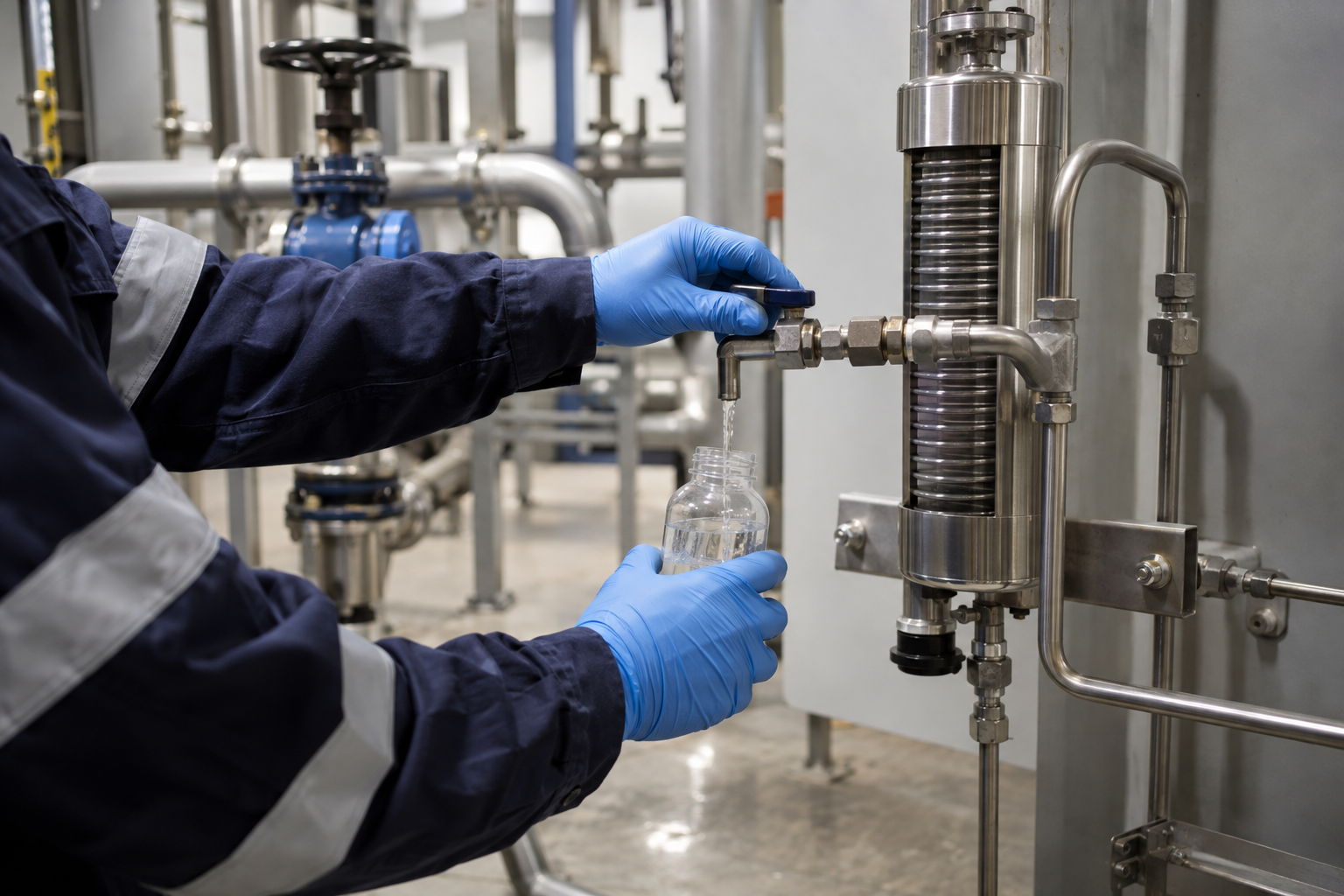
A feedwater change is easier to understand when the sample names describe actual locations. Record treated makeup before it joins the return, each materially different condensate source, the mixed feedwater at a defined position, and representative boiler water. Mark chemical additions, flash-steam recovery, storage and any extra water connections on the same sketch. A sample taken upstream of conditioning cannot be compared as though it were downstream of an unchanged formulation.
For each location, retain time, operating condition, flow or return fraction, pH, alkalinity method and reporting basis, hardness and conductivity with its temperature convention. Add chloride, silica, sodium, iron or treatment residuals only where they help distinguish the suspected change. Match laboratory methods and sampling preparation across the old and new baseline. Record whether a titration is total alkalinity or another specified endpoint; an unexplained change in method can look like a process change.
Alkalinity and pH answer different questions. pH describes the acid-base condition at measurement; alkalinity is a method-defined neutralizing capacity. ASHRAE notes that treated-water alkalinity can include contributions beyond carbonate and bicarbonate. A mixed boiler-water titration therefore does not automatically reveal how much untreated makeup bicarbonate entered. Keep the measured result, its method and the proposed explanation in separate columns of the operating log.
Separate feedwater concentration, incoming load and boiler accumulation
A return percentage without its denominator is ambiguous. Specify whether it is returned liquid divided by total mixed feedwater, steam production or another measured quantity. Use actual flow measurements over comparable intervals where available, and note tank inventory changes. The makeup valve position or pump run time is not necessarily a calibrated flow. When a return stream flashes or a receiver vents, identify where the flow was measured before attempting a balance.
For a simple, well-mixed inlet boundary before conditioning, a useful accounting estimate is: mixed alkalinity equals the sum of each stream's flow multiplied by its alkalinity, divided by total stream flow. Use comparable liquid volumes and the same equivalent reporting basis, such as mg/L as CaCO3; use a mass basis when density differences matter. The estimate assumes representative simultaneous samples and no unaccounted reaction, addition, loss or storage change between those points. It is a check on the boundary, not a boiler-chemistry prediction.
Incoming equivalent load is concentration multiplied by flow. For example, reporting concentration in mg/L and flow in m3/h gives g/h of the same reporting equivalent after unit conversion. Those units describe accounting, not a recommended treatment rate. Compare the before-and-after terms separately: makeup concentration, makeup flow, return concentration and return flow. A higher concentration can coincide with a lower total load, or an unchanged concentration with a higher load, depending on throughput.
Do not average pH values with this worksheet. Do not extend the inlet estimate through a heated tank, chemical addition or the boiler without checking transformations. In particular, boiler alkalinity is not a conservative tracer for cycles: carbonate chemistry, treatment constituents and reactions can change what the titration measures. A disagreement between predicted inlet blend and measured feedwater should first trigger a boundary, timing and sampling check, not an immediate adjustment to the chemical pump.
Use a suitable concentration check to test the explanation
For a constituent that remains in the water and is not materially added, removed or carried into steam, a boiler-to-feedwater concentration ratio can help assess concentration. The selection is system-specific: treatment additions, precipitation, volatility, contamination and analytical uncertainty can invalidate a convenient tracer. Low feedwater concentrations near the method's detection capability also make ratios unstable. Confirm the choice with the water-treatment specialist rather than assuming that every chloride, silica or conductivity ratio is interchangeable.
DOE's steam-system guidance supports metering makeup and comparing an appropriate constituent in feedwater and boiler water. Veolia's blowdown guidance emphasizes equipment and operating dependence. Use these principles alongside the installed boiler's limits, not as permission to maximize a generic cycles number. Record the exact denominator if a flow calculation is used: blowdown as a fraction of feedwater and blowdown as a fraction of steam are different quantities.
| Observed pattern | What it may mean | Compare next | First decision |
|---|---|---|---|
| Makeup alkalinity rises; return share similar | Source or external-treatment load changed | Raw/treated makeup, actual makeup flow and mixed feedwater | Review source and pretreatment capability |
| Makeup stable; less condensate returns | Blend shifts toward makeup | Return and makeup flows, receiver inventory, feedwater | Verify the changed return/mixing boundary |
| Mixed feedwater stable; boiler alkalinity rises | Concentration, treatment contribution or sampling changed | Suitable tracer, actual blowdown, additions and sample method | Test the concentration/control explanation |
| Boiler result stable; total feed increases | Incoming load may still have increased | Flow-weighted load and residual trend across the new duty | Review feed response, not just a spot concentration |
| Only one location or instrument changes | Local sampling, mixing or method difference | Matched repeat samples and instrument convention | Resolve comparability before changing treatment |
Choose source correction, mixing, blowdown review or chemistry
If the changed load is already visible at the treated makeup outlet, review the external-treatment purpose and performance. A sodium-exchange softener addresses hardness; it is not proof that alkalinity or all dissolved salts have been removed. A dealkalization, RO or other pretreatment review is an engineering decision tied to source composition, boiler design and steam duty, not a conclusion from the word “soft.” A demonstrated hardness breakthrough belongs in its own source-removal investigation.
If source analyses are comparable but the return share changes, establish why and whether the new blend is intended. A normal production change is different from a failed return pump, additional unmetered connection or suspect process return. Preserve the identity of those possibilities. Use the condensate-contamination response guide for a genuinely suspect return; do not treat a clean but smaller return as proof of contamination.
If feedwater loading is stable while boiler concentration drifts, review actual blowdown and the measurement/control path with qualified personnel. Surface concentration control and removal of settled material are not interchangeable tasks. Any adjustment must remain within the unit's operating procedure and steam-purity requirements. A simultaneous steam-demand event may require the separate load-change and carryover investigation rather than another steady-state chemical comparison.
Revalidate the remaining task across the new operating pattern
Once the cause is bounded, state the question an internal-treatment review must answer. It might concern maintaining the designed boiler-water balance under a new makeup contribution, or the response of the existing formulation/feed arrangement to a changed throughput. Identify the current formulation and addition point, measured residuals and the permitted control method. Do not assume that a product listed as scale-and-corrosion treatment provides alkalinity control, dispersion and every other function in the needed proportions.
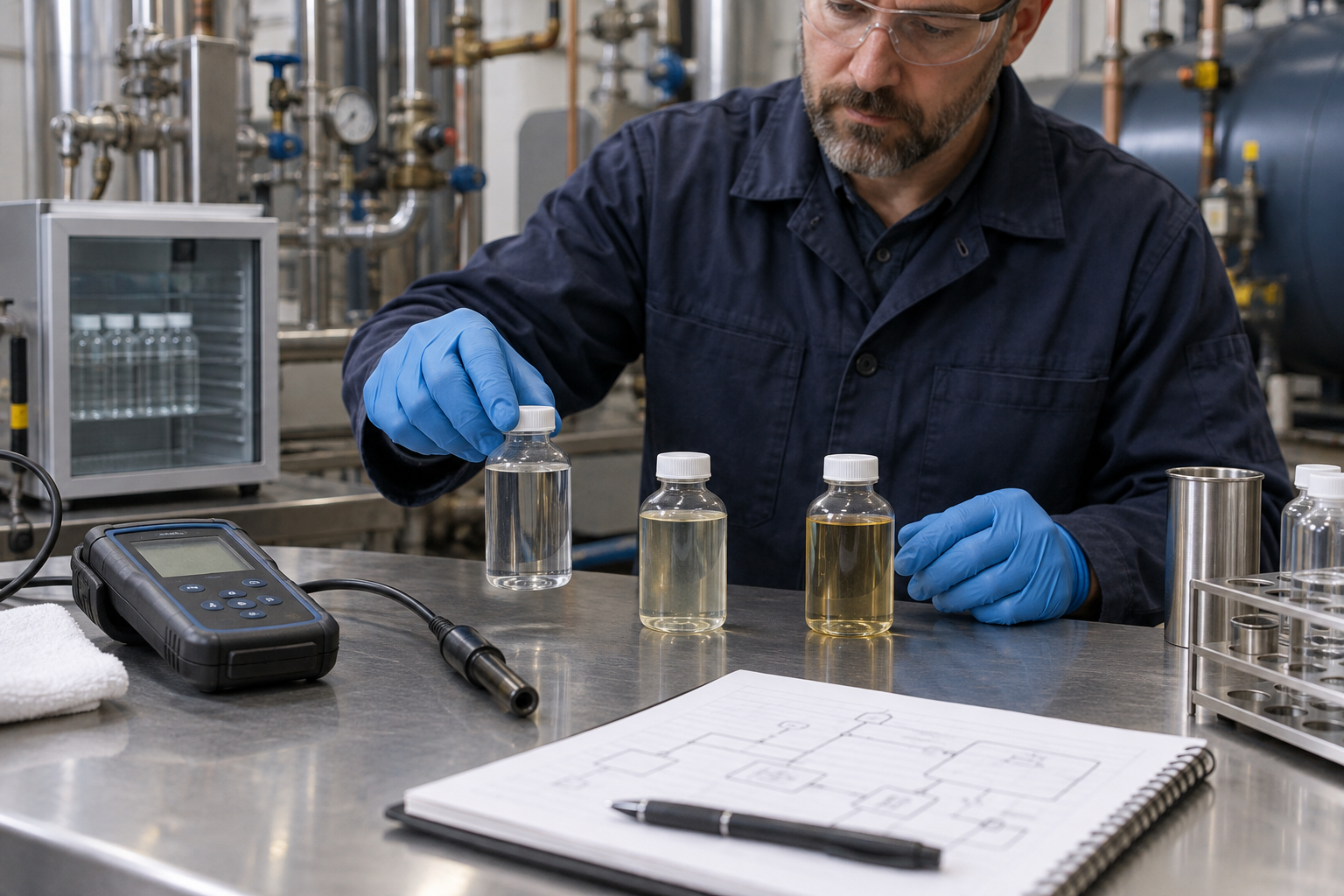
Agree a baseline, comparison condition and stop/escalation criteria with the responsible boiler team. Follow periods representing the new source and return pattern, including relevant normal transitions, rather than choosing a convenient sample after the process settles. Compare feedwater and boiler chemistry, actual water flows, steam-purity requirements and relevant inspection or corrosion observations. If source correction and chemistry are changed together for operational reasons, record the combined intervention and avoid crediting improvement to the product alone.
Sampling and response delays matter. A changed makeup source can be diluted by a receiver inventory before reaching the boiler; boiler-water composition may then respond on a different timescale. Use actual equipment volumes, flows and mixing behavior to choose the observation window. An early stable result does not demonstrate long-term suitability, while a short transient does not by itself justify switching treatment families. Keep the chosen evidence tied to the decision it can actually change.
Bring the water-path question to a product discussion
The Boiler Water Treatment application connects source, internal-treatment, oxygen and return-system decisions. VCYCLETECH lists WT-503 and WT-503B as boiler scale-and-corrosion product routes. Use these identities for an exact-grade discussion only after the changed water path and intended task are clear; their names do not establish a pressure window, formulation equivalence or a correction for excessive incoming alkalinity.
For a useful inquiry, share the boiler type and operating pressure, steam use, four-location analyses and methods, measured makeup/return flows, recent changes, current formulation and feed arrangement, and the comparison you need to make. Add quantity and destination for a quotation. Discuss the changed feedwater and treatment objective so candidate screening starts with the cause, not an unexplained adjustment to a dosing pump.
Frequently asked questions
Does more condensate return always reduce feedwater alkalinity?
Not automatically. A clean, low-alkalinity return can dilute makeup, but the actual return quality, added treatment, other connections and flow basis matter. Compare contemporaneous stream analyses and measured proportions before attributing a change to the return percentage.
Can I use conductivity to calculate an alkalinity correction?
No single conversion establishes that correction. Conductivity responds to the ionic mixture and measurement temperature, while alkalinity depends on the titration method and constituents present. Use matched analyses and the installed program's control method before considering a treatment change.
Why can boiler alkalinity rise when the makeup analysis is unchanged?
The return share, throughput, boiler concentration, chemical contribution or sampling condition may have changed. Compare mixed feedwater and actual stream flows first, then assess a suitable concentration indicator and treatment records. An unchanged makeup sample does not fix the whole system boundary.
Is alkalinity a reliable tracer for boiler cycles?
Do not assume it is. Heating, carbonate chemistry, treatment constituents and reactions can change measured boiler alkalinity. Select a suitable constituent and method for the actual system, and check additions, losses, volatility and analytical uncertainty before interpreting a ratio as concentration.
When should WT-503 or WT-503B enter the discussion?
After the source, blend and concentration questions are understood and an internal-treatment task remains. Review current information for the exact grade against boiler design, water chemistry, steam use and the existing program. A catalog name does not establish the needed formulation or operating limits.