
Boiler water · condensate-return decisions
Boiler Condensate Return Contamination: Decide What to Isolate, Test and Return
When condensate suddenly looks oily, changes conductivity, smells unusual, carries color, or no longer matches its normal iron, copper or pH trend, the first decision is not which boiler chemical to add. It is whether that return can continue toward the deaerator while the source is identified. Separate a suspicious branch when the site’s operating procedure allows it, compare a fresh sample at the return source with a mixed-return and feedwater sample, and check what changed upstream: a heat exchanger, process leak, cooling-water interface, cleaning event or makeup contribution. The pattern determines whether the safe next route is isolation, controlled disposal, polishing, source repair or monitored return. Internal boiler chemistry can condition a designed feedwater program; it cannot make an unknown contamination event disappear.
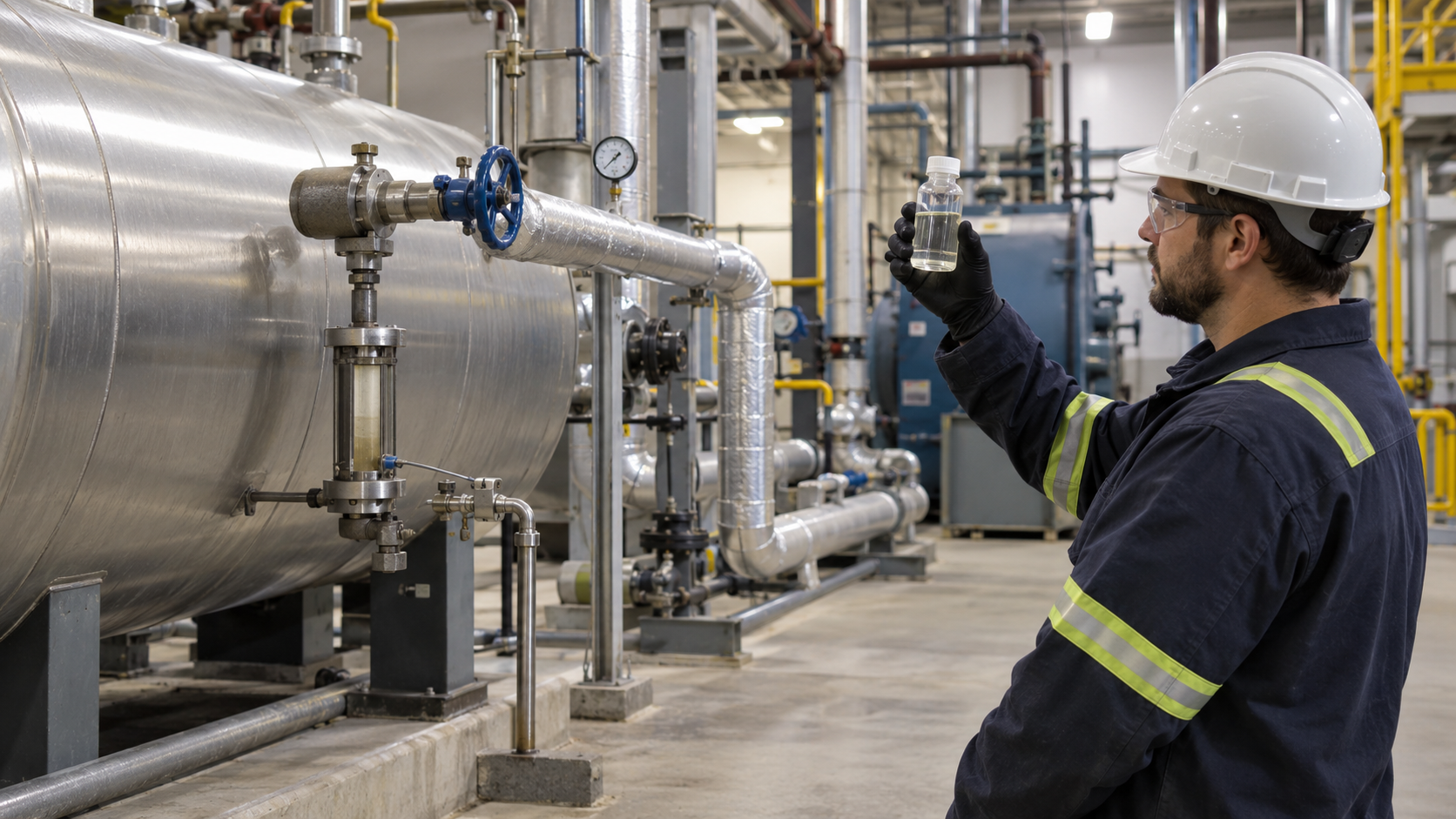
Make the first routing decision
Condensate is valuable because it is hot, treated water, but it also connects the boiler to every process exchanger and steam user. A changed return can bring oil, organics, salts, cleaning chemicals or corrosion products back toward the feedwater system. The U.S. Department of Energy’s steam handbook describes boiler feedwater as a blend of makeup and returned condensate; that is exactly why a return change should be located before it becomes a mixed-feedwater problem.1
Start with the site’s own limits and operating procedure. If a branch has a visible sheen, an unexpected odor, a rapid conductivity shift, abnormal pH or a process-specific marker, flag the time and operating state, retain a sample, and isolate or divert only through the approved operating path. Do not use a universal “safe return” number from an unrelated boiler. The practical objective is simple: keep the known-good returns separate from the suspect path while preserving enough information to find where the stream changed.
| Observed change | Likely decision it triggers | Useful comparison | Do not assume |
|---|---|---|---|
| Oil sheen, odor or unusual organic load | Review process-side and heat-exchanger sources; decide whether to divert the branch. | Source return, mixed header and feedwater. | That extra oxygen scavenger or amine will correct oil contamination. |
| Conductivity or chloride rise | Look for cooling-water, brine or process ingress and protect the mixed return. | Suspect branch versus a stable branch at similar load. | That a single grab sample identifies the leak location. |
| Iron/copper trend changes | Separate a corrosion-transport question from an external ingress event. | Return, feedwater and affected equipment history. | That dark material automatically means scale. |
| pH shift after cleaning or process change | Review the event timeline and return acceptance before normalizing treatment. | Pre-event baseline and time-stamped samples. | That the existing amine setting should be adjusted first. |
Read the signal without guessing the cause
Some signals tell you more about the next question than about the final cause. Conductivity and chloride can reveal a new dissolved-salt load; a sheen or organic indicator can point toward process or lubricant ingress; iron and copper trends can indicate material transport but do not identify the source on their own. A cooling-water leak may also bring salts and oxidants, while a process leak can bring organic material that changes deaerator or boiler behavior. Veolia notes that oil and organic contamination should be removed before feedwater reaches the boiler because internal boiler treatment cannot be relied on to prevent associated carryover.2
Use the plant timeline beside the data. Did the signal appear after a new process batch, a heat-exchanger changeover, an online wash, a cooling-water upset, or a shift in return flow? A clear time match narrows the physical walkdown. It is more useful than treating every abnormal result as a chemistry problem.
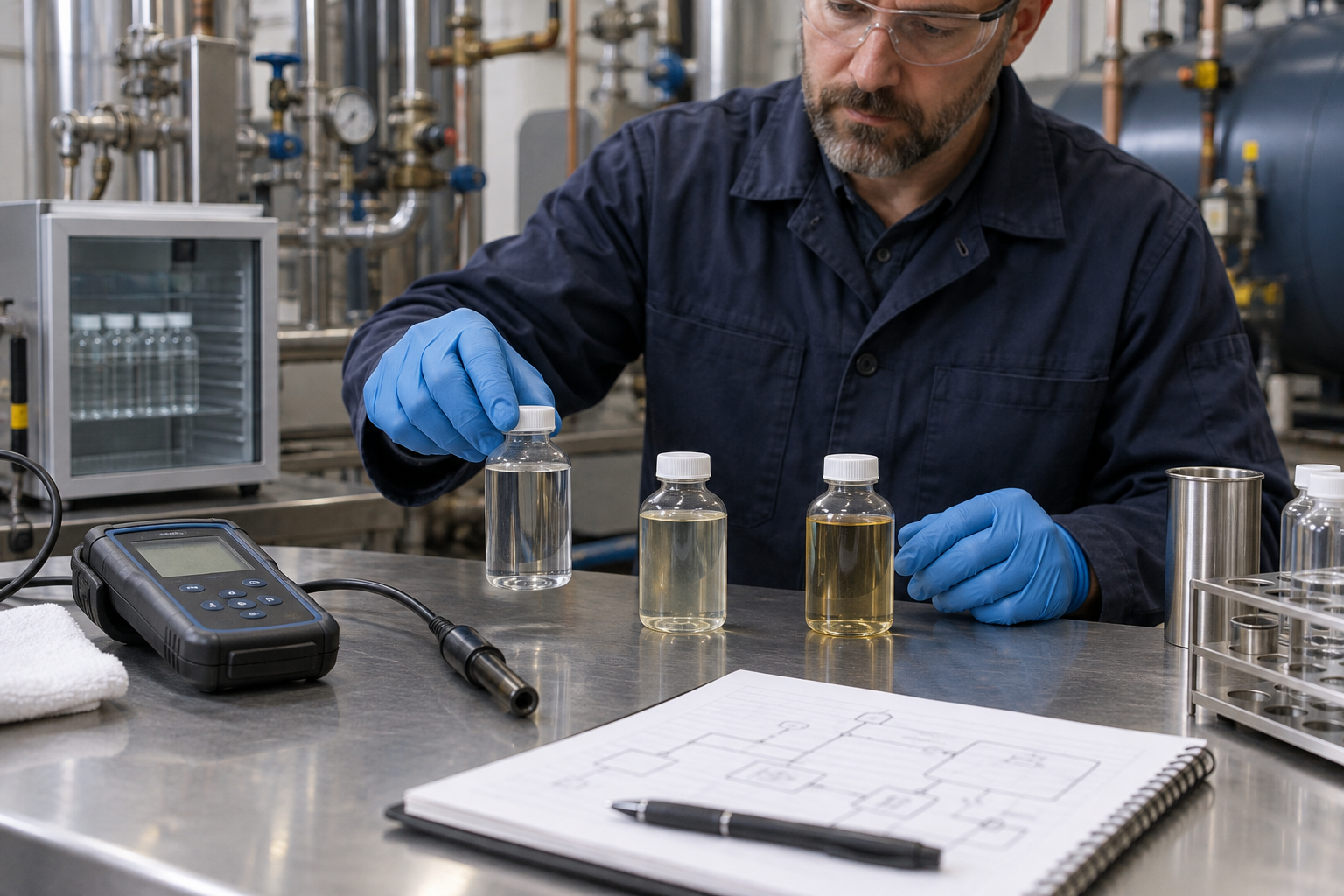
Build a three-point sample comparison
A useful first comparison has three locations: the suspected return before it joins the header, a stable or mixed return, and the feedwater downstream of normal mixing. Take them as close in time and operating load as practical. Record temperature, flow condition and relevant local observations with each sample. This turns a vague “bad condensate” report into a route map.
- Suspect branch: shows whether the change is local to one user or exchanger.
- Mixed return: shows the dilution and whether the event is already reaching common equipment.
- Feedwater: shows whether the barrier between return and boiler has already been challenged.
Match the test list to the signal and plant risk: conductivity, pH, chlorides or a chosen ion, iron/copper, turbidity or solids, oil/organics where relevant, and a process marker when one is available. Preserve chain-of-custody and laboratory details as required by the site, but keep the operating decision in view: which line is safe to keep returning, and which needs source correction?
Choose the return path from the pattern
If the branch is clearly abnormal while the mixed return remains stable, focus on that user, exchanger or process interface. If the mixed return and feedwater move together, the event is broader or has already passed the branch boundary; increase the urgency of the source search and follow the site’s feedwater-control procedure. Where an external contamination source is confirmed, the repair and return-routing decision come before product selection. The condensate corrosion guide is useful when the enduring issue is corrosion mechanism and amine route, not when an acute contaminant is entering the return.
Once the water path is stable, use the boiler-water treatment application page to place deposit control, oxygen scavenging and condensate protection in the correct part of the system. For a discussion of a formulated boiler treatment such as WT-503B, share the restored makeup/return quality, boiler operating conditions and the specific deposit or corrosion objective. It should not be selected as a remedy for an unresolved process leak.
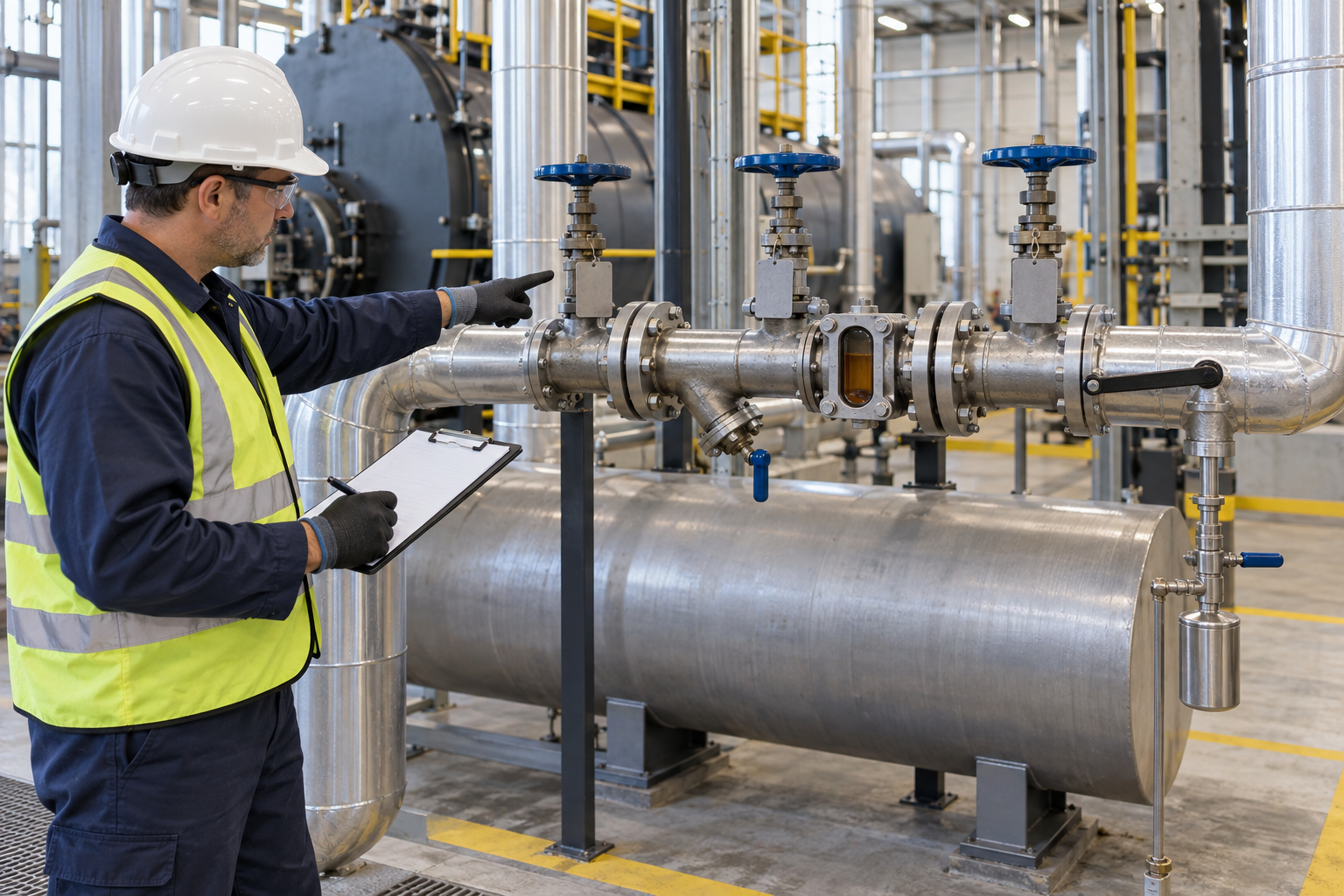
Verify recovery under real load
Restoring a branch is a performance check, not just a one-sample event. Confirm that the relevant signal stays within the site’s operating window across representative load and process conditions. Review the return trend, feedwater trend, boiler-water control data and any affected equipment after the source correction. The goal is to establish that the route is stable again, not simply that one sample looks normal after dilution.
For a focused technical conversation, bring the steam-user list, return routing sketch, before-and-after samples, operating timeline, relevant water analyses, existing treatment program and the event you are trying to prevent. Discuss a condensate-return response path →
Frequently asked questions
Should suspicious condensate always be returned to the deaerator?
No. Follow the site’s approved return-routing procedure. When a return is outside its accepted condition, keep the suspect branch out of the normal feedwater path while the source and corrective route are determined.
Can boiler treatment chemicals remove an oil-contaminated condensate problem?
No. Internal boiler treatment is not a replacement for source control or appropriate removal of oil and organic contamination ahead of the boiler feedwater path.
Which sample points help locate a condensate problem?
Compare the suspected branch before it joins the header, a stable or mixed return, and the feedwater. Sampling them near the same operating time shows where the condition first appears.
Does high iron prove that the condensate is contaminated by a process leak?
No. Iron can come from corrosion transport as well as an external event. Interpret it with pH, conductivity, branch location, operating history and other relevant markers.
When can a diverted condensate branch return to service?
After the source has been corrected and the return meets the site’s accepted condition through representative operation. The exact release criteria are specific to the plant and applicable procedure.
Sources
- U.S. Department of Energy, Improving Steam System Performance — feedwater/condensate context and steam-system operating principles.
- Veolia Water Handbook, Steam Purity — why oil and organics require removal before feedwater reaches the boiler.
- Veolia Water Handbook, Condensate System Corrosion — condensate-system corrosion context and monitoring considerations.
- UFC 3-230-13, Industrial Water Treatment Operation and Maintenance — industrial boiler water-treatment operating context.
Checked 2 October 2026. The sources describe system principles; they do not set a universal return limit, chemical dose or VCYCLETECH performance result.