
Boiler water · chemical selection
Boiler Deposit-Control Chemicals: Choose by Deposit and System
Choose a boiler deposit-control chemical by identifying what is depositing, where it enters and how the boiler is operated—not by treating every deposit as “scale.” Calcium-rich deposits can point to hardness reaching hot surfaces; iron-rich material may originate in feedwater or condensate corrosion; silica creates a different selection problem. Start with a representative deposit analysis where possible, paired feedwater and boiler-water trends, the pressure and steam-use requirements, and the current pretreatment and blowdown program. Then compare the role of phosphate precipitation, polymer dispersion or a controlled chelant route with the actual constraint. A formulated product is a candidate only when its current grade information fits that system. This guide helps you narrow a treatment family and trial question; it does not turn a product label into a universal deposit-removal promise.
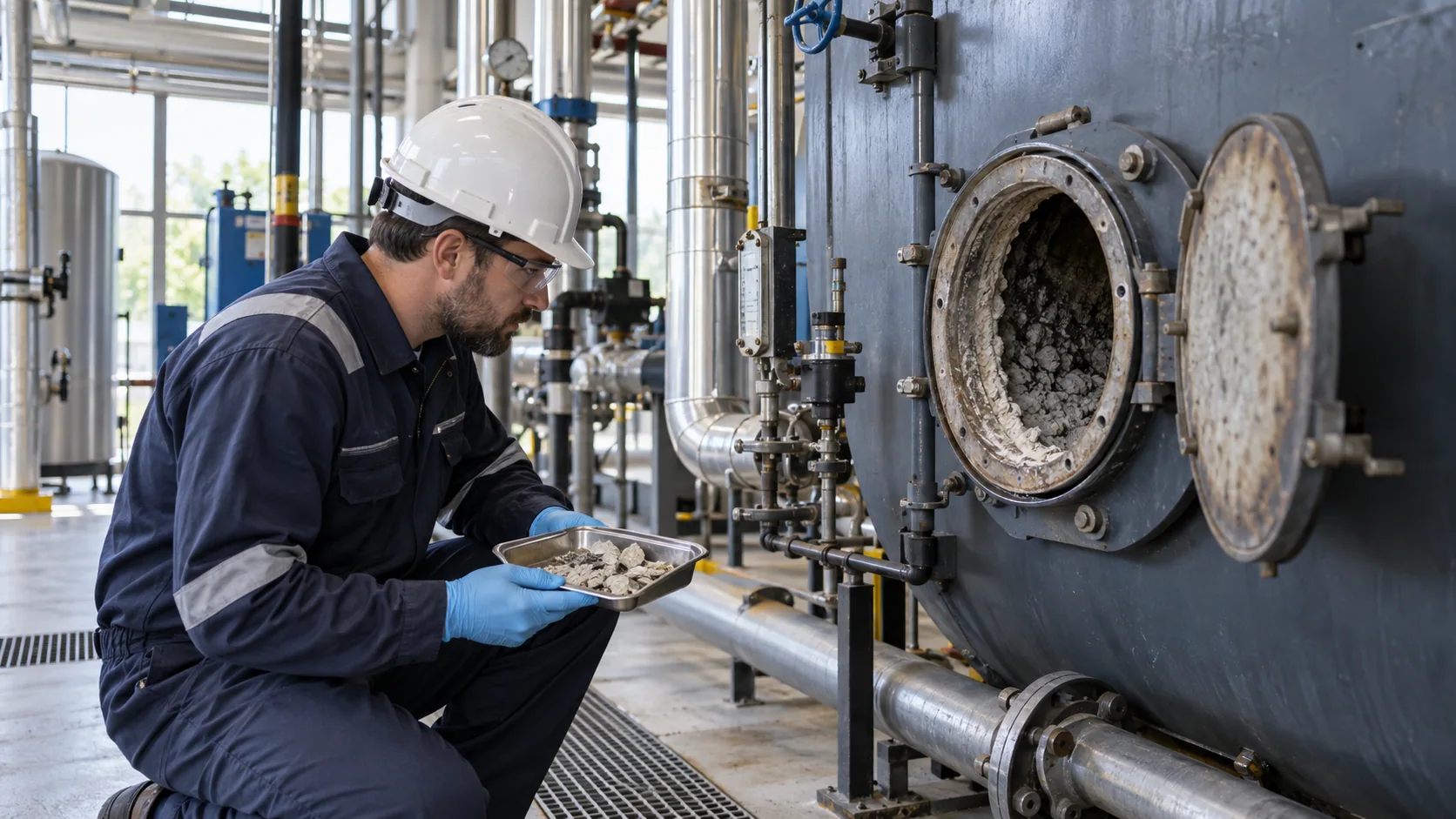
Start with what is on the surface
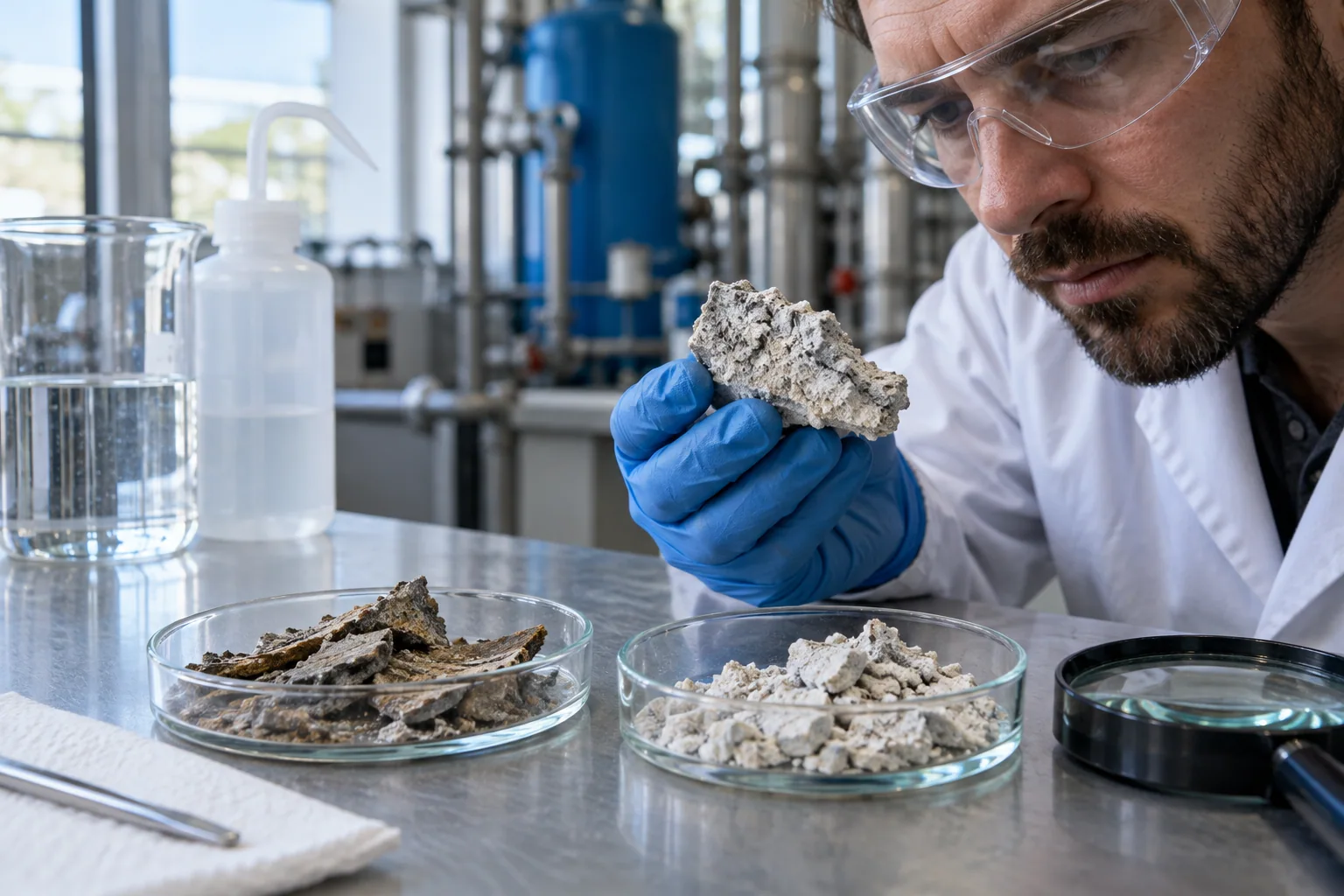
“Boiler scale” can describe several different materials. Veolia distinguishes crystalline scale formed directly on a tube from sludge precipitated elsewhere and carried to the metal. Both may reduce heat transfer, but they do not lead to the same first decision.1 Inspect the location and texture, then request a representative composition result if the choice affects a chemical change or cleaning. A pale hard layer is not automatically calcium carbonate; a dark deposit is not automatically iron oxide. Mixed deposits are common, and visual color alone can mislead.
Compare the sample with the operating history. Did it appear after a makeup-water change, a softener upset, a new condensate return, a change in blowdown or a change in chemical feed? If a deposit is found on a tube, note its position and whether the neighboring surface looks different. That context helps distinguish a localized heat-transfer problem from material arriving throughout the water circuit. It also stops an expensive polymer comparison from distracting the team from an open bypass valve.
| What analysis suggests | Check first | Treatment-family question | Avoid this shortcut |
|---|---|---|---|
| Calcium or magnesium dominant | Makeup treatment, softener leakage and feedwater hardness trend | Does the current internal program condition only the expected residual load? | Increasing inhibitor while untreated hardness continues to enter. |
| Iron oxide dominant | Feedwater and return-line corrosion or transported oxide | Does the program handle transport and dispersion after the corrosion source is addressed? | Calling every dark deposit a hardness-scale failure. |
| Silica or silicate significant | Source and pretreatment silica, boiler operating limits | Is a different pretreatment or specialist program review needed? | Assuming a conventional hardness inhibitor removes tenacious silica scale. |
| Mixed or uncertain composition | Representative sample, water trends and recent operating changes | Which mechanism is dominant enough to justify a trial? | Choosing solely from a photo or a product-category name. |
ASHRAE identifies calcium, magnesium, iron and silica among boiler deposit constituents and notes that iron-bearing material can be transported from pre- and post-boiler corrosion into the boiler.2 The source, not just the substance on the tube, is therefore part of product selection.
Connect the deposit to the water path
For hardness-dominated material, compare incoming makeup, each treated-water outlet, mixed feedwater and boiler water across normal and upset periods. If feedwater hardness recently broke through, follow the hardness-spike troubleshooting guide first. No internal program should be asked to compensate indefinitely for failed external removal. If the deposit is iron-rich, compare condensate return, deaerator outlet and feed line iron with corrosion indicators. The condensate-corrosion guide addresses that source question.
Look at the hydraulic and thermal story as well as chemistry. A local hot spot or poor circulation can concentrate impurities differently from the bulk sample. Blowdown removes concentrated water and suspended solids, but the rate must fit steam-purity and water-quality limits; a polymer cannot fix a blowdown valve that is not operating as designed. The existing boiler blowdown guide covers that separate decision. An engineer should not infer “wrong chemical” from one deposit without checking whether it was asked to solve the right problem.
Makeup percentage and return quality matter. A boiler receiving mainly treated makeup has a different impurity path from one receiving a large, variable condensate return. ASHRAE lists makeup quality and quantity, pretreatment, operating conditions and steam-purity requirements among the factors that determine the treatment method.2 These are not procurement formalities; they change which mechanism a candidate program must handle.
Compare what each treatment family actually does
Phosphate, polymer and chelant are not interchangeable names for “anti-scale.” In a precipitation-style program, phosphate converts appropriate hardness into a more manageable precipitate; a polymer or sludge conditioner helps keep particles mobile until removal. In a dispersant-centered program, the polymer works to limit deposition and transport suspended material. Chelants complex some dissolved metal ions, but require tight control and a compatible boiler program. Veolia describes these approaches and notes that a polymer chosen for one deposit class may not be the best for another.1
| Family | Useful selection question | Operating dependency | What it does not replace |
|---|---|---|---|
| Phosphate plus polymer | Is limited hardness precipitation and sludge transport part of the designed program? | Boiler-water chemistry, solids removal and site monitoring | Softening/demineralization when feedwater loading exceeds design. |
| Dispersant-focused polymer | Is the main task to keep identified suspended or precipitated material off hot surfaces? | Deposit class, temperature exposure, feed point and blowdown | Correction of corrosion, silica ingress or physical circulation faults. |
| Chelant-containing program | Is controlled complexation appropriate for the metals and boiler design? | Feed quality, competing chemistry, precise control and materials | A casual extra dose in response to an unknown deposit. |
| Pretreatment or equipment correction | Is the contaminant entering in a way no internal program should carry? | Softener/RO/demin performance, return quality and hydraulics | A product trial until the incoming load is stable. |
The choice within a polymer family is still technical. A Lubrizol paper comparing deposit-control polymers under high-temperature test conditions found performance varied with polymer architecture, the dispersed material and thermal exposure. That laboratory comparison is useful for framing questions to a supplier, not as a performance ranking for any VCYCLETECH formulation.3
Do not confuse a deposit-control program with an in-service cleaning claim. Preventing new attachment, dispersing incoming solids and removing an established tightly bound layer are different tasks. Veolia warns that some deposits are poor candidates for an online chelant cleanup, particularly hard silicate or iron-oxide-rich material. If a boiler already has substantial deposits, the plant specialist should decide inspection and cleaning separately from a preventive chemical selection.1
Let boiler conditions narrow the chemistry
Pressure and steam use change the permissible water-treatment approach. A low- or medium-pressure package boiler, a high-pressure utility unit and a steam-contact food process do not share one universal additive menu. Start with the installed boiler maker’s feedwater and boiler-water requirements, the site's steam-use constraints and the existing chemistry. Review where the product would be fed, whether a measurable control variable exists, and whether the proposed program adds solids or affects steam purity. The site’s pressure-based program guide explains the broader design question; this article stays with deposit-control selection.
Check water chemistry that may change the mechanism: hardness, alkalinity, silica, iron, copper and any return contamination relevant to the deposit. Then consider temperature exposure, dose-control method, blowdown and feed-system materials. A candidate whose mechanism looks attractive on paper may be a poor fit if the plant cannot maintain the needed monitoring or if its existing program is incompatible. Spirax emphasizes that internal conditioning supplements the external water-treatment system and must fit makeup, condensate and boiler operation.4
If a process requires steam to contact food or another sensitive product, discuss applicable site and jurisdictional requirements for the exact formulation before testing. This article does not assign a product-specific approval from a generic chemical class. Equally, an oxygen scavenger or condensate amine should not be treated as the answer to a hardness or iron-deposition problem merely because it is part of the same boiler program.
Design a comparison that can change a purchase decision
A useful trial begins with a specific question: for example, whether a candidate improves transport of the identified iron-bearing solids while feedwater quality, boiler operation and blowdown stay in a comparable range. Record the current program and its control method before introducing a candidate. Decide which operating periods and inspection opportunities can show whether deposition is slowing. Trends in feedwater constituents, boiler-water control variables, blowdown solids and any suitable inspection are more informative together than a product-use claim by itself.
Keep one major change at a time where plant safety and operation allow. If the softener is repaired on the same day as a chemical switch, an improved result cannot automatically be credited to the chemical. If a candidate changes the type of suspended solids, plan how those solids will leave the system. If the deposit cannot be sampled or the feedwater remains unstable, delay the product comparison until the question is answerable. This is not an excuse to stop at “we need more data”; it tells you exactly which missing input changes the selection.
Bring the right question to a product discussion
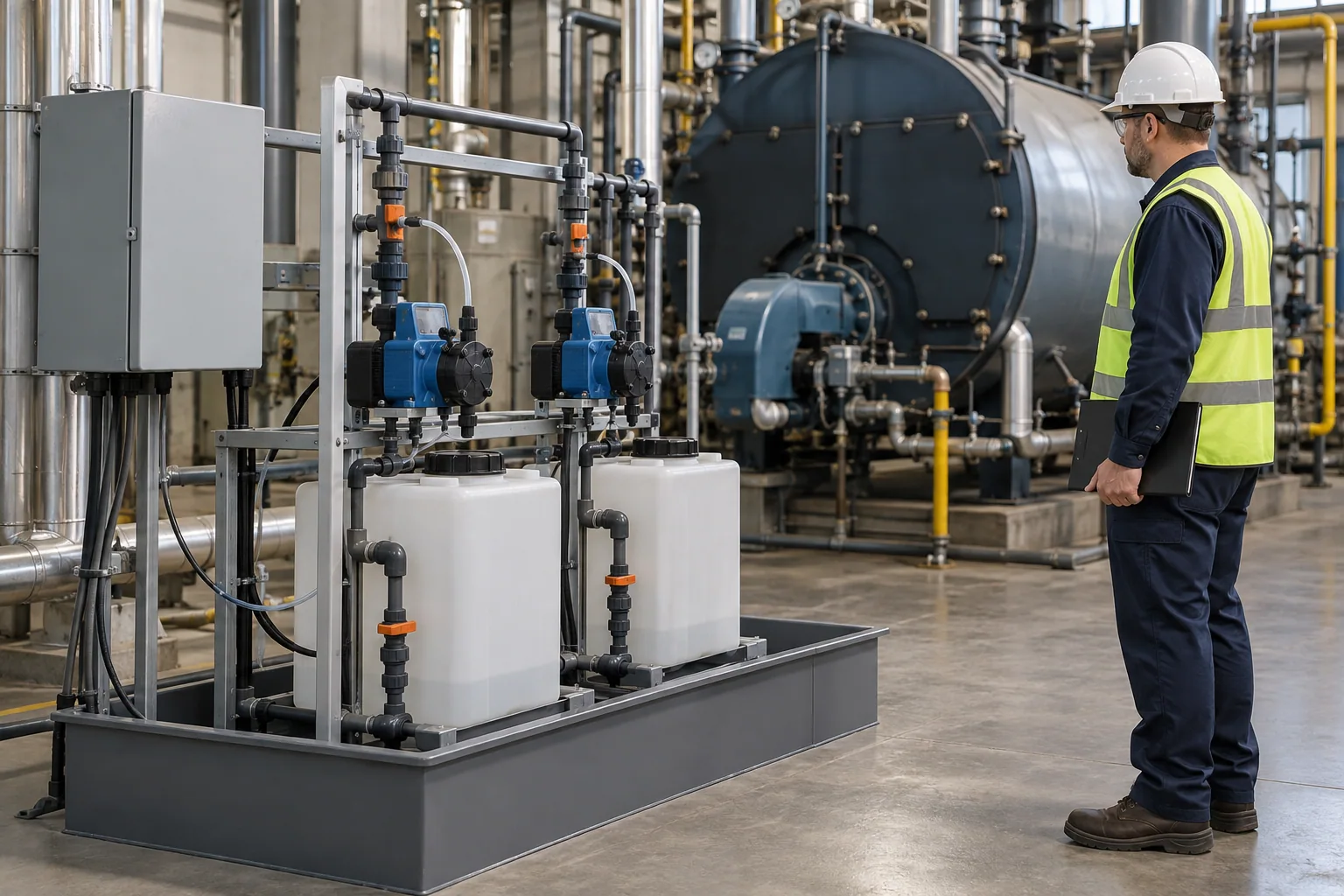
VCYCLETECH lists WT-503B among its boiler scale-and-corrosion products. Treat that page as a route to discuss an exact grade, not as confirmation that it disperses your identified deposit or fits your boiler. Share the deposit description or analysis, feedwater and return-water results, boiler pressure and steam use, pretreatment and blowdown arrangement, current program, intended trial question, quantity and destination. Ask for current grade-specific technical information before plant use. The boiler application page shows the surrounding treatment categories and contact path.
If the main issue is dissolved oxygen, move to the oxygen-scavenger comparison. If the main issue is a hardness spike, repair that upstream path first. The right product conversation begins with the mechanism the water system actually needs.
Frequently asked questions
Is a boiler dispersant the same as a scale inhibitor?
Not exactly. A dispersant helps keep certain particles or precipitates mobile rather than attached to a surface. A scale-control program may also use precipitation, complexation or other mechanisms. The deposit type, feedwater loading and boiler conditions determine which role matters most.
Can one product remove an established boiler deposit?
Do not assume so. Preventing new deposition differs from removing a hard existing layer. Identify the material and its location, then let the plant specialist decide whether cleaning or inspection is needed. A preventive grade should not be sold as an online cleaning guarantee without product- and site-specific evidence.
Why does iron-rich sludge change product selection?
Iron may arrive as corrosion products from feedwater or condensate equipment. If that source continues, a dispersant alone cannot solve the whole problem. Address corrosion and transport, then compare whether the proposed internal program keeps the remaining solids off heat-transfer surfaces.
When is phosphate/polymer worth comparing with a chelant program?
Compare the intended mechanism, feedwater quality, boiler design, control capability and existing chemistry. A phosphate/polymer route conditions suitable precipitates; a chelant route complexes certain metal ions but calls for careful control. Neither is a universal upgrade over the other or a replacement for failed pretreatment.
What information makes a boiler product inquiry useful?
Provide a description or analysis of the deposit, feedwater and return results, boiler pressure, steam use, pretreatment, blowdown, current chemistry and the outcome you want to compare. Add quantity and destination for a quote. Those inputs allow a focused candidate discussion instead of a generic product list.