
Defoamers · Technical purchasing guide
Silicone Defoamer Dilution: Test Holding and Pump Delivery Before Approving a Grade
Before approving a silicone-emulsion defoamer, check whether the preparation reaching the process still represents the product used in the bench trial. Compare the as-supplied material, a supplier-authorized fresh dilution and the same preparation after representative holding and pump delivery. Record water quality, preparation order, temperature, mixing, container history and actual residence time. Observe the emulsion separately from testing foam suppression and recurrence in the real process liquid. A clear surface in one fresh beaker does not qualify a day tank, and a visually uniform emulsion does not prove downstream compatibility. Use the comparison to decide whether to correct preparation or delivery, repeat the process trial, or evaluate another documented grade before committing to routine supply.

TL;DR
Treat dilution stability and foam-control performance as related but separate purchasing questions. Confirm the exact silicone-emulsion grade and whether its supplier supports dilution at all. Compare a fresh authorized preparation with material held and delivered through a representative arrangement, using the same stated product basis. Check separation, deposits, delivery consistency, initial foam response, recurrence and relevant downstream effects. Keep trial water, process liquid, temperature and mixing controlled so an equipment or preparation change is not mistaken for a chemical advantage. There is no universal dilution ratio, holding time or pump setting for all silicone defoamers. Ask for current grade documents and send the actual preparation-to-process conditions with a quotation request.
Confirm the supplied emulsion and the intended preparation
A silicone defoamer is a product family, not a complete formulation description. The supplied material may include a dispersed silicone phase, emulsifying components and other ingredients whose arrangement matters to handling. Confirm the exact offered form, documented specifications and application instructions. Do not infer dilution stability from a silicone content claim or assume two white emulsions can be prepared in the same way.
The VCYCLETECH silicone defoamer listing identifies an emulsion with published catalog reference characteristics. Request the current grade-specific specification, TDS and SDS for the proposed offer. Those documents should resolve whether pre-dilution is supported and what preparation and storage conditions apply. The catalog reference pH describes a supplied-product attribute; it is not a universal operating window for every receiving liquid.
Original producer documents illustrate the variation. Dow describes dilution stability for a specific XIAMETER emulsion. Momentive's SagTex DSA bulletin discusses product-specific application and dilution considerations, while Applied Material Solutions distinguishes supplied-product storage from diluted preparation handling. These examples explain why the buyer needs exact instructions. They do not establish the concentration, shelf life, dilution ratio or approval status of VCYCLETECH's product.
Map water, holding and delivery before choosing test samples
Draw the proposed route from the package to the process: any transfer vessel, make-up water, mixing step, day tank, recirculation, metering pump and injection connection. Record working volumes and actual operating patterns. A tank emptied once per shift can still contain older material if it is repeatedly topped up. Include shutdowns, low-flow periods and the first material delivered after a restart.
Characterize the water used for an authorized dilution rather than describing it simply as clean. Record the source, relevant hardness and salts, pH, temperature and any treatment residual or contamination concern. Establish whether the same water is available in the laboratory and plant. If a reference water is used, identify it explicitly and retain the actual-water comparison; a convenient laboratory preparation may conceal a site-specific difficulty.
Review the preparation vessel and transfer equipment with the supplier and responsible engineer. Previous contents, poorly cleaned surfaces, unsuitable mixing or repeated recirculation can change what reaches the process. An emulsion can be sensitive to mechanical handling, but that does not justify prescribing one pump type for every formulation. Obtain guidance for the proposed grade and reproduce the relevant installation conditions in a controlled comparison.
Separate physical stability from foam performance
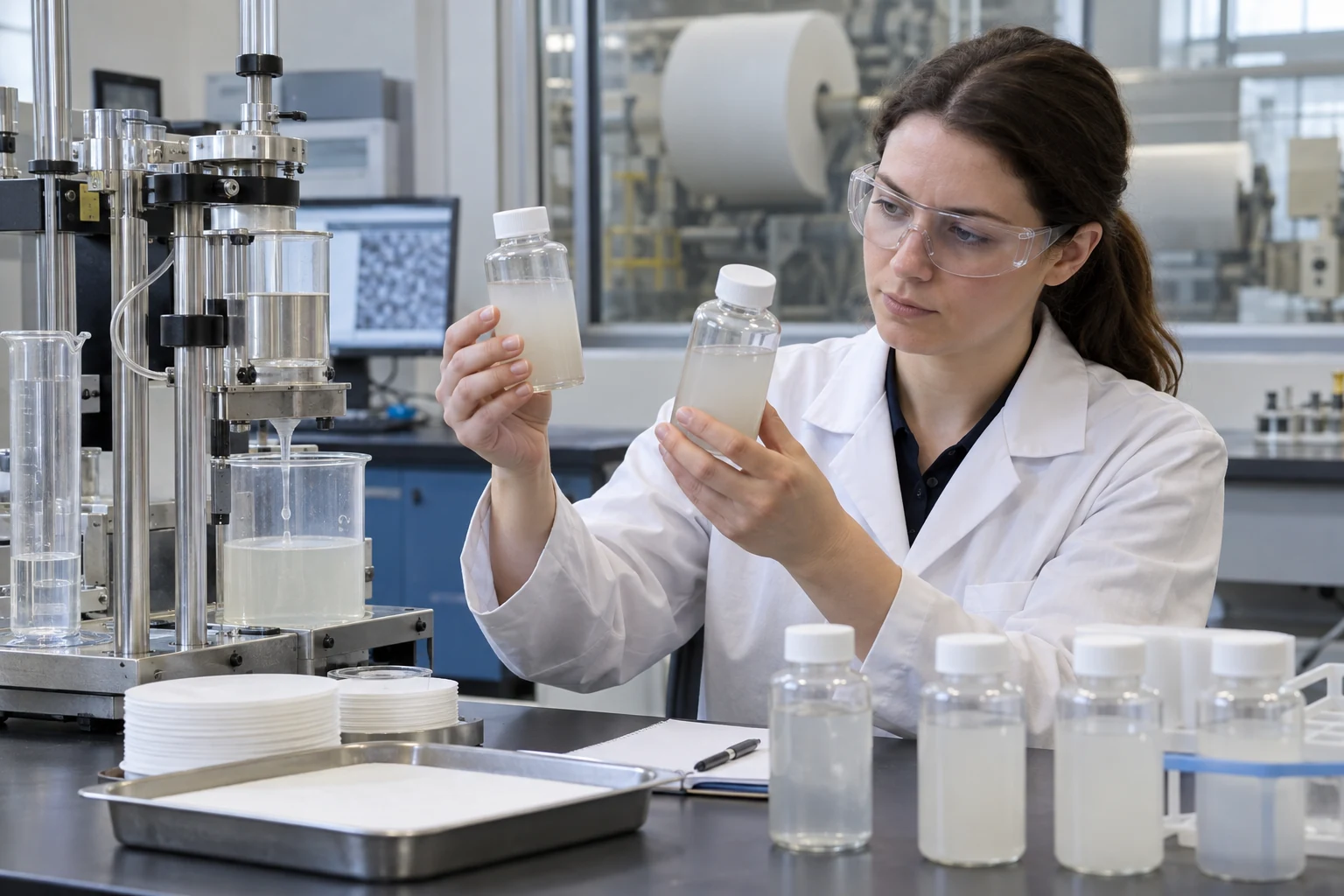
Begin with a clearly stated question: does the supported preparation remain usable through its expected holding and delivery path? Agree how physical condition will be observed and sampled, including surface layers, sediment or deposits where relevant. Do not skim a visibly changed tank and test only the convenient fraction. A sampling plan should represent the material intended for feed without introducing an undocumented homogenization step.
| Comparison sample | Keep and record | Decision supported |
|---|---|---|
| As supplied | Exact grade, current documents and product basis | What material is being compared? |
| Fresh authorized dilution | Actual water, addition order, mixing and temperature | Is the proposed preparation reproducible? |
| Held preparation | Residence history, vessel condition and representative physical observations | Does the day-tank arrangement remain supported? |
| Delivered preparation | Pump/transfer exposure, feed verification and sampling method | Does the trial represent material reaching the process? |
| Process-liquid trial | Initial response, recurrence and relevant downstream measures | Is this documented grade and arrangement a suitable candidate? |
Then compare foam behavior in the same representative process liquid. State the product-mass basis and, where a reliable documented value exists, the relevant concentration basis. Keep liquid condition, temperature, test geometry, mixing, timing and addition point consistent. Use controls and repeat observations. Record both the immediate effect and recurrence under the selected test; a single photograph taken just after addition cannot describe sustained operation.
A physically stable preparation may still perform poorly in the receiving liquid. Conversely, an impressive fresh-sample foam test may not represent material after holding or pump exposure. Keep those results separate when comparing candidates. If the physical preparation changes, investigate that boundary before interpreting a plant trial as proof that the underlying chemical family is ineffective.
Test the delivered preparation under representative conditions
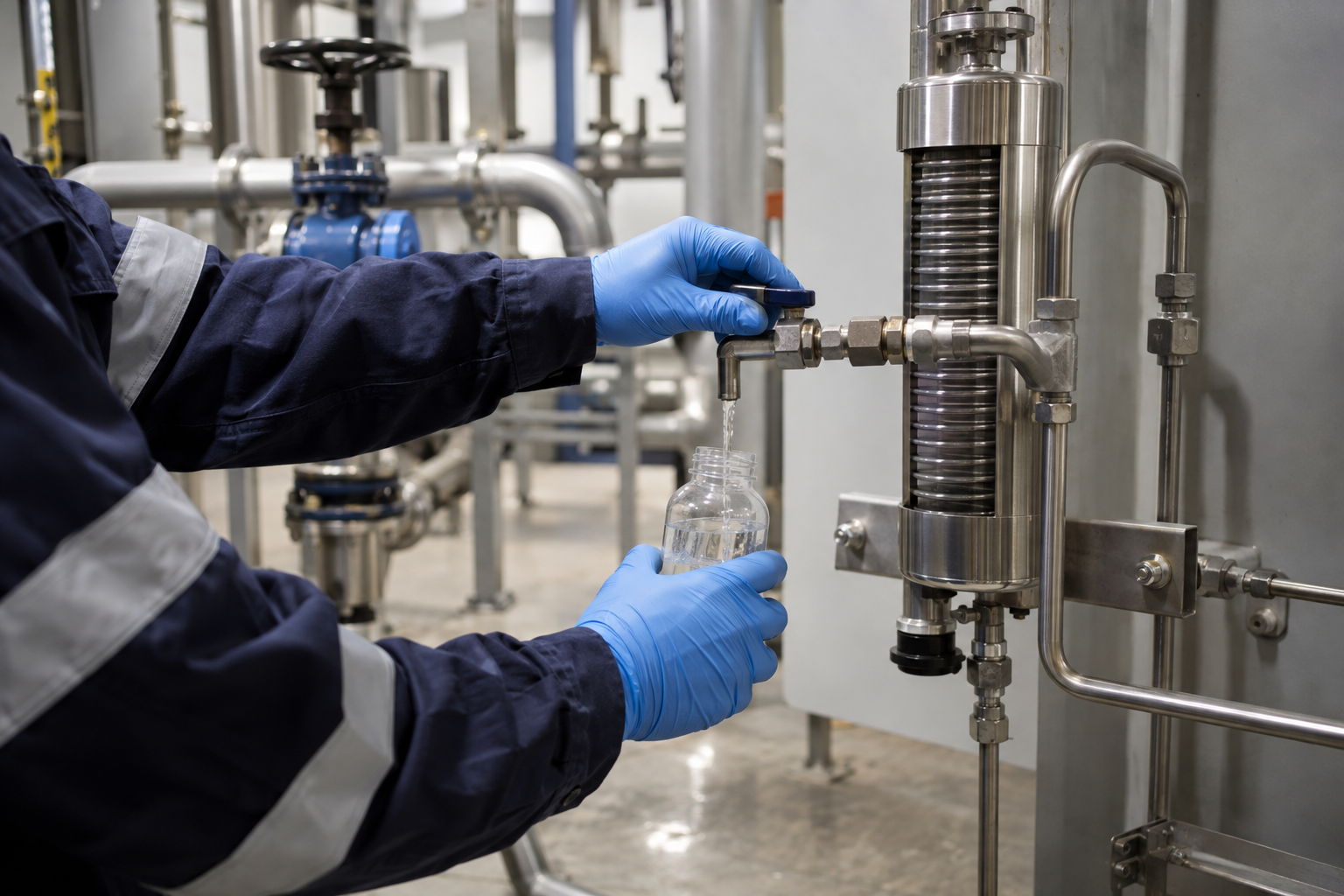
Where safe and technically supported, compare samples before and after the relevant delivery arrangement, with the pump operating in a representative state. Record feed rate verification, actual operating duration, return flow and any interruptions. Nominal pump stroke or a controller command is not evidence of the condition or quantity arriving at the injection point. Use the site's approved sampling and equipment procedures.
Observe the emulsion and run the same defined process-liquid comparison on fresh, held and delivered samples. If only the delivered sample differs, investigate the delivery path, residence and sampling before asking for a stronger grade. If fresh and held samples both differ from the reference, examine preparation water, handling and the offered product. If preparation condition is consistent but the process response changes, review the receiving liquid and operating event.
Keep physical observations proportionate to the decision. Color, a visible layer or a viscosity change may justify further work, but no single appearance check identifies every emulsion mechanism. Obtain suitable laboratory advice when composition or contamination must be established. Do not try to repair an unexplained preparation by adding surfactant, solvent or another treatment chemical; that produces a different mixture with its own handling and application questions.
Check downstream effects before selecting the commercial route
Choose acceptance measures for the actual system, beyond a low foam height. Depending on the application, relevant observations can include filtration behavior, deposits, separation, coating or finished-product quality and equipment stability. Define the methods with the site team and keep operating conditions comparable. A silicone family name cannot prove suitability for a membrane, coating line, biological process or every wastewater treatment train.
In a paper-machine trial, foam and entrained air, drainage and sheet quality need their own evidence. The paper wet-end foam and feed-point guide addresses that process diagnosis. This preparation comparison does not replace it. Similarly, a successful laboratory foam test should lead to an appropriately controlled plant trial, not a claim that a held preparation will remain stable through every shutdown or production change.
If the supported silicone preparation cannot meet the installation's practical requirements, discuss either a preparation or delivery correction or another documented candidate. The defoamers and antifoams category gives the family context. A polyether defoamer is a separate candidate to verify, not an automatically interchangeable substitute. Compare its supplied form, preparation and process endpoints on a consistent basis before making a purchasing decision.
Agree a sample plan and quotation inputs before routine supply
Write the sample request around the real constraint. State whether the plant must pre-dilute, how the day tank is operated, the longest relevant holding event, the delivery arrangement and the receiving liquid. Include available water analysis, operating temperature and pH, other additions, foam symptoms and downstream concerns. Ask whether the proposed grade is supported under those conditions before designing the comparison.
For a quotation, add the required specification, estimated quantity, package needs and destination. Request current technical and safety documents and confirm the availability and basis of batch documentation. Do not treat an external producer's certificate statement as a promise about this offer. Reconcile the difference between the supplied product specification, physical stability of an authorized dilution and the process trial acceptance measures.
Set a practical decision after the trial: approve the documented grade and arrangement, revise preparation or delivery and repeat, investigate an unexplained change, or compare another supported candidate. Retain results from both satisfactory and unsatisfactory conditions. A reproducible preparation and meaningful process trial provide a stronger basis for routine purchasing than a dramatic first foam collapse. Discuss a silicone defoamer sample, preparation trial and quotation →
Frequently asked questions
Can every silicone defoamer be diluted with water?
No. Dilution suitability and instructions are formulation-specific. Confirm the exact offered grade and supported water, preparation and holding conditions before making a dilution.
Is there a universal holding time for diluted silicone antifoam?
No universal period can be assigned from the family name. Obtain guidance for the grade and compare preparations under the actual tank operation, water and relevant holding events.
Does a uniform emulsion prove effective foam control?
No. Physical condition and foam response answer different questions. Test the representative preparation in the actual process liquid and assess recurrence and relevant downstream effects.
Can pump delivery change the interpretation of a defoamer trial?
Yes. The delivery path can alter residence, physical exposure and actual feed. Compare suitable samples and operating records before assigning a difference to the chemical grade.
What should accompany a silicone defoamer quotation request?
Include the application, liquid and water conditions, required supplied form, dilution and holding arrangement, delivery equipment, trial endpoints, quantity, packaging and destination. Request current grade-specific documents.