
Polymers · sludge dewatering
High-Solids Sludge PAM Selection: Match the Polymer to the Test
For high-solids or chemically complex sludge, do not pick a polyacrylamide grade from charge type, a catalogue label, or a single clear supernatant. First describe the sludge source and recent process changes; measure feed solids and relevant water chemistry; then screen polymer charge and physical form using a preparation and mixing sequence that can be reproduced. Match the test to the actual dewatering equipment and judge more than one endpoint: filtrate or centrate quality, solids capture, drainage, cake condition, machine load, and stability across normal feed variation. A quick jar test is a useful first filter, not a guarantee of full-scale performance. Confirm finalists with equipment-relevant or continuous testing before changing operating settings.
TL;DR
Choose a sludge-dewatering PAM candidate by the feed, equipment, preparation route, and acceptance endpoint together. Record sludge origin, digestion or upstream chemicals, feed-solids range, pH and ionic conditions, temperature, and the actual machine. Screen charge and molecular architecture only as candidate dimensions; do not assume a product specification predicts a result. Keep make-down water, preparation, aging, dilution, addition point, mixing energy, and test timing controlled. Compare filtrate or centrate, capture, drainage, floc survival, cake handling, and machine load. Use a bench test to reject poor candidates, then validate shortlisted options on the relevant equipment and operating envelope. Published and supplier examples are specific to their sludge and trial conditions.
On this page

Describe the sludge before comparing PAM
“High-solids sludge” is not a single feed condition. Primary sludge, waste activated sludge, mixed or digested sludge, mineral-rich industrial solids, food-processing residues, and sludge carrying iron, aluminum, lime, oil, or process additives can respond differently. Even the same plant can change after a production shift, precipitation change, digestion upset, upstream coagulant change, or a different return-stream blend. Record the source and the recent history with the sample rather than treating a one-time bottle as a permanent plant average.
At a minimum, record total or dry solids, sample point, flow or batch state, temperature, pH, conductivity or a suitable ionic-strength indicator, and upstream chemicals that may remain in the solids or water. Add ash or volatile solids, alkalinity, soluble organics, oil, metals, and particle information when they can change the mechanism or disposal route. The test should use a sample taken as close as practical to the real conditioning point and should preserve the site's mixing and timing conditions. Ontario's design guidance emphasizes pilot and full-scale testing because suitable conditioning chemistry and dose depend on the sludge, equipment, and operating objectives.
Separate feed characteristics from the outcome you are trying to improve. If filtrate turbidity matters because return water goes back to the process, define that separately from cake solids. If a centrifuge is near a torque or centrate limit, record that operational constraint. If the sludge is too sticky for transport or handling, a large floc is not automatically a successful result. The chemistry screen is only useful when it addresses the process constraint that caused the search.
Use charge and form as screening dimensions
PAM products can differ in ionic character, charge density, molecular architecture, molecular weight, and supplied form. Those variables can influence adsorption, charge neutralization, bridging, viscosity, preparation, and floc response. They are useful for organizing candidate trials, but they do not predict a universal winner. The actual sludge surface chemistry, soluble biopolymers, mineral fraction, salinity, coagulant residues, and mechanical stress all affect the result.
Peer-reviewed work on different sludge types reports that conditioning mechanisms and polymer demand can vary with digestion and sludge composition. One study comparing methods for anaerobically digested, aerobically digested, and waste activated sludge found that soluble biopolymers and bridging mechanisms contributed differently across the tested samples. That study does not establish a charge-density rule for every plant. It is a reason to keep the sludge type, method, and measured endpoint attached to each conclusion.
Begin with a controlled matrix rather than an oversized trial grid. Include the currently used product as a reference, candidate charge types or forms that are supported by the supplier's current technical documentation, and a no-polymer or current-process control where the test question allows it. Keep active basis and product basis distinct if the supplier's active content is known and documented. If it is not known, record the supplied-basis comparison and request the information rather than inventing an active conversion.
| Screening dimension | Why it may matter | What to hold or record | What it cannot prove alone |
|---|---|---|---|
| Charge character and charge density | May affect interaction with particle surfaces and soluble organic material. | Sludge source, pH, water chemistry, current coagulants, candidate identity, and same-sample comparison. | A universal “cationic for sludge” rule or a winning dose. |
| Chain architecture and molecular range | May influence bridging, floc structure, viscosity, and resistance to process shear. | Supplier specification, solution condition, mixer, feed location, and downstream separation stress. | Full-scale floc strength or cake outcome from a catalogue value alone. |
| Physical form | Changes wetting, inversion or dissolution, storage, make-down equipment, and delivery constraints. | Product form, lot identity, water quality, preparation sequence, aging, dilution, and transfer. | Equivalent performance at equal product mass without a documented active basis. |
| Mixing and feed point | Controls polymer dispersion, particle contact, and the shear imposed on formed flocs. | Addition point, mixing time and intensity, dilution, residence, pump, and equipment configuration. | That a bench optimum transfers to a different machine or pipe layout. |
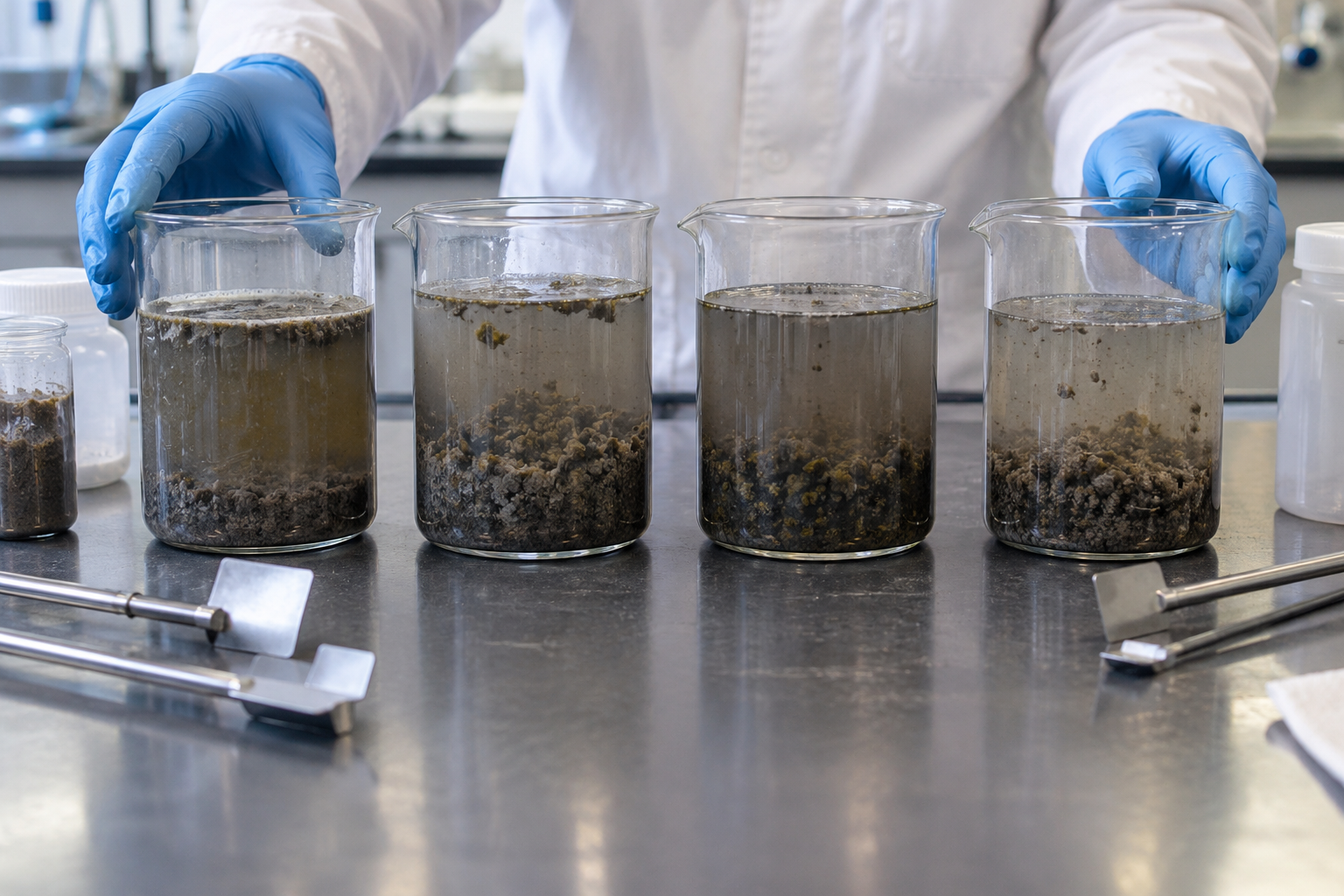
Control make-down, aging, shear, and feed location
A polymer candidate can look weak because it was prepared poorly or tested under a different mixing regime. Conversely, a freshly prepared bench solution can look better than the plant solution without proving that polymer chemistry is the root cause. Control the preparation as part of the trial: water source and quality, temperature, product form, wetting or inversion, mixing intensity, maturation or aging time, storage, dilution, and transfer pump. Follow the current supplier instructions for the exact product form; do not borrow preparation times or concentrations from a different grade.
For a fair comparison, prepare each candidate using a documented procedure and verify that the solution is usable before adding it to sludge. Record visible fish-eyes, undissolved material, viscosity changes, storage duration, and any water-quality difference. Use a fresh control if the plant solution is suspected, but change one factor at a time. Preparation troubleshooting after a product form has been selected is a separate decision; this article focuses on comparing candidates and connecting the test to sludge and equipment.
Next, reproduce the energy and sequence of the actual conditioning point as closely as the bench method permits. A jar with prolonged gentle stirring is not equivalent to a high-shear pump, inline mixer, transfer pipe, or centrifuge feed zone. Record the order of any coagulant or conditioning reagent, polymer addition point, dilution stream, mixing time, and time from conditioning to separation. If flocs form before a pump or valve, test whether the same structure survives that transfer. An OEM brochure from Komline describes polymer addition and mixing ahead of a flocculation tank on one belt-press arrangement; other equipment layouts differ, so use the installed machine drawing rather than copying a vendor diagram.
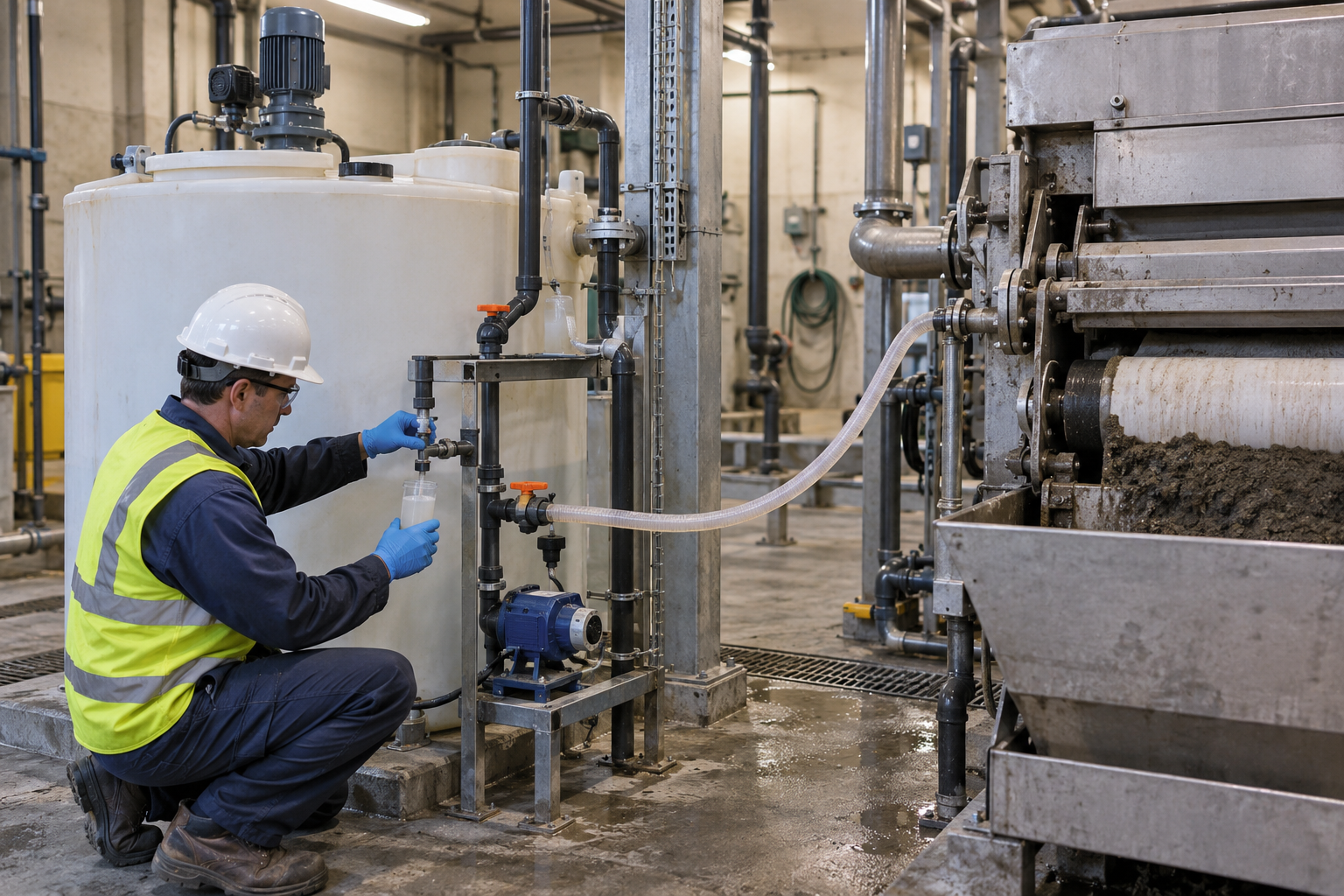
Use endpoints that match the machine
Do not select from floc size or settling appearance alone. For a belt press, compare gravity drainage, filtrate quality, solids capture, floc integrity through the wedge and pressure zones, belt release, cake handling, and loading. For a centrifuge, record centrate quality, capture, cake solids, torque or equivalent load signals, feed rate, and floc survival under the relevant shear and acceleration. For a screw press or filter press, define the drainage, screen or cloth behavior, cake discharge, and operating condition that matter. The target indicators and acceptable ranges are site-specific; this guide does not prescribe universal values.
Use simple tests for their proper purpose. Capillary suction time, specific resistance to filtration, free drainage, settling, filtrate turbidity, and floc observations can help screen candidates, but each represents only part of a dewatering process. Research comparing bench methods with centrifuge performance has shown that a method can be useful for polymer demand or cake solids under a defined study while another method measures water-release rate rather than the complete equipment outcome. Keep the measured property and test apparatus in the result label.
Run replicates when sludge variability or measurement noise could change the choice. Maintain a control sample or current product reference, standardize mixing, and record the basis of polymer addition. Avoid comparing one candidate at a different solids content, preparation age, or contact time. Record both the optimum observed point and the response around it: a narrow peak may be less robust to routine feed variation than a broad operating window, but that tradeoff should be judged with actual plant data.
Accessible decision flow: a bench screen narrows candidates; representative equipment validation supports the operating choice.
Move from bench screen to equipment validation
Take shortlisted candidates to a pilot, equipment-relevant test, or controlled operating trial that reproduces the actual feed range and separation train. Include the current reference condition, agreed sample handling, measured feed solids, machine settings, polymer preparation and feed records, and the same acceptance endpoints used by operations. Where possible, test both ordinary and difficult feed conditions rather than only a stable sample selected for convenience.
Evaluate the whole dewatering balance. A cleaner centrate may come with a wetter cake, lower throughput, higher torque, more frequent belt washing, or different downstream filtrate loading. A drier cake may reflect lower solids capture rather than improved dewatering. Track solids capture or a suitable mass balance alongside liquid quality and cake condition. Include operating staff observations such as floc breakage, ragging, belt blinding, pumpability, and discharge behavior. These observations should be defined and recorded, not converted into a supplier guarantee.
For complex sludge, consider whether current pre-treatment is part of the target. Iron or aluminum salts, lime, polymer, recycled filtrate, and industrial contaminants can interact. A published case or supplier guide may illustrate why feed changes and dosing location matter, but it cannot establish the right combination for another plant. Keep current product identity and supplier specifications separate from generic selection logic; the live PAM product page is a product route, not proof of a grade-specific dewatering result.
For adjacent application context, the industrial wastewater and mining-water application page shows how operating questions route to product families; its mine-tailings decision remains distinct from municipal or industrial sludge dewatering. The PAM preparation video shows a preparation context only and is not a sludge-performance trial. Share the feed source, equipment, preparation route, and desired endpoints through the technical inquiry route.
For further method and equipment context, consult Ontario's sewage-works design guidance, the U.S. EPA's municipal sludge dewatering design manual, a peer-reviewed study of polymer selection methods, and research on PAM conditioning and sludge rheology. The study conditions, method, sludge, and equipment delimit what each result supports.
High-solids sludge PAM selection FAQs
Which PAM charge type is best for high-solids sludge?
There is no universal best charge type for all high-solids sludge. Sludge origin, pH, salts, soluble organics, mineral content, prior treatment, and separation equipment affect the response. Screen supplier-supported candidates on the same representative feed and compare equipment-relevant endpoints.
Can a jar test choose a full-scale dewatering polymer?
A jar or bench test can reject poor candidates and help define a shortlist when sample, preparation, mixing, and endpoints are controlled. It cannot by itself prove full-scale cake, capture, throughput, torque, or stability. Confirm finalists on equipment-relevant or continuous testing.
Why does polymer preparation change the dewatering result?
Wetting or inversion, make-up water, mixing, aging, storage, dilution, and transfer shear can change the solution delivered to the sludge. Hold these conditions consistent across candidates and follow the current instructions for the exact supplied form.
Which endpoints should be compared for sludge dewatering?
Use a balanced set such as filtrate or centrate quality, solids capture, drainage, cake solids and handling, machine load, and operating stability. The important endpoints depend on the installed belt press, centrifuge, screw press, or filter press and the plant's downstream constraints.
How should a polymer trial be compared when sludge solids vary?
Measure and record feed solids for each trial, preserve a current-product reference, and compare results on a consistent product or documented active basis. Include ordinary and difficult feed conditions where possible; a single sample does not represent the full operating envelope.
Compare candidates against your real feed and machine
Share sludge source, feed-solids range, upstream chemicals, equipment, preparation route, current control, and the endpoints that matter. A technically useful discussion starts with those conditions, not a universal grade or dose.
Discuss your PAM application