

Water Treatment Knowledge and Industry Insights — VCYCLETECH Blog

Cooling Water Chemical RFQ Checklist: COA, TDS, SDS and Trial Acceptance Criteria — realistic editorial scene
AI-generated realistic editorial image, visually inspected on 2026-09-06. Generic editorial context only; it is not a VCYCLETECH or customer facility, chemical label, test result, certification or performance record.

Cooling Water Chemical RFQ Checklist: COA, TDS, SDS and Trial Acceptance Criteria

TL;DR A cooling-water chemical RFQ should ask for a decision-ready evidence package, not just a price and a product name. Define the system and water envelope, exact product role, active-basis/specification fields, current TDS and SDS, representative and shipment-specific COA expectations, storage/handling and compatibility questions, and a trial/acceptance/change-control plan. Documents establish what must be checked; they do not create a guaranteed corrosion, scale or microbiological result for a different site.

Request a water-data and document review →

What belongs in a cooling-water chemical RFQ?

This guide is about procurement evidence after a team knows the buying task—not a single-phosphonate comparison. Use it after the HEDP vs PBTC selection guide or a similar engineering screen, and keep it distinct from the site’s water-analysis program selection. An RFQ should let procurement, operations and engineering compare like-for-like candidates, understand safety and handling, and agree what evidence would support acceptance or a controlled change. It should not ask a supplier to promise outcomes that the site has not bounded.

Generic incoming laboratory check of an unlabelled cooling-water chemical sample
AI-generated realistic editorial image, visually inspected on 2026-09-06. It illustrates generic receiving and review context, not an actual assay, lot release or approval. It is generic illustrative context, not a VCYCLETECH or customer facility, chemical label, test result, certificate, approval or performance record.
Document or recordPrimary role in the RFQMinimum cross-checkWhat it does not establish
Technical Data Sheet (TDS)Product-level technical identity, intended use and stated properties/specification context.Revision date, exact grade/form, units and consistency with the requested specification.That a future shipment lot met the stated range or that the program will work at the site.
Certificate of Analysis (COA)Lot-specific quality evidence for agreed parameters and methods.Product/grade, lot identity, production/test date where supplied, units, method and result versus agreed criterion.Safety handling, compatibility, universal performance or a substitute for site acceptance.
Safety Data Sheet (SDS)Hazard communication, handling, storage, exposure, transport and emergency information.Exact product identity/revision; Section 1, hazard, composition, handling/storage and transport relevance to destination.Product quality, active assay or a performance claim.
Trial and acceptance recordDefines what site evidence will be compared before a release decision.Baseline, method, sample points, operating window, roles, hold points and change triggers.A pre-set supplier guarantee independent of site water, operations and equipment.

Why COA, TDS and SDS must stay separate

OSHA’s Hazard Communication Standard requires a safety data sheet for each hazardous chemical produced or imported and specifies the standardized SDS headings, including identification, hazards, composition, handling/storage, physical/chemical properties and transport information. That makes the SDS a safety and handling document, not a lot assay. Conversely, a COA should be treated in the RFQ as evidence against the buyer’s agreed lot criteria: request the fields and test methods needed for the particular chemical and contract. The TDS is a product-level technical reference. If the three documents identify different grades, revisions, forms or units, stop and clarify before trial or receipt.
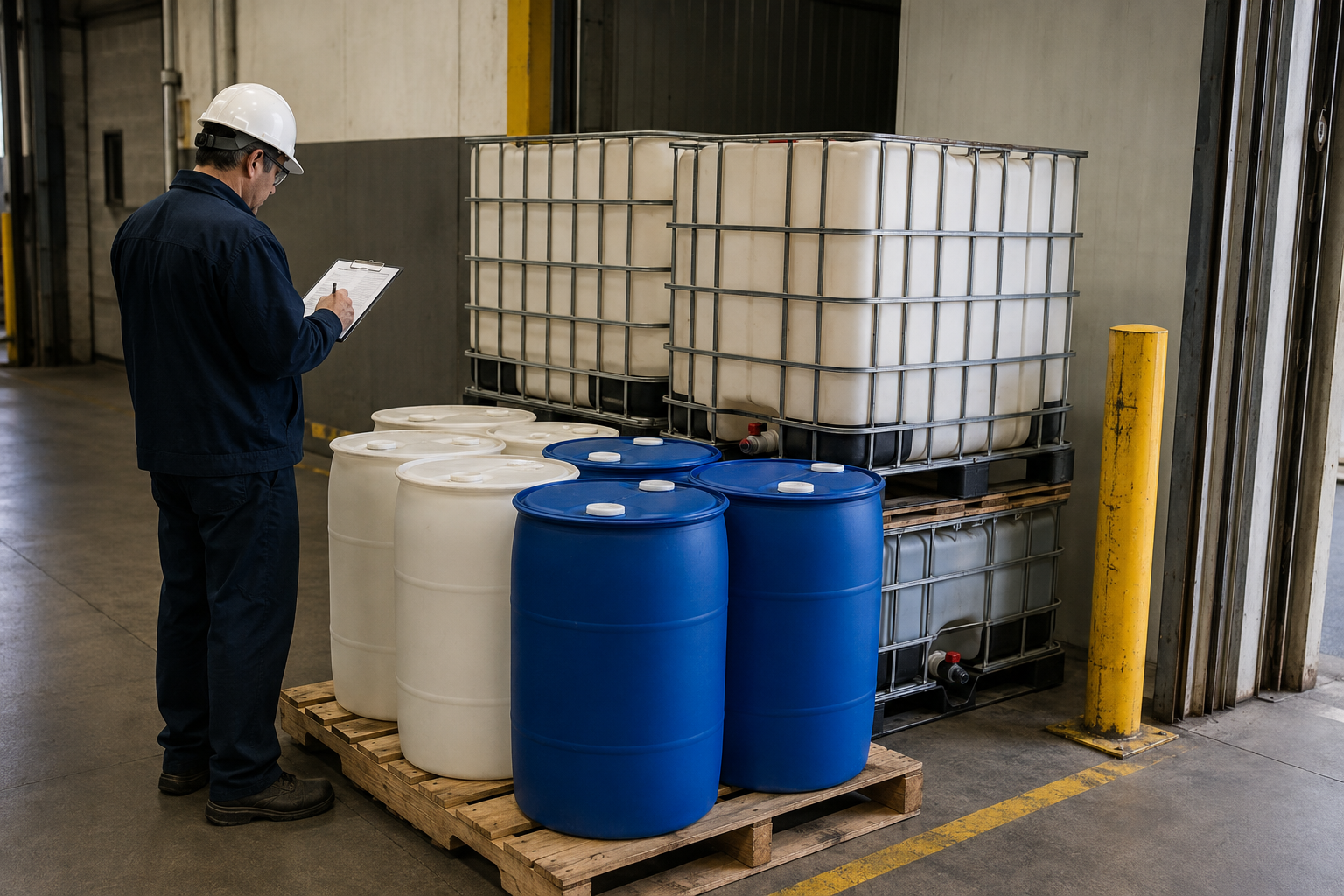
Generic warehouse receiving check of unbranded chemical drums and IBC containers
AI-generated realistic editorial image, visually inspected on 2026-09-06. It illustrates generic receipt inspection only; it is not a VCYCLETECH shipment, lot acceptance, customer site or compliance record. It is generic illustrative context, not a VCYCLETECH or customer facility, chemical label, test result, certificate, approval or performance record.

RFQ acceptance matrix: define evidence before the quote is awarded

RFQ fieldBuyer should provide or requestAcceptance boundary
System and water contextOpen/closed boundary, volume/flow where relevant, metallurgy, makeup and recirculating analysis, cycles basis, temperature, deposit/corrosion history and biocide/oxidant context.Use current, dated site data; a supplier cannot validate an undisclosed system boundary.
Product identity and active basisRequired role, exact grade/form, active-basis convention, agreed test parameters, units and accepted analytical methods.Do not infer active content, formulation or equivalence from a product-family name or an old web page.
DocumentsCurrent TDS and SDS; representative COA format before award; lot COA tied to each shipment as contractually required; applicable destination/regulatory declarations only when specified.Verify document revision and lot/grade identity. Do not request or claim certificates that have not been verified.
Delivery, compatibility and storageDelivery form, container compatibility, handling/storage constraints, shelf-life statement if supplied, transport and receiving requirements.Confirm against the current SDS/TDS and the site’s storage/feed equipment; no generic compatibility promise.
Trial and technical acceptanceBaseline, operating envelope, duration, sample points, methods, responsibilities, records, non-conformance route and re-test/stop conditions.Acceptance is conditional on agreed methods and actual system data—not a copied lab dose or universal KPI.
Change controlWritten notice/review for grade, active basis, raw-material/process site, delivery form, document revision or test-method change that could affect the agreed scope.Site-specific contract language and risk review are required; this is a procurement control, not legal advice.

Trial acceptance and change-control workflow

  1. Write the buyer task first. State whether the candidate addresses mineral scale, suspended solids/dispersancy, corrosion context or microbial control. Link it to actual equipment and water constraints rather than a generic “cooling chemical” label.
  2. Set document identity controls. Record product name, grade, revision, delivery form and request date. Require a discrepancy route if the sample, TDS, SDS and COA do not describe the same requested item.
  3. Separate a representative COA from a shipment COA. A format example helps set expectations before award; an actual shipment COA must be tied to the received lot and the agreed fields. Whether and how incoming testing is needed depends on risk and contract.
  4. Bound the trial. Define baseline data, analytical methods, operating range, sample locations, responsible reviewers and decision timing. Avoid turning a benchtop or supplier result into a permanent site setpoint.
  5. Document change triggers. Review a change in product form, active basis, stated specification, test method, SDS/TDS revision, packaging or supply source before assuming prior acceptance still applies.

Cooling-water RFQ checklist to attach to an inquiry

  • System diagram and open/closed boundary; water volume/flow, cooling duty, materials and equipment limitations that are known.
  • Dated makeup and recirculating-water analyses with sample point, method and units; cycles/blowdown and oxidant/biocide context where relevant.
  • Deposit, corrosion, filtration, cleaning and maintenance history—clearly labelled as observations, not a diagnosis.
  • Candidate product role and required documentation: current TDS, SDS, representative COA format and lot-specific COA expectation.
  • Agreed active-basis/specification fields, units, methods, delivery form, storage/feed compatibility questions and destination requirements.
  • Trial baseline, data method, review window, acceptance evidence, hold/retest condition and a written change-control path.

Use the water-treatment chemicals category as the commercial starting point, then connect the actual system to the cooling-water treatment application, deposit-investigation guide and generic supplier-quote data checklist. The VCYCLETECH video library is visual process context only, not batch or performance proof. Send the RFQ matrix for a documented technical review; specifications, documents and any trial scope remain subject to the actual product and site context.

Frequently asked questions

What is the difference between a COA, TDS and SDS for cooling-water chemicals?

A TDS provides product-level technical context; a COA is lot-specific evidence against agreed quality parameters; and an SDS communicates hazards, handling, storage and related safety information. They should identify the same requested grade and form but do not replace one another.

Should a cooling-water RFQ require a COA for every shipment?

The RFQ should state the contract expectation for lot-specific COA evidence and which fields/methods must be present. The appropriate incoming-verification level depends on the chemical, application risk, contract and site quality system.

Can a technical data sheet set a cooling-tower dose or guarantee performance?

No. A TDS may provide technical context, but a site setting or outcome depends on water chemistry, metallurgy, operating conditions, formulation, feed arrangement and agreed verification. Define a bounded trial instead.

What should trigger change control after a cooling-water chemical is accepted?

Review material changes that could affect the agreed scope, such as grade or delivery-form change, active-basis/specification change, test-method change, relevant document revision, packaging change or supply-source change. Set the exact triggers in the purchase and quality process.

What data should accompany a cooling-water chemical trial?

Use a dated baseline for water and operating conditions, material/equipment context, current treatment history, document identity, defined sample points and methods, observation records, trial boundaries and pre-agreed review/stop/retest conditions.

Author, review and evidence boundary

VCYCLETECH Technical Team prepares this engineering and procurement material from public technical guidance, industry sources and document-process context. It does not certify a facility, prescribe an analysis or dose, verify a product, provide legal advice or guarantee deposit control, compatibility or system performance. Final decisions require representative site data, current product documents and qualified site-specific review.

Sources

Guides & Articles

Cooling Tower Deposit Investigation: Iron, Calcium Phosphate and Under-Deposit Corrosion — realistic editorial sceneCooling Tower Deposit Investigation: Iron, Calcium Phosphate and Under-Deposit CorrosionRead → Cooling Water Chemical RFQ Checklist: COA, TDS, SDS and Trial Acceptance Criteria — realistic editorial sceneCooling Water Chemical RFQ Checklist: COA, TDS, SDS and Trial Acceptance CriteriaRead →HEDP vs PBTC for Cooling Water Treatment: Selection by Hardness, pH and Chlorine Exposure — realistic editorial sceneHEDP vs PBTC for Cooling Water Treatment: Selection by Hardness, pH and Chlorine ExposureRead → How to Select a Cooling Tower Water Treatment Program from Water Analysis Data — realistic editorial sceneHow to Select a Cooling Tower Water Treatment Program from Water Analysis DataRead →Coagulant Jar-Test to Purchase Order: Data and Acceptance Criteria — realistic editorial sceneCoagulant Jar-Test to Purchase Order: Data and Acceptance CriteriaRead → Dewatering PAM: Belt Press vs Centrifuge vs Screw Press — realistic editorial sceneDewatering PAM: Belt Press vs Centrifuge vs Screw PressRead →RO Antiscalant Trial Design: Feedwater, Recovery and Membrane Compatibility — realistic RO editorial sceneRO Antiscalant Trial Design: Feedwater, Recovery and Membrane CompatibilityRead → RO Cleaning Chemical Selection: Acid, Alkaline and Biocide Decision Tree — realistic RO editorial sceneRO Cleaning Chemical Selection: Acid, Alkaline and Biocide Decision TreeRead →Open vs Closed Cooling Water: Corrosion Inhibitor Selection by Metallurgy — realistic cooling-water sceneOpen vs Closed Cooling Water: Corrosion Inhibitor Selection by MetallurgyRead → Cooling Tower Chemical Program KPI Dashboard: Cycles, Blowdown & Deposit Signals — realistic cooling-water sceneCooling Tower Chemical Program KPI Dashboard: Cycles, Blowdown & Deposit SignalsRead →Quote-Ready Water Treatment Chemical Supplier: System Data Checklist — realistic water-treatment sceneQuote-Ready Water Treatment Chemical Supplier: System Data ChecklistRead → Private-Label Water Treatment Chemicals: OEM Sample, COA & Packaging Workflow — realistic water-treatment scenePrivate-Label Water Treatment Chemicals: OEM Sample, COA & Packaging WorkflowRead →Can Coagulation Remove PFAS? Realistic Limits — realistic water-treatment sceneCan Coagulation Remove PFAS? Realistic LimitsRead → Removing Microplastics with Coagulation — realistic water-treatment sceneRemoving Microplastics with CoagulationRead →Controlling Anionic Trash (DCS) & Charge Demand - real paper-mill sceneControlling Anionic Trash (DCS) & Charge DemandRead → Microparticle Retention & Drainage Systems - real paper-mill sceneMicroparticle Retention & Drainage SystemsRead →Converting a Cooling Tower to Non-Phosphorus — real industrial cooling-water sceneConverting a Cooling Tower to Non-PhosphorusRead → Reclaimed Water as Cooling Makeup: The Problem — real industrial cooling-water sceneReclaimed Water as Cooling Makeup: The ProblemRead →Tolyltriazole & Benzotriazole: REACH & Alternatives - photorealistic industrial treatment photographTolyltriazole & Benzotriazole: REACH & AlternativesRead → Molybdate vs Phosphonate vs All-Organic Inhibitors - photorealistic industrial treatment photographMolybdate vs Phosphonate vs All-Organic InhibitorsRead →EU BPR Compliance Checklist for Cooling BiocidesEU BPR Compliance Checklist for Cooling BiocidesRead →Isothiazolinone Restrictions & Allergen LimitsIsothiazolinone Restrictions & Allergen LimitsRead → High-Recovery RO Antiscalant: CCRO at 95–98%High-Recovery RO Antiscalant: CCRO at 95–98%Read → Minimal Liquid Discharge (MLD) vs ZLDMinimal Liquid Discharge (MLD) vs ZLDRead →Direct-to-Chip Cooling Corrosion Control: Tolyltriazole & Yellow-Metal ProtectionDirect-to-Chip Cooling Corrosion Control: Tolyltriazole & Yellow-Metal ProtectionRead → Cooling-Tower Biocide Selection: Legionella Control & 2026 Compliance CheckCooling-Tower Biocide Selection: Legionella Control & 2026 Compliance CheckRead → Cooling Tower Water Treatment for AI Data CentersCooling Tower Water Treatment for AI Data CentersRead → Data Center Cooling Water: WUE, Cycles & ReuseData Center Cooling Water: WUE, Cycles & ReuseRead → Buying Coagulants in 2026: PAC, Alum & Ferric SpecsBuying Coagulants in 2026: PAC, Alum & Ferric SpecsRead → Residual Acrylamide in PAM: NSF-60 & EU LimitsResidual Acrylamide in PAM: NSF-60 & EU LimitsRead → Pitch & Stickies: Paper Machine Deposit ControlPitch & Stickies: Paper Machine Deposit ControlRead → Paper Mill Chemical Procurement: Specs & COA ChecklistPaper Mill Chemical Procurement: Specs & COA ChecklistRead → Internal Sizing Agents: AKD vs ASA vs RosinInternal Sizing Agents: AKD vs ASA vs RosinRead → Paper Wet End: Additive Order & CompatibilityPaper Wet End: Additive Order & CompatibilityRead → Surface Sizing Agents: The Size Press GuideSurface Sizing Agents: The Size Press GuideRead → Dry Strength Agents: Selection, Dosage & TroubleshootingDry Strength Agents: Selection, Dosage & TroubleshootingRead → Cationic Surfactant Selection: CTAC vs DTAC vs OTAC vs DDACCationic Surfactant Selection: CTAC vs DTAC vs OTAC vs DDACRead → THPC Biocide: Uses, Dosage & How to BuyTHPC Biocide: Uses, Dosage & How to BuyRead → Inorganic Coagulants: Alum vs PAC vs PFS ComparedInorganic Coagulants: Alum vs PAC vs PFS ComparedRead → Dry Strength vs Wet Strength Agents: Which for Paper?Dry Strength vs Wet Strength Agents: Which for Paper?Read → How to Choose a Phosphonate Scale Inhibitor SupplierHow to Choose a Phosphonate Scale Inhibitor SupplierRead → MGDA vs GLDA: Which Biodegradable Chelant?MGDA vs GLDA: Which Biodegradable Chelant?Read → PESA vs PASP: Which Green Antiscalant?PESA vs PASP: Which Green Antiscalant?Read → Phosphonate Acid vs Sodium Salt: Which to Buy?Phosphonate Acid vs Sodium Salt: Which to Buy?Read → Cooling Water: All-Organic vs Stabilized PhosphateCooling Water: All-Organic vs Stabilized PhosphateRead → LSI & RSI: Scaling Indices Explained & CalculatedLSI & RSI: Scaling Indices Explained & CalculatedRead → Cooling Water Corrosion: Mechanisms & ProtectionCooling Water Corrosion: Mechanisms & ProtectionRead → Cooling Tower Legionella & Microbial ControlCooling Tower Legionella & Microbial ControlRead → RO Silica Scaling: Control, Solubility & AntiscalantsRO Silica Scaling: Control, Solubility & AntiscalantsRead → RO Membrane Fouling: Types, Diagnosis & PreventionRO Membrane Fouling: Types, Diagnosis & PreventionRead → RO Scale Control: Antiscalant vs Acid vs SofteningRO Scale Control: Antiscalant vs Acid vs SofteningRead → Zero Liquid Discharge (ZLD): Process & ChemicalsZero Liquid Discharge (ZLD): Process & ChemicalsRead → Boiler Oxygen Scavengers: DEHA vs Sulfite vs HydrazineBoiler Oxygen Scavengers: DEHA vs Sulfite vs HydrazineRead → Condensate Corrosion: Neutralizing vs Filming AminesCondensate Corrosion: Neutralizing vs Filming AminesRead → Boiler Water Treatment Program Design by PressureBoiler Water Treatment Program Design by PressureRead → Boiler Blowdown & Cycles of Concentration (COC)Boiler Blowdown & Cycles of Concentration (COC)Read → TCCA vs SDIC vs Calcium Hypochlorite: Which Chlorine?TCCA vs SDIC vs Calcium Hypochlorite: Which Chlorine?Read → BKC vs Glutaraldehyde vs Isothiazolinone BiocidesBKC vs Glutaraldehyde vs Isothiazolinone BiocidesRead → Pool Water Chemistry: pH, Free Chlorine & Cyanuric AcidPool Water Chemistry: pH, Free Chlorine & Cyanuric AcidRead → Drinking Water Disinfection: Methods, Dosage & SafetyDrinking Water Disinfection: Methods, Dosage & SafetyRead → PAC Coagulant Selection: Basicity, Dosage & Water MatchPAC Coagulant Selection: Basicity, Dosage & Water MatchRead → PolyDADMAC vs Polyamine: Which Organic Coagulant?PolyDADMAC vs Polyamine: Which Organic Coagulant?Read → Anionic vs Cationic vs Nonionic PAM: Differences & UsesAnionic vs Cationic vs Nonionic PAM: Differences & UsesRead → Jar Test: Step-by-Step Coagulation & Dose OptimizationJar Test: Step-by-Step Coagulation & Dose OptimizationRead → DTPMP Scale Inhibitor: Uses, Dosage & ComparisonDTPMP Scale Inhibitor: Uses, Dosage & ComparisonRead → HPAA Corrosion Inhibitor for Carbon Steel & CopperHPAA Corrosion Inhibitor for Carbon Steel & CopperRead → EDTMPA: Chelating Agent for Plating & BleachingEDTMPA: Chelating Agent for Plating & BleachingRead → BHMTPMPA: Scale Inhibitor for High-Hardness WaterBHMTPMPA: Scale Inhibitor for High-Hardness WaterRead → How Does Water Treatment Work? Steps, Chemicals & MethodsHow Does Water Treatment Work? Steps, Chemicals & MethodsRead → Water Treatment Process Steps Explained (with Chemicals)Water Treatment Process Steps Explained (with Chemicals)Read → Types of Water Treatment Chemicals (Complete List)Types of Water Treatment Chemicals (Complete List)Read → Industrial Water Treatment Chemicals — Applications & SelectionIndustrial Water Treatment Chemicals — Applications & SelectionRead → What Is an Antiscalant? How Scale Inhibitors WorkWhat Is an Antiscalant? How Scale Inhibitors WorkRead → ATMP vs HEDP: Which Scale Inhibitor Should You Choose?ATMP vs HEDP: Which Scale Inhibitor Should You Choose?Read → What Is HEDP? Uses, Dosage & PropertiesWhat Is HEDP? Uses, Dosage & PropertiesRead → PBTC Antiscalant for Cooling Towers — Why It Tolerates ChlorinePBTC Antiscalant for Cooling Towers — Why It Tolerates ChlorineRead → Cooling Tower Water Treatment — A Practical GuideCooling Tower Water Treatment — A Practical GuideRead → Cooling Tower Scale & Corrosion ControlCooling Tower Scale & Corrosion ControlRead → Boiler Water Treatment Chemicals ExplainedBoiler Water Treatment Chemicals ExplainedRead → Coagulation vs Flocculation: Difference, Chemicals & OrderCoagulation vs Flocculation: Difference, Chemicals & OrderRead → RO Antiscalant: Selection & Dosing GuideRO Antiscalant: Selection & Dosing GuideRead → RO Membrane Cleaning: Acid & Alkaline CleanersRO Membrane Cleaning: Acid & Alkaline CleanersRead → Phosphorus-Free & Green Antiscalants (PASP, PESA)Phosphorus-Free & Green Antiscalants (PASP, PESA)Read → Biodegradable Chelating Agents — EDTA Alternative (GLDA, MGDA)Biodegradable Chelating Agents — EDTA Alternative (GLDA, MGDA)Read → What Is Polyaspartic Acid (PASP)? Green Scale InhibitorWhat Is Polyaspartic Acid (PASP)? Green Scale InhibitorRead → Defoamers in Water Treatment: Types & How They WorkDefoamers in Water Treatment: Types & How They WorkRead → Paper Wet Strength, Dry Strength & Sizing AgentsPaper Wet Strength, Dry Strength & Sizing AgentsRead → Water Treatment Biocides: Oxidizing vs Non-OxidizingWater Treatment Biocides: Oxidizing vs Non-OxidizingRead →

No articles match your search.

Scroll to Top