
Coagulant Jar-Test to Purchase Order: Data and Acceptance Criteria
TL;DR Use a coagulant jar test to compare PAC, PFS, alum, ferric and polymer options under the same representative-water, mixing and separation conditions. Measure the treated-water endpoint, repeat the leading condition and carry the winning candidate into a pilot or plant confirmation. The result helps buyers select the right chemistry and delivery form without treating one laboratory dose as a permanent operating setpoint.
What should a coagulant jar test record?
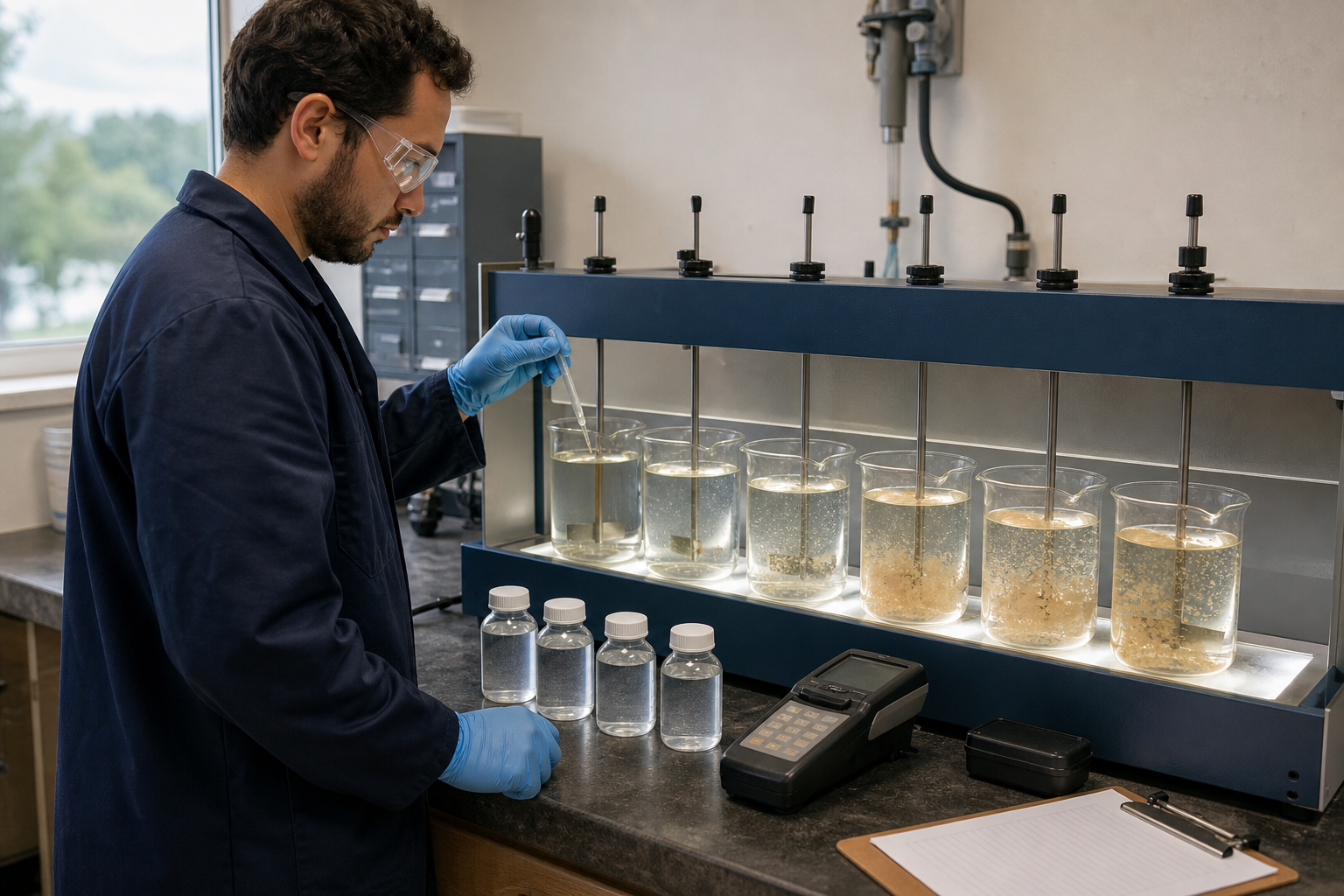
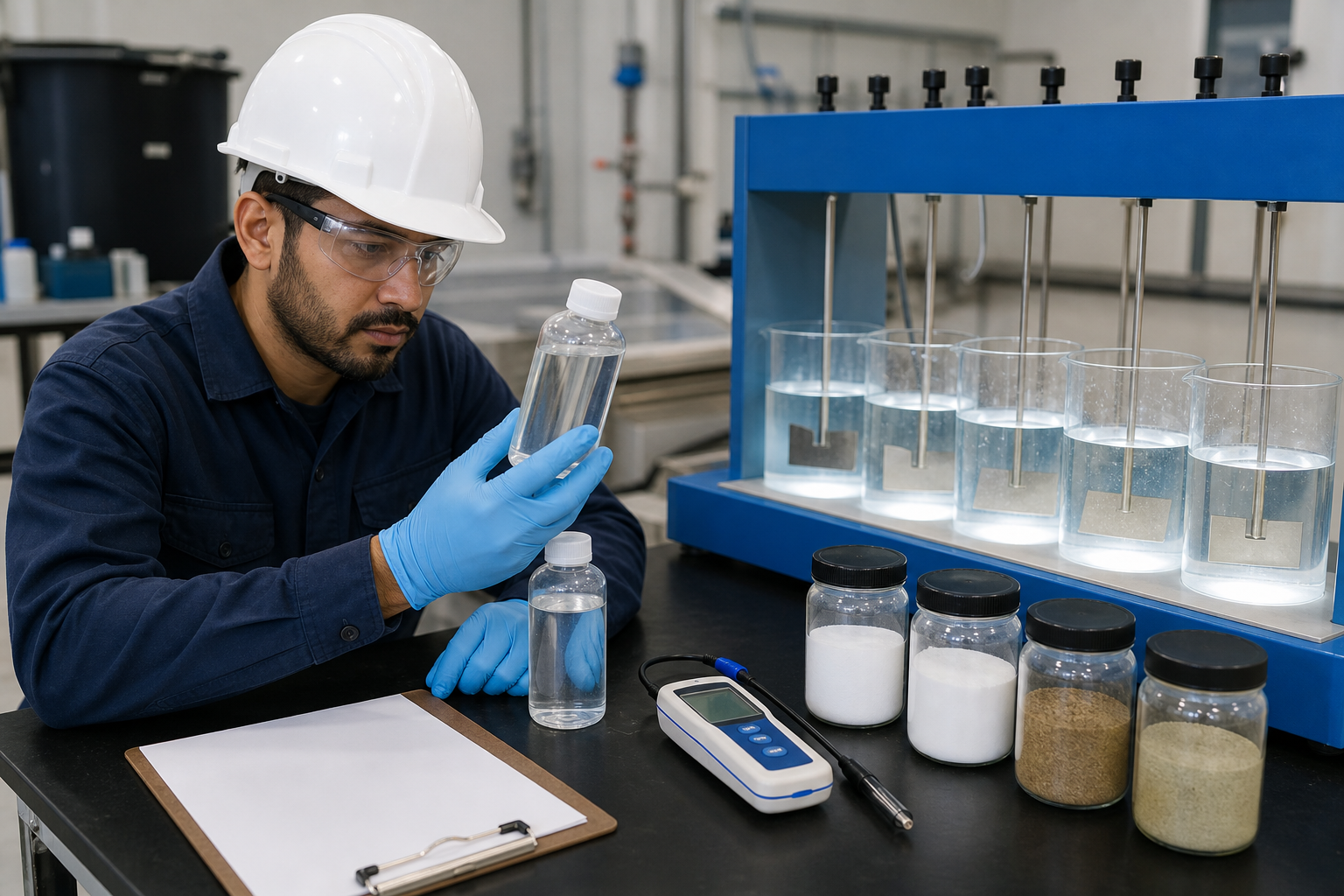
A defensible file begins before the jars are filled. EPA guidance notes that there is no single standard jar-test protocol: the procedure needs to represent the treatment objective and be consistent enough to repeat. Capture the raw-water source, sampling time, preservation and baseline measurements; the exact candidate product and relevant COA/TDS/SDS; rapid and slow mixing settings; settling or filtration endpoint; and the numerical acceptance rule agreed by operations and procurement. Re-test the leading condition with representative water before turning it into an order requirement.
| Comparison input | Why it affects selection | What to record | Scale-up note |
|---|---|---|---|
| Water matrix | pH, alkalinity, temperature, turbidity, colour/NOM, conductivity and relevant metals or suspended solids affect coagulation response. | Sampling point/time, analytical method, units, preservation and source/process changes. | A single grab sample is not a permanent raw-water specification. |
| Mixing and separation sequence | Rapid mix, flocculation energy/time and settling or filtration endpoint determine what the laboratory actually simulated. | Jar volume, equipment, sequence, mixing program, settling/filtration method and timing. | Teaching examples are not universal plant settings; match the local process before scaling. |
| Candidate identity | The exact chemistry, grade and delivery form determine what is being compared. | Candidate code, lot where available, COA, TDS, SDS, delivery form and test dilution. | Re-test a different formulation or grade before substitution. |
| Endpoints and repeatability | Clear success rules prevent an attractive floc from replacing treated-water evidence. | Residual turbidity/colour or agreed analyte, pH, settled/filtered result, replicate runs and observations. | Laboratory endpoints require pilot or plant confirmation where system hydraulics differ. |
Which acceptance criteria convert a jar test into a purchase order?
Write acceptance criteria as a traceable package rather than a single minimum dose. Include the representative-water envelope, candidate documents, test sequence, measured endpoint(s), repeatability expectation, decision owner and the trigger for a plant or pilot confirmation. EPA’s scale-up guidance cautions that jar tests can differ from full-scale contact and hydraulics; that difference belongs in the acceptance plan rather than being hidden by a laboratory result.
| Candidate family | Useful jar-test question | What to specify | What to confirm at site scale |
|---|---|---|---|
| PAC or PFS | Does the selected iron- or aluminium-based coagulant meet the stated endpoint under the representative matrix and mixing sequence? | Declared chemistry/document package, test basis, endpoint and approved-water envelope. | All-season dosage, residual control or equivalence of a different formulation. |
| Alum | How does it compare under the same pH, alkalinity and separation conditions? | Same controlled comparison and site-specific handling/compatibility requirements. | That a classroom or historical condition will reproduce the same result. |
| Ferric coagulant | Does it achieve the agreed treated-water endpoint without unacceptable process side effects in the tested matrix? | Candidate identity, endpoint, residual/handling review and repeat-run evidence. | Universal pH, dose or solids-management outcome. |
| Coagulant aid / polymer | Does order of addition improve the agreed endpoint while preserving a stable, repeatable floc? | Polymer form, preparation method, addition point/order and controlled comparison record. | Final plant feed setting or suitability in a different shear environment. |
Jar-test to product-selection workflow
- Define the treatment objective. State whether the priority is turbidity, colour, phosphorus, metals, solids separation or upstream protection; select the measurement method before seeing a result.
- Control the comparison. Keep the water batch, mix sequence, jar volume and separation endpoint comparable. Record pH adjustment or polymer addition rather than treating it as background noise.
- Compare measured results, not appearance alone. Record settled or filtered-water data, residuals where relevant, floc observations and repeat variability.
- Identify the candidate. Keep the exact product identity, delivery form, test dilution and supporting COA, TDS and SDS with the result.
- Confirm the operating window. Carry the leading option into pilot or plant conditions and re-evaluate when source water, process loading or separation hardware changes.
Jar-test comparison and scale-up checklist
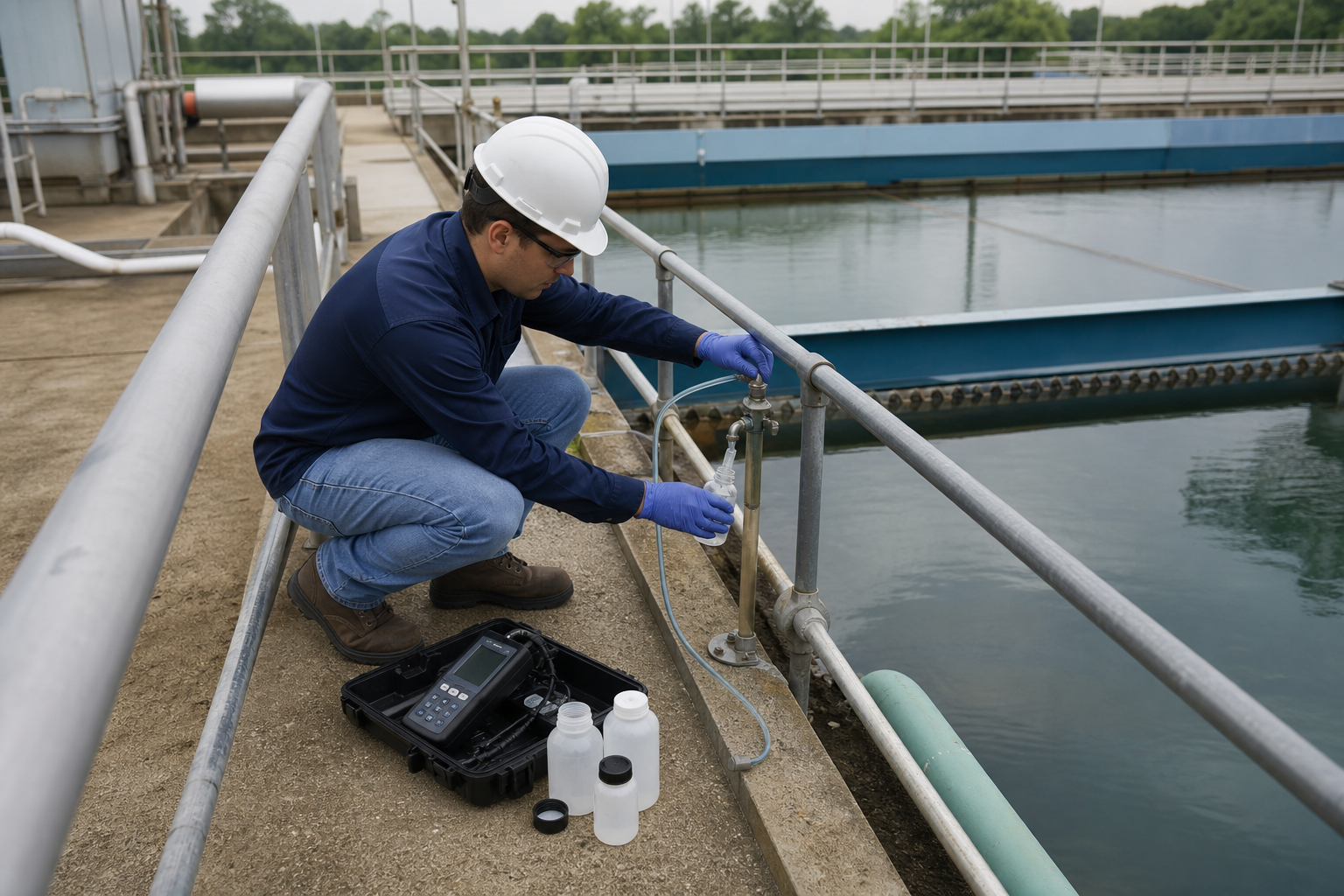
- Raw-water and, where relevant, treated-water analysis with sampling context, pH, temperature, turbidity, alkalinity, colour/NOM and site-specific analytes.
- Jar apparatus, volume, rapid/slow mixing sequence, order of addition, settling or filtration endpoint and all timing.
- Candidate identity, COA, TDS, SDS, delivery concentration/form, batch/lot traceability where supplied and storage/handling needs.
- Measured acceptance endpoint, analytical method, replicates, result variability, test operator and approval owner.
- Plant/pilot confirmation scope, stop criteria, incoming acceptance documents and re-test triggers for water or formulation changes.
Continue with the coagulants and flocculants category, the practical jar-test procedure guide, the alum, PAC and PFS comparison and the PAC selection guide. For a site-specific comparison, send representative water data, the treatment objective and test results through technical inquiry.
Frequently asked questions
What should a coagulant jar test record?
Record the representative water matrix and sampling context, candidate identity and documents, dose as a test variable, order of addition, rapid and slow mixing, settling or filtration method, measured endpoints, replicate results and the decision owner. Include the limitations and the conditions that require a re-test.
How do I turn a jar test into a purchase specification?
Define the water/process envelope, candidate documents, controlled test method, numerical acceptance endpoints, repeatability requirement, incoming-document checks and site confirmation gate. Reference the exact tested candidate rather than assuming every product in the same chemical family is equivalent.
Is a laboratory coagulant dose a plant setpoint?
No. A laboratory dose is a candidate-screening result under stated water, mixing and separation conditions. Confirm it against representative process hydraulics, controls and monitoring before assigning a plant operating setting; revise it when water or process conditions change.
Should PAC, alum, ferric and polymer be compared in the same jar test?
They can be compared only with a controlled, documented method and a relevant treatment endpoint. Their chemistry, pH/alkalinity response, residual and handling considerations differ, so the result should identify each candidate and should not collapse them into one generic coagulant claim.
Why repeat the best jar-test condition?
Repeat runs reveal whether the apparent winner is stable within the sampled water and method. Replication improves the procurement record, but it still does not replace pilot or plant confirmation where full-scale mixing, contact time, filtration or source water differs.
About the author and evidence
VCYCLETECH Technical Team prepares application content from current public technical guidance, peer-reviewed or technical sources and product documentation. It does not certify facilities, turn generic images into site evidence, or provide a universal chemical dose, equipment result, compatibility guarantee or legal advice. Final decisions need representative site data, document review and site-specific verification.
References
- US EPA: consistent, site-specific jar-test protocol context
- US EPA: treatment-plant jar-test worksheets and simulation context
- US EPA: treatability testing and laboratory-to-full-scale scale-up boundary
Related: Coagulants & flocculants · Jar-test guide · Polyacrylamide PAM · Technical inquiry