Water Treatment Knowledge and Industry Insights — VCYCLETECH Blog

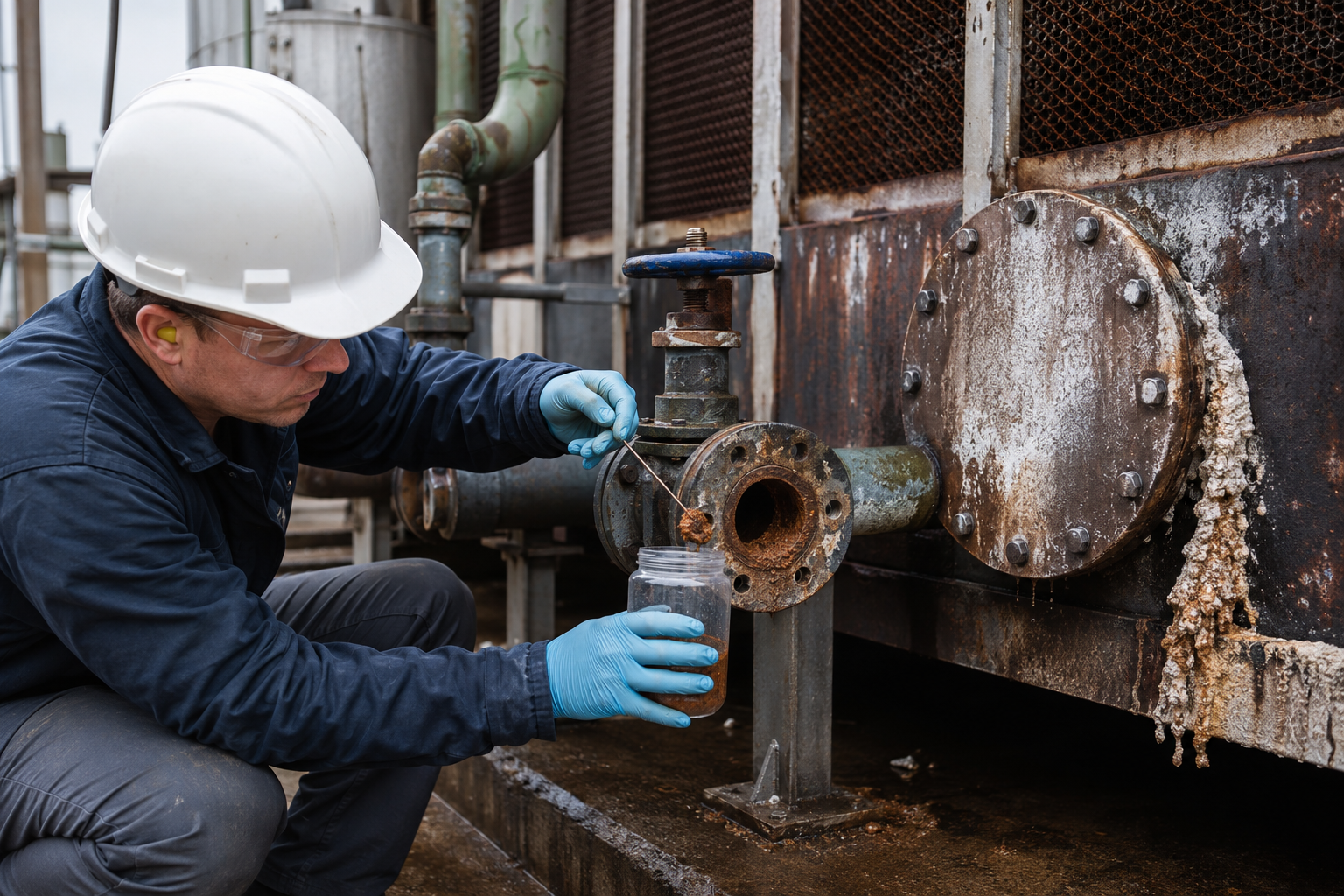
Cooling Tower Deposit Investigation: Iron, Calcium Phosphate and Under-Deposit Corrosion — realistic editorial scene
AI-generated realistic editorial image, visually inspected on 2026-09-06. Generic editorial context only; it is not a VCYCLETECH or customer facility, chemical label, test result, certification or performance record.

Cooling Tower Deposit Investigation: Iron, Calcium Phosphate and Under-Deposit Corrosion

TL;DR Do not identify a cooling-tower deposit by colour alone or change treatment from one iron result. Preserve a representative deposit sample, compare it with dated makeup and circulating-water data, map its exact location and operating history, then separate mineral scale, corrosion products, suspended solids and biological material. The result is a testable root-cause hypothesis—not a universal chemical prescription. Confirm cleaning, filtration, corrosion-control or program changes against metallurgy, flow, microbiological evidence and current product documents.

Request a water-data and document review →

What should a cooling-tower deposit investigation prove?

The purpose is to explain a failure mode after it appears: a plugged strainer, brown tubercle, white scale, declining heat transfer, rising pressure drop or a localized corrosion indication. It is not a replacement for the cooling-tower KPI dashboard, which watches routine trends, or for program selection from water analysis, which happens before a failure. Start by retaining physical evidence and linking it to time, location, material, flow, temperature, recent cleaning, makeup change, blowdown, treatment delivery and biocide history.

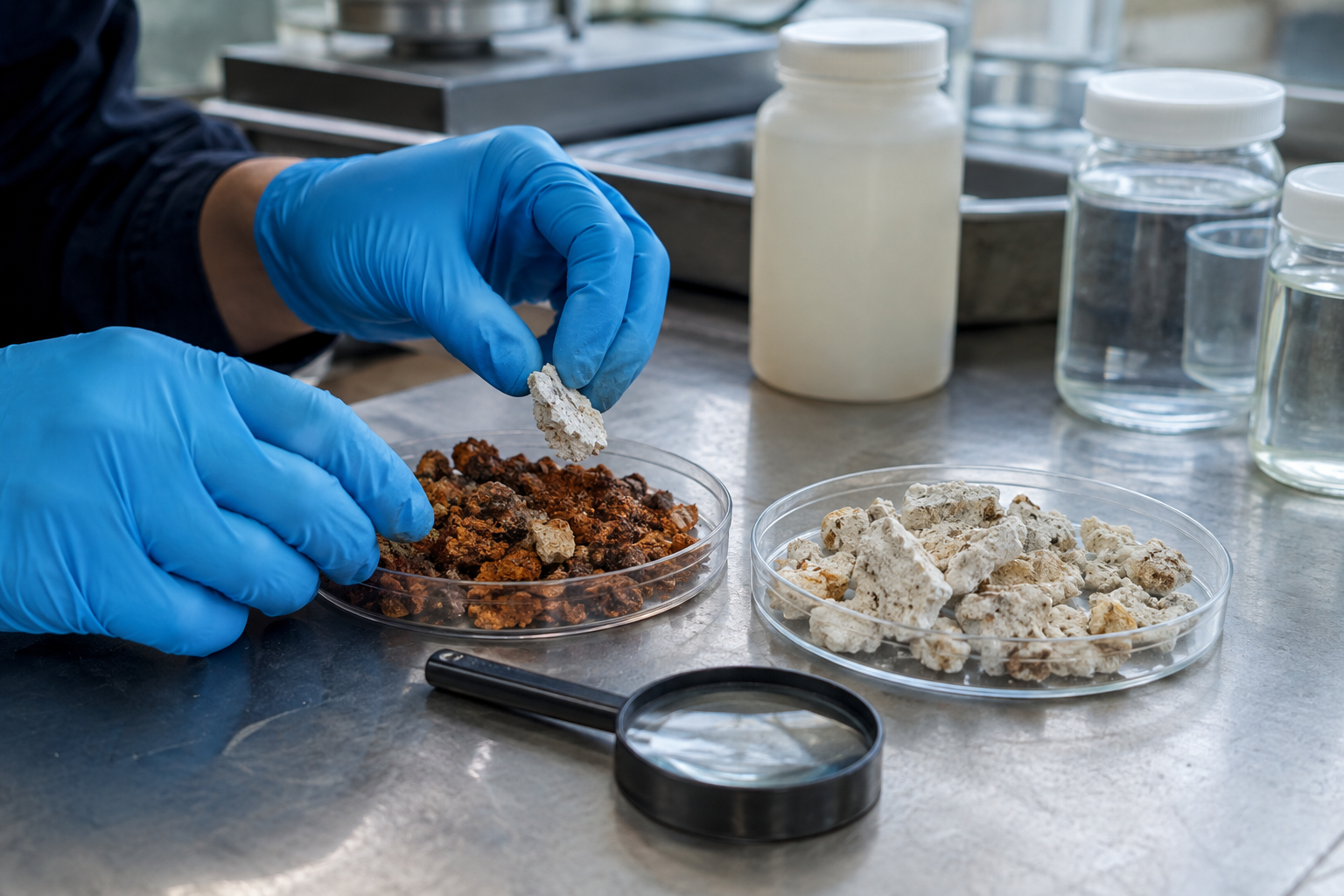
Generic laboratory examination of rust-coloured and off-white cooling-water deposit fragments
AI-generated realistic editorial image, visually inspected on 2026-09-06. It illustrates evidence handling, not a confirmed deposit composition or analysis result. It is generic illustrative context, not a VCYCLETECH or customer facility, chemical label, test result, certificate, approval or performance record.
ObservationWhat it may indicateWhat it cannot prove aloneUseful next evidence
Brown or red material with iron presentCorrosion product, incoming solids, process contamination or a mixed deposit.That the deposit began as internal corrosion or that one inhibitor failed.Location map, metallurgy, coupon/inspection history, dissolved and total iron context, deposit microscopy or elemental/mineral analysis where appropriate.
Hard off-white mineral layerMineral scaling conditions may be present; calcium carbonate and calcium phosphate are possible families.The exact mineral, driving saturation condition or a universal cleaning method.Representative deposit identification, calcium/phosphate/alkalinity/pH/temperature/cycles history and exchanger operating context.
Dark, soft or slimy materialBiofilm, suspended solids, corrosion product or a mixed matrix may be involved.Microbiologically influenced corrosion or a specific organism.Sampling method, microbiological method, oxidant/biocide history, water age, dead-leg and surface inspection context.
Localized attack beneath a depositAn oxygen-differential or crevice-like environment can be a corrosion concern.That all deposits cause corrosion at the same rate or that the observed attack is current.Material identification, cleaned-surface examination, representative coupons or inspection, flow and under-deposit conditions.

Iron, calcium phosphate and biological material: keep the hypotheses separate

Open-recirculating cooling systems are exposed to airborne debris and biological contamination; DOE identifies corrosion, scaling, fouling and microbiological activity as linked but separate treatment concerns. Veolia’s technical water handbook similarly notes that iron from steel corrosion can contribute to fouling, that calcium-phosphate deposits can occur when conditions are not controlled, and that deposits can create oxygen-differential cells. Those references describe mechanisms, not a diagnosis of any particular tower. A field sample often contains more than one material, so the key question is sequence: did mineral matter nucleate first, did corrosion products settle, did solids enter from makeup, or did a biological matrix retain all three?

Candidate deposit familyContext worth checkingCorrection to validate—not assumeBoundary
Iron-rich corrosion product or suspended solidsCarbon-steel condition, ingress, low-flow regions, corrosion evidence, filtration and recent upset/cleaning history.Source control, solids management, corrosion review and deposit removal plan.Iron trend and colour cannot distinguish source without context and analysis.
Calcium-phosphate or other mineral scaleCalcium, phosphate, pH, alkalinity, temperature, cycles, feed points and local high-heat surfaces.Water-balance and formulation-compatibility review; retain sample before cleaning.Do not infer a mineral phase from a field appearance or apply a generic acid-cleaning recipe.
Biofilm or mixed biological foulingBiocide/oxidant history, water age, dead legs, suspended solids, cleaning practice and monitoring method.Site water-management and biocide strategy review with safety/regulatory checks.A soft deposit is not organism identification or proof of MIC.

Evidence-preserving deposit workflow

  1. Do not clean away the evidence first. Photograph scale, deposits and surrounding geometry; log date, location, surface, flow condition and whether the material was wet or dry. Follow site safety procedures before collecting anything.
  2. Take paired evidence. A deposit sample without a contemporaneous recirculating-water sample leaves a weak comparison. Where meaningful, include makeup water and a sample upstream/downstream of the affected section with method, unit and sample point.
  3. Map the equipment boundary. Note metallurgy, galvanic couples, heat flux, low-flow zones, strainers, dead legs, filtration, treatment-feed points and recent shutdown, cleaning or water-source changes.
  4. Ask a laboratory the right question. Suitable methods vary by material and question. Elemental, mineralogical, microscopy, microbiological or corrosion examinations should be selected by a qualified laboratory or corrosion professional; the article does not prescribe one method for every deposit.
  5. Correct the confirmed mechanism, then verify. The corrective option may involve solids control, cleaning, water-balance changes, corrosion review or program compatibility. Define success evidence and reinspection timing before release.
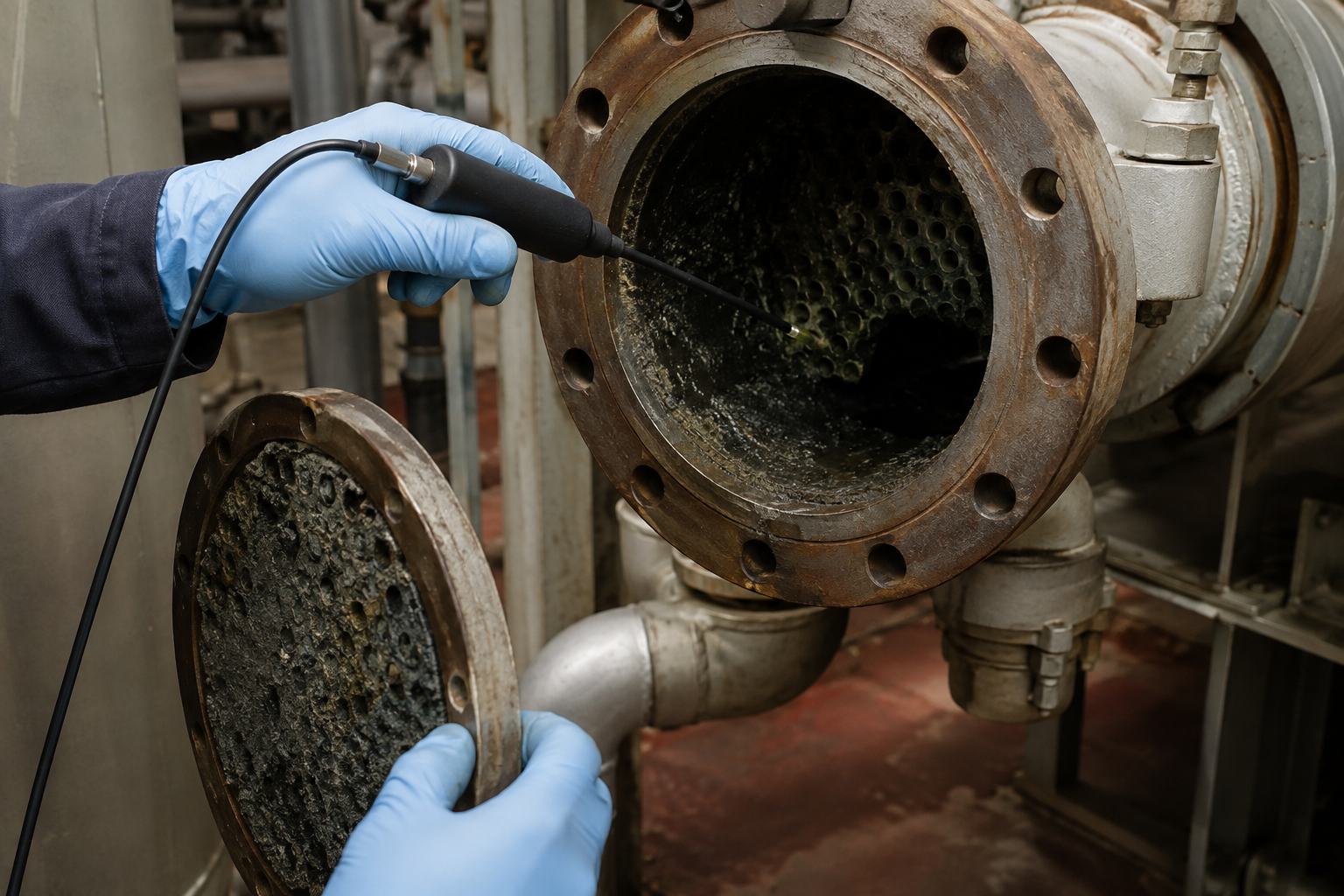
Generic borescope inspection of an opened heat-exchanger water channel with fouling
AI-generated realistic editorial image, visually inspected on 2026-09-06. It illustrates an inspection scenario only; no deposit identity, corrosion rate or equipment result is shown. It is generic illustrative context, not a VCYCLETECH or customer facility, chemical label, test result, certificate, approval or performance record.

How to investigate under-deposit corrosion without over-claiming

Deposits can restrict transport at a metal surface and create differential conditions, but a photograph of a pit under a deposit does not establish the timing, mechanism or rate of attack. Preserve the deposit and document the surface condition before aggressive cleaning; then consider the material, geometry, water chemistry, oxygen/oxidant exposure, flow, previous coupon or inspection evidence and the sequence of operating changes. CTI’s 2026 journal identifies active work on corrosion-coupon preparation/testing and inspection/maintenance strategies for water-cooled heat exchangers—useful reminders that method and surface condition affect interpretation. A coupon, inspection report or lab result must retain its own method and exposure boundary.

Deposit-investigation data package for a technical review

RetainWhy it mattersDo not substitute
Deposit chain of custody, photographs and location sketchKeeps a laboratory finding tied to an actual surface and operating position.A loose sample with no equipment context.
Dated makeup and recirculating-water resultsSupports mineral, metal, concentration and treatment-context review.A single old water report or a conductivity value alone.
Material and equipment mapShows where compatibility and local corrosion questions differ.A generic “cooling tower” description.
Current TDS, COA and SDS for products in use or proposedSupports identity, handling and formulation-change questions.A blog claim, generic product family name or unverified dose.
Trial/change-control recordDefines what changed, accepted evidence, hold points and reinspection.An assumption that cleaning or a new product solved the root cause.

Continue with the cooling-water treatment application, the cooling-water corrosion-mechanisms guide, the water-analysis selection guide and the HEDP product context. Product pages are identity routes, not verified performance evidence. The VCYCLETECH video library can provide process context; it does not replace inspection or laboratory evidence. Send an evidence package for a technical review; suitability and any trial scope must be confirmed for the actual system.

Frequently asked questions

What is the first step in a cooling-tower deposit investigation?

Make the area safe, preserve a representative sample, photograph and map the exact location, then collect paired water and operating-context evidence before cleaning removes the clues.

Does iron in a cooling-tower deposit prove corrosion?

No. Iron can come from corrosion products, incoming solids or a mixed deposit. Compare deposit findings with metallurgy, location, water data, inspection and operating history before assigning a source.

Is a white deposit always calcium phosphate scale?

No. Colour and hardness do not identify a mineral phase. Calcium phosphate is one possible family in cooling water, but representative analysis and water/operating context are needed before drawing that conclusion.

How do deposits contribute to under-deposit corrosion?

A deposit can create localized transport and oxygen-differential conditions at a metal surface. The consequence depends on material, geometry, water chemistry, deposit character, flow and time; a field photo alone does not establish mechanism or rate.

Should a cooling tower be cleaned before a deposit sample is taken?

Where safe and practical, document and retain representative evidence before cleaning. Follow site procedures and use qualified sampling/analysis support; cleaning without records can remove the information needed to identify the root cause.

Author, review and evidence boundary

VCYCLETECH Technical Team prepares this engineering and procurement material from public technical guidance, industry sources and document-process context. It does not certify a facility, prescribe an analysis or dose, verify a product, provide legal advice or guarantee deposit control, compatibility or system performance. Final decisions require representative site data, current product documents and qualified site-specific review.

Sources

Guides & Articles

Cooling Tower Deposit Investigation: Iron, Calcium Phosphate and Under-Deposit Corrosion — realistic editorial sceneCooling Tower Deposit Investigation: Iron, Calcium Phosphate and Under-Deposit CorrosionRead → Cooling Water Chemical RFQ Checklist: COA, TDS, SDS and Trial Acceptance Criteria — realistic editorial sceneCooling Water Chemical RFQ Checklist: COA, TDS, SDS and Trial Acceptance CriteriaRead →HEDP vs PBTC for Cooling Water Treatment: Selection by Hardness, pH and Chlorine Exposure — realistic editorial sceneHEDP vs PBTC for Cooling Water Treatment: Selection by Hardness, pH and Chlorine ExposureRead → How to Select a Cooling Tower Water Treatment Program from Water Analysis Data — realistic editorial sceneHow to Select a Cooling Tower Water Treatment Program from Water Analysis DataRead →Coagulant Jar-Test to Purchase Order: Data and Acceptance Criteria — realistic editorial sceneCoagulant Jar-Test to Purchase Order: Data and Acceptance CriteriaRead → Dewatering PAM: Belt Press vs Centrifuge vs Screw Press — realistic editorial sceneDewatering PAM: Belt Press vs Centrifuge vs Screw PressRead →RO Antiscalant Trial Design: Feedwater, Recovery and Membrane Compatibility — realistic RO editorial sceneRO Antiscalant Trial Design: Feedwater, Recovery and Membrane CompatibilityRead → RO Cleaning Chemical Selection: Acid, Alkaline and Biocide Decision Tree — realistic RO editorial sceneRO Cleaning Chemical Selection: Acid, Alkaline and Biocide Decision TreeRead →Open vs Closed Cooling Water: Corrosion Inhibitor Selection by Metallurgy — realistic cooling-water sceneOpen vs Closed Cooling Water: Corrosion Inhibitor Selection by MetallurgyRead → Cooling Tower Chemical Program KPI Dashboard: Cycles, Blowdown & Deposit Signals — realistic cooling-water sceneCooling Tower Chemical Program KPI Dashboard: Cycles, Blowdown & Deposit SignalsRead →Quote-Ready Water Treatment Chemical Supplier: System Data Checklist — realistic water-treatment sceneQuote-Ready Water Treatment Chemical Supplier: System Data ChecklistRead → Private-Label Water Treatment Chemicals: OEM Sample, COA & Packaging Workflow — realistic water-treatment scenePrivate-Label Water Treatment Chemicals: OEM Sample, COA & Packaging WorkflowRead →Can Coagulation Remove PFAS? Realistic Limits — realistic water-treatment sceneCan Coagulation Remove PFAS? Realistic LimitsRead → Removing Microplastics with Coagulation — realistic water-treatment sceneRemoving Microplastics with CoagulationRead →Controlling Anionic Trash (DCS) & Charge Demand - real paper-mill sceneControlling Anionic Trash (DCS) & Charge DemandRead → Microparticle Retention & Drainage Systems - real paper-mill sceneMicroparticle Retention & Drainage SystemsRead →Converting a Cooling Tower to Non-Phosphorus — real industrial cooling-water sceneConverting a Cooling Tower to Non-PhosphorusRead → Reclaimed Water as Cooling Makeup: The Problem — real industrial cooling-water sceneReclaimed Water as Cooling Makeup: The ProblemRead →Tolyltriazole & Benzotriazole: REACH & Alternatives - photorealistic industrial treatment photographTolyltriazole & Benzotriazole: REACH & AlternativesRead → Molybdate vs Phosphonate vs All-Organic Inhibitors - photorealistic industrial treatment photographMolybdate vs Phosphonate vs All-Organic InhibitorsRead →EU BPR Compliance Checklist for Cooling BiocidesEU BPR Compliance Checklist for Cooling BiocidesRead →Isothiazolinone Restrictions & Allergen LimitsIsothiazolinone Restrictions & Allergen LimitsRead → High-Recovery RO Antiscalant: CCRO at 95–98%High-Recovery RO Antiscalant: CCRO at 95–98%Read → Minimal Liquid Discharge (MLD) vs ZLDMinimal Liquid Discharge (MLD) vs ZLDRead →Direct-to-Chip Cooling Corrosion Control: Tolyltriazole & Yellow-Metal ProtectionDirect-to-Chip Cooling Corrosion Control: Tolyltriazole & Yellow-Metal ProtectionRead → Cooling-Tower Biocide Selection: Legionella Control & 2026 Compliance CheckCooling-Tower Biocide Selection: Legionella Control & 2026 Compliance CheckRead → Cooling Tower Water Treatment for AI Data CentersCooling Tower Water Treatment for AI Data CentersRead → Data Center Cooling Water: WUE, Cycles & ReuseData Center Cooling Water: WUE, Cycles & ReuseRead → Buying Coagulants in 2026: PAC, Alum & Ferric SpecsBuying Coagulants in 2026: PAC, Alum & Ferric SpecsRead → Residual Acrylamide in PAM: NSF-60 & EU LimitsResidual Acrylamide in PAM: NSF-60 & EU LimitsRead → Pitch & Stickies: Paper Machine Deposit ControlPitch & Stickies: Paper Machine Deposit ControlRead → Paper Mill Chemical Procurement: Specs & COA ChecklistPaper Mill Chemical Procurement: Specs & COA ChecklistRead → Internal Sizing Agents: AKD vs ASA vs RosinInternal Sizing Agents: AKD vs ASA vs RosinRead → Paper Wet End: Additive Order & CompatibilityPaper Wet End: Additive Order & CompatibilityRead → Surface Sizing Agents: The Size Press GuideSurface Sizing Agents: The Size Press GuideRead → Dry Strength Agents: Selection, Dosage & TroubleshootingDry Strength Agents: Selection, Dosage & TroubleshootingRead → Cationic Surfactant Selection: CTAC vs DTAC vs OTAC vs DDACCationic Surfactant Selection: CTAC vs DTAC vs OTAC vs DDACRead → THPC Biocide: Uses, Dosage & How to BuyTHPC Biocide: Uses, Dosage & How to BuyRead → Inorganic Coagulants: Alum vs PAC vs PFS ComparedInorganic Coagulants: Alum vs PAC vs PFS ComparedRead → Dry Strength vs Wet Strength Agents: Which for Paper?Dry Strength vs Wet Strength Agents: Which for Paper?Read → How to Choose a Phosphonate Scale Inhibitor SupplierHow to Choose a Phosphonate Scale Inhibitor SupplierRead → MGDA vs GLDA: Which Biodegradable Chelant?MGDA vs GLDA: Which Biodegradable Chelant?Read → PESA vs PASP: Which Green Antiscalant?PESA vs PASP: Which Green Antiscalant?Read → Phosphonate Acid vs Sodium Salt: Which to Buy?Phosphonate Acid vs Sodium Salt: Which to Buy?Read → Cooling Water: All-Organic vs Stabilized PhosphateCooling Water: All-Organic vs Stabilized PhosphateRead → LSI & RSI: Scaling Indices Explained & CalculatedLSI & RSI: Scaling Indices Explained & CalculatedRead → Cooling Water Corrosion: Mechanisms & ProtectionCooling Water Corrosion: Mechanisms & ProtectionRead → Cooling Tower Legionella & Microbial ControlCooling Tower Legionella & Microbial ControlRead → RO Silica Scaling: Control, Solubility & AntiscalantsRO Silica Scaling: Control, Solubility & AntiscalantsRead → RO Membrane Fouling: Types, Diagnosis & PreventionRO Membrane Fouling: Types, Diagnosis & PreventionRead → RO Scale Control: Antiscalant vs Acid vs SofteningRO Scale Control: Antiscalant vs Acid vs SofteningRead → Zero Liquid Discharge (ZLD): Process & ChemicalsZero Liquid Discharge (ZLD): Process & ChemicalsRead → Boiler Oxygen Scavengers: DEHA vs Sulfite vs HydrazineBoiler Oxygen Scavengers: DEHA vs Sulfite vs HydrazineRead → Condensate Corrosion: Neutralizing vs Filming AminesCondensate Corrosion: Neutralizing vs Filming AminesRead → Boiler Water Treatment Program Design by PressureBoiler Water Treatment Program Design by PressureRead → Boiler Blowdown & Cycles of Concentration (COC)Boiler Blowdown & Cycles of Concentration (COC)Read → TCCA vs SDIC vs Calcium Hypochlorite: Which Chlorine?TCCA vs SDIC vs Calcium Hypochlorite: Which Chlorine?Read → BKC vs Glutaraldehyde vs Isothiazolinone BiocidesBKC vs Glutaraldehyde vs Isothiazolinone BiocidesRead → Pool Water Chemistry: pH, Free Chlorine & Cyanuric AcidPool Water Chemistry: pH, Free Chlorine & Cyanuric AcidRead → Drinking Water Disinfection: Methods, Dosage & SafetyDrinking Water Disinfection: Methods, Dosage & SafetyRead → PAC Coagulant Selection: Basicity, Dosage & Water MatchPAC Coagulant Selection: Basicity, Dosage & Water MatchRead → PolyDADMAC vs Polyamine: Which Organic Coagulant?PolyDADMAC vs Polyamine: Which Organic Coagulant?Read → Anionic vs Cationic vs Nonionic PAM: Differences & UsesAnionic vs Cationic vs Nonionic PAM: Differences & UsesRead → Jar Test: Step-by-Step Coagulation & Dose OptimizationJar Test: Step-by-Step Coagulation & Dose OptimizationRead → DTPMP Scale Inhibitor: Uses, Dosage & ComparisonDTPMP Scale Inhibitor: Uses, Dosage & ComparisonRead → HPAA Corrosion Inhibitor for Carbon Steel & CopperHPAA Corrosion Inhibitor for Carbon Steel & CopperRead → EDTMPA: Chelating Agent for Plating & BleachingEDTMPA: Chelating Agent for Plating & BleachingRead → BHMTPMPA: Scale Inhibitor for High-Hardness WaterBHMTPMPA: Scale Inhibitor for High-Hardness WaterRead → How Does Water Treatment Work? Steps, Chemicals & MethodsHow Does Water Treatment Work? Steps, Chemicals & MethodsRead → Water Treatment Process Steps Explained (with Chemicals)Water Treatment Process Steps Explained (with Chemicals)Read → Types of Water Treatment Chemicals (Complete List)Types of Water Treatment Chemicals (Complete List)Read → Industrial Water Treatment Chemicals — Applications & SelectionIndustrial Water Treatment Chemicals — Applications & SelectionRead → What Is an Antiscalant? How Scale Inhibitors WorkWhat Is an Antiscalant? How Scale Inhibitors WorkRead → ATMP vs HEDP: Which Scale Inhibitor Should You Choose?ATMP vs HEDP: Which Scale Inhibitor Should You Choose?Read → What Is HEDP? Uses, Dosage & PropertiesWhat Is HEDP? Uses, Dosage & PropertiesRead → PBTC Antiscalant for Cooling Towers — Why It Tolerates ChlorinePBTC Antiscalant for Cooling Towers — Why It Tolerates ChlorineRead → Cooling Tower Water Treatment — A Practical GuideCooling Tower Water Treatment — A Practical GuideRead → Cooling Tower Scale & Corrosion ControlCooling Tower Scale & Corrosion ControlRead → Boiler Water Treatment Chemicals ExplainedBoiler Water Treatment Chemicals ExplainedRead → Coagulation vs Flocculation: Difference, Chemicals & OrderCoagulation vs Flocculation: Difference, Chemicals & OrderRead → RO Antiscalant: Selection & Dosing GuideRO Antiscalant: Selection & Dosing GuideRead → RO Membrane Cleaning: Acid & Alkaline CleanersRO Membrane Cleaning: Acid & Alkaline CleanersRead → Phosphorus-Free & Green Antiscalants (PASP, PESA)Phosphorus-Free & Green Antiscalants (PASP, PESA)Read → Biodegradable Chelating Agents — EDTA Alternative (GLDA, MGDA)Biodegradable Chelating Agents — EDTA Alternative (GLDA, MGDA)Read → What Is Polyaspartic Acid (PASP)? Green Scale InhibitorWhat Is Polyaspartic Acid (PASP)? Green Scale InhibitorRead → Defoamers in Water Treatment: Types & How They WorkDefoamers in Water Treatment: Types & How They WorkRead → Paper Wet Strength, Dry Strength & Sizing AgentsPaper Wet Strength, Dry Strength & Sizing AgentsRead → Water Treatment Biocides: Oxidizing vs Non-OxidizingWater Treatment Biocides: Oxidizing vs Non-OxidizingRead →

No articles match your search.

Scroll to Top