
Boiler water · feedwater troubleshooting
Boiler Feedwater Hardness Spike: Find the Entry Point
When boiler feedwater hardness suddenly rises, first find where calcium and magnesium entered the water path. Take comparable hardness samples from incoming makeup, the softener outlet, the feedtank after makeup and condensate mix, and the boiler feed line. If hardness is already high after the softener, check regeneration, resin service flow and bypass arrangements. If the softener outlet is stable but feedwater is not, examine downstream mixing, storage and condensate return. Restore the failed pretreatment or water route before considering more internal chemical. A boiler deposit-control product can help manage low residual loading within a designed program; it cannot make a continuing softener failure disappear. Use the boiler maker’s water specification and the site’s established operating procedure for any immediate plant response.

Locate the first rise, not just the highest result
Draw the water path before testing: source or incoming makeup, each softener train, treated-water storage, feedtank or deaerator, condensate return and boiler-feed pump. Some sites have parallel softeners, temporary supply lines or service bypasses. Mark those connections on the sketch. Take paired samples close enough in time to represent the same source and operating state; record which train was in service and whether regeneration or a load change had just occurred.
The most useful measurement is the first point where hardness rises above the plant’s normal trend. A boiler-water sample alone is a poor locator: evaporation concentrates dissolved material, internal treatment can precipitate or complex some hardness, and blowdown changes the mixture. The feedwater path tells you where to look for the source. ASHRAE describes pretreatment and internal conditioning as complementary tools, with pretreatment removing much of the scale-forming load before the boiler.1
| First unusual result | Likely branch to inspect | Useful comparison | Decision it supports |
|---|---|---|---|
| Incoming makeup | Source-water change or a newly connected supply | Current source versus previous source record and softener inlet | Check whether the pretreatment train still fits the load. |
| Softener outlet | Resin exhaustion, regeneration, flow, valve or bypass | Each vessel outlet separately, before the blend point | Restore the softening barrier before changing boiler chemistry. |
| Feedtank after mixing | Untreated top-up, storage or condensate return | Softened makeup, return and mixed tank water | Trace the downstream connection that adds hardness. |
| Boiler feed line only | Sampling difference or a post-tank injection/connection | Tank outlet and feed line using the same method | Repeat the measurement and inspect that short segment. |
Use the table to choose your next sampling pair, not to declare a failed component from one reading. If a softener switches vessels automatically, compare both vessel outlets while each is actually supplying water. A blended outlet can hide one weak train until steam demand or regeneration timing changes.
Make sure the spike is real
Repeat the hardness test from a fresh, representative sample. Record the sample point, time, method, reporting units and detection range. If one instrument reports calcium hardness and another reports total hardness as CaCO₃, the figures are not interchangeable without a proper conversion and method check. Check the kit expiry, reagent condition, meter calibration where relevant, and whether the sample bottle or line introduced residue. A second method or laboratory check is valuable when the result would change plant operation.
Conductivity does not replace a hardness measurement. Sodium-cycle ion exchange swaps calcium and magnesium for sodium; Spirax Sarco notes that base-exchange softening does not itself reduce total dissolved solids. Therefore a softener can leak hardness without a dramatic conductivity change. A feedwater conductivity alarm may flag other contamination, but a normal conductivity trend cannot close the hardness question.2

If the softener outlet rises, follow its operating cycle
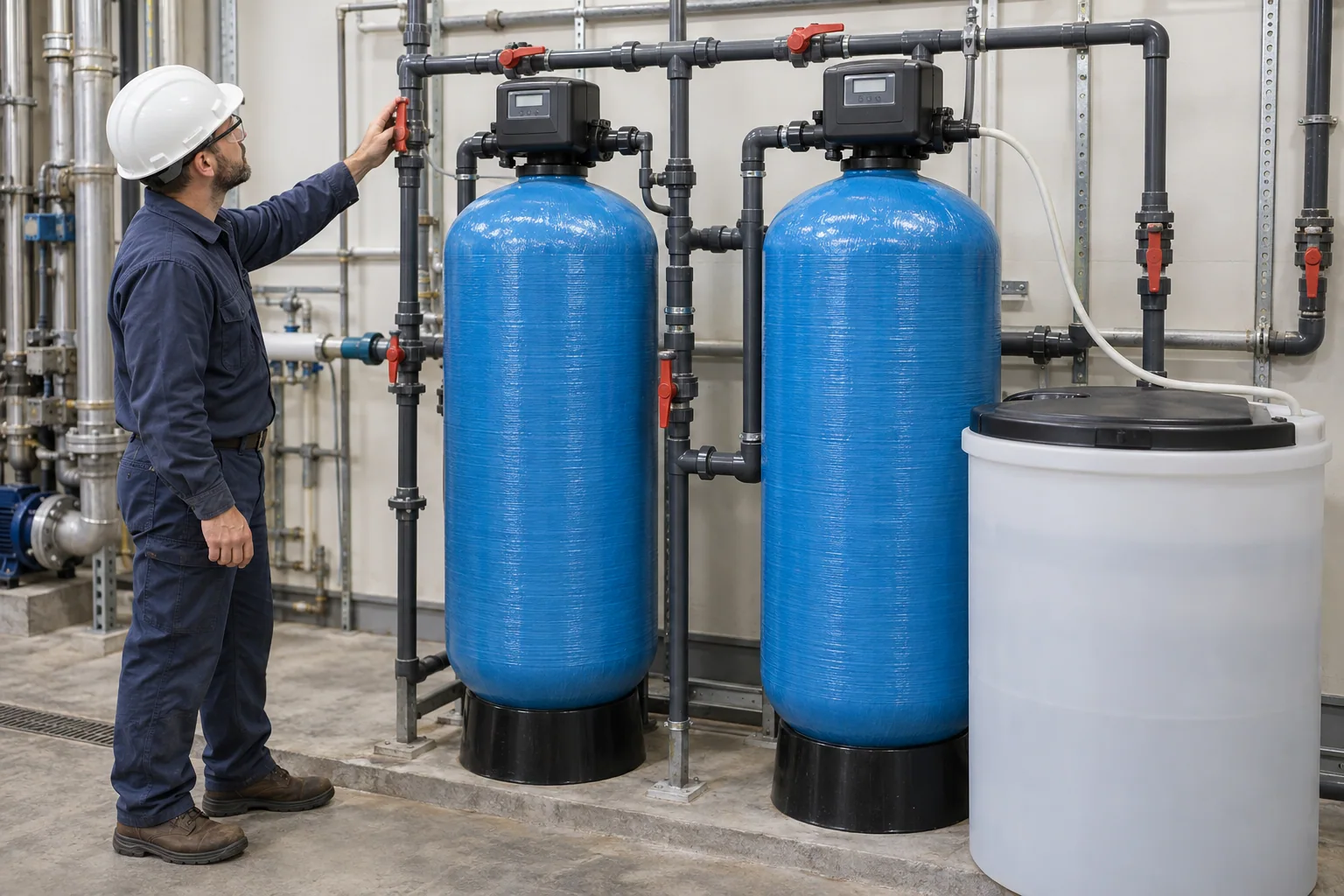
A sodium-cycle softener has a service period and a regeneration period. The resin exchanges calcium and magnesium for sodium until available capacity falls; the outlet can then show a sharp hardness breakthrough. Veolia also identifies service-flow extremes, channeling and inadequate regeneration as reasons treated-water quality can deteriorate.3 Review the vessel’s position in the cycle, raw-water hardness, treated volume, actual flow, brine preparation, salt supply, rinse completion and valve sequencing. Compare the suspect vessel with a parallel vessel at the same inlet quality rather than changing every setting at once.
Look for a bypass or cross-connection that sends untreated water around the vessel. A valve left in service during regeneration, a failed automatic valve or an emergency makeup hose can produce a feedwater spike even when the resin itself is healthy. The first decision is whether to restore equipment/flow routing or examine resin performance. Treating both as “use more inhibitor” delays the correction and can leave the boiler exposed to a continuing load.
If raw-water hardness has increased, recalculate whether the existing service run and regeneration schedule still fit the new inlet load. If the softener outlet is normal immediately after regeneration but rises early under high demand, record outlet hardness against throughput and flow. That pattern is more informative than a single start-of-shift sample. Softening may also be insufficient for a boiler whose design needs removal of silica, alkalinity or other dissolved salts; the boiler maker and treatment specialist should confirm the correct pretreatment route rather than treating the softener as universal.2
If softened makeup is good, inspect what joins it later
At many plants, softened or demineralized makeup joins returned condensate in a feedtank. A clean softener outlet therefore does not prove that mixed boiler feedwater is clean. Compare a sample from the softener outlet with one from the return line and one after mixing. Look for a newly connected process return, an alternate untreated top-up, tank overflow/level-control changes or an improperly isolated line. Spirax describes the treatment choice as dependent not only on makeup hardness but also on the amount and quality of condensate returned.4
Do not assume every abnormal return is a hardness source. Some condensate problems involve iron, copper, oil or pH and need a different path. If hardness stays low but iron or copper rises, the related condensate-corrosion guide is more relevant. If the concern is dissolved oxygen after the feedtank, use the deaerator guide. Keeping these decisions separate prevents a hardness article from turning into a vague tour of every boiler chemical.
Choose external correction first; review internal chemistry second
Internal treatment has a real purpose: it can condition the small impurity load that remains after suitable feedwater treatment, help prevent adherent deposits and keep transportable solids manageable under the designed boiler-water program. It is not a substitute for a failed softener or open bypass. Spirax describes conditioning as supplementary to external treatment, while ASHRAE calls the internal program a polishing tool after pretreatment.41
| Observed pattern | First treatment decision | When chemistry enters the discussion |
|---|---|---|
| Short breakthrough at one softener outlet | Correct the vessel, regeneration or hydraulic problem. | Review the existing boiler-water program after stable feed quality returns. |
| Sustained hardness in softened makeup | Repair, resize or redesign pretreatment against actual source and demand. | Ask the boiler specialist whether the current internal program remains appropriate while the plant follows its operating procedure. |
| Good softener outlet, high mixed feedwater | Isolate the downstream source and verify the return/makeup blend. | Screen a product only after the contamination path is controlled. |
| Stable low residual hardness, deposits still grow | Identify deposit composition and review pressure, iron, silica and blowdown. | Use the deposit-control selection guide to compare treatment families. |
The site lists WT-503 as a boiler scale-and-corrosion product. That identity makes it a possible conversation for a compatible boiler program, not an instruction to increase its feed during an upset. A product choice needs the current grade information, water analyses, boiler design and trial plan. For the wider application path, see boiler water treatment options.
Decide what “back to normal” means before closing the event
Repeat hardness at the same points through a representative operating period, including the train changeover or regeneration state associated with the spike. Compare against the plant’s own normal trend and the boiler maker’s water specification. If the softener outlet is stable but mixed feedwater varies with condensate return, the downstream branch remains unresolved. If both are stable but deposits or boiler-water indicators remain abnormal, turn to a separate deposit or blowdown review rather than declaring the incident solved from one good hardness result.
Keep the operating context alongside the samples: raw-water source, load, makeup fraction, return fraction, softener vessel and service volume. This makes the next recurrence faster to locate. It also helps a chemical supplier avoid suggesting the wrong product for what is actually a valve or pretreatment problem. The plant’s established safety and boiler-operating procedure governs any immediate response to water outside its accepted limits; this article supplies the diagnostic path, not an emergency operating order.
Talk through the boiler program once the entry point is known
If you are selecting or revisiting a boiler product, share paired hardness results from source, each softener outlet and mixed feedwater; the boiler pressure class; makeup and condensate-return arrangement; relevant deposit history; and the current treatment. Include the required product quantity and destination if you also need a quotation. That gives VCYCLETECH a concrete starting point for discussing its boiler application range and whether a listed formulation is worth a controlled review.
Frequently asked questions
Can a boiler scale inhibitor fix a softener hardness breakthrough?
No product should be used as a substitute for restoring a failed softener or bypass. Internal treatment can manage a designed residual load, but a continuing inlet upset changes the load and risk. Find the first bad sampling point, correct the water route and then review the boiler-water program.
Why did hardness increase while conductivity stayed about the same?
A sodium-cycle softener exchanges calcium and magnesium for sodium rather than removing all dissolved salts. Its outlet hardness can deteriorate without a proportionate conductivity signal. Measure hardness directly at the vessel outlet and compare it with the mixed feedwater sample.
Where should hardness be measured during a boiler feedwater upset?
Start with incoming makeup, each softener outlet and the feedtank after makeup and condensate mix. Add the boiler-feed line if it differs from the tank outlet. Take comparable samples close in time and note which treatment vessel and return path were operating.
Could condensate return cause the apparent hardness spike?
It can if an upstream process or connection introduces hardness into the return, but do not assume that from the feedwater value alone. Compare the return, softened makeup and mixed feedtank samples. Other return problems, such as iron or oil, require their own diagnosis.
When should a chemical change be considered?
After the entering hardness load and pretreatment route are understood. Compare stable feedwater quality, boiler design, steam use, existing chemistry and any deposit information. A site-specific candidate trial may then be useful; a generic dose copied from another boiler is not.